Non Forbes

Google not alone with robocar advances

This weekend's announcement that Google had logged 140,000 miles of driving in traffic with their prototype robocars got lots of press, but it's not the only news of teams making progress. A team at TU Braunschweig in Germany has their own model which has been driving on ordinary city streets with human oversight. You can watch a video of the car in action though there is a lot of B-roll in that video, so seek ahead to 1:50 and particularly 3:20 for the inside view of the supervisor's hands hovering just over the self-turning steering wheel. There is some information on Stadtpilot here, but we can see many similarities, including the use of the Velodyne 64 line LIDAR on the roof and a typical array of sensors, and more use of detailed maps.

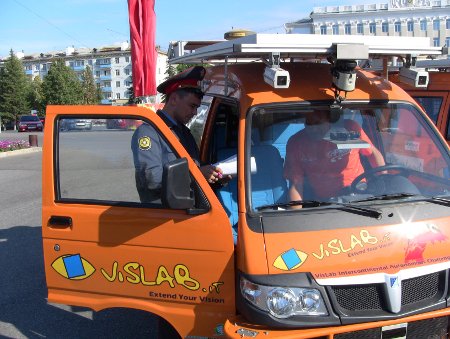
The team at Vislab in Milan has completed most of their Milan to Shanghai autonomous car journey which I have been following. You can read their blog or watch video (sometimes live) of their trip. A lot of the blog has ended up being not about the autonomous challenges, but just the challenges of taking a fleet of very strange looking vehicles in a convoy across Eastern Europe and Asia. For example, they have trucks which can carry their robocars inside, and once decided it was simpler to cross a border into Hungary this way. However, they left driving the vehicles, and the exit officials got very concerned that there was no record of the robocars coming into the country. I presume it wasn't hard to convince them they were not smuggling Hungarian robocars out.
Topic: 

Voluntary Taxes

In my "New Democracy" topic I am interested in ideas about how technology can change democracy and governance. In California, a rule was passed (curiously needing only a 50% majority) that any ballot propositions that wanted to raise new taxes for specific projects needed a 2/3rds majority to come into effect. I'm in agreement with that. My libertarian bent knows the dangers of letting 51% of the people decide to spend the money of 100% of the people on the flavour-of-the-month.

In this county, a proposition that needs 66% asks for a $29 levy on all properties to pay for medical programs for children. How could anybody vote against that? (I have not examined this proposition in detail, but generally when you see "motherhood" propositions on the ballot, particularly bonds, they have been put there by politicians who have other projects they know would not be popular. So they arrange a ballot proposition to raise money for something nobody could be against, which normally they would have had to spend general revenue on, and this frees up general revenue so they can spend it with less accountability.)

But I digress. And I'm not trying to comment on this particular issue or wishing to come out against medicine for children. But in looking at this proposal, it was clear to me that if 2/3rds of voters wanted it, then you would get the same amount of money if 2/3rds of voters just paid $43.50 (50% more) out of their pockets! No need for a vote (which probably costs quite a bit of money) or asking those who don't agree to pay. In fact, since property owners are probably just a small fraction of the voting population, it might require less than $29 per eligible voter (though not, alas, per ballot casting voter.) With a small amount like this, is there a different way we could do things?

Imagine a contribution system where some sort of publicly funded project could be proposed, with an amount and time period. Each person could register their agreement to pay any amount, including the suggested one, but also less or more. Agreements by registered voters would count as a vote for the plan in addition to being a pledge to pay. (You will see why later.)

(Update: This was written back when Kickstarter and similar companies had just gotten started, you will see similarities to it, and my earlier proposal for congressional voting from 2006.)

The total amount pledged, and the general distribution of it, would be public. People would see if the measure was close to getting its funding target. If it does not reach the target, nobody has to pay. If it reaches the target by a deadline, everybody has to pay what they committed -- in fact it is just added to their tax bill. (This works only with property tax and income tax, not with sales taxes.)

I'm loving the Shweeb concept

There was a bit of a stir when Google last week announced that one of the winners of their 10^100 contest would be Shweeb, a pedal-powered monorail from New Zealand that has elements of PRT. Google will invest $1M in Shweeb to help them build a small system, and if it makes any money on the investment, that will go into transportation related charities.

While I had a preference that Google fund a virtual world for developing and racing robocars I have come to love a number of elements about Shweeb, though it's not robocars and the PRT community seems to not think it's PRT. I think it is PRT, in that it's personal, public and, according to the company, relatively rapid through the use of offline stations and non-stop point to point trips. PRT is an idea from the sixties that makes sense but has tried for almost 50 years to get transit planners to believe in it and build it. A micro-PRT has opened as a Heathrow parking shuttle, but in general transit administrators simply aren't early adopters. They don't innovate.

What impresses me about Shweeb is its tremendous simplicity. While it's unlikely to replace our cars or transit systems, it is simple enough that it can actually be built. Once built, it can serve as a testbed for many of PRT's concepts, and go through incremental improvements.

Better meeting-room-to-many video conference calls

Yesterday we had a meeting using some videoconferencing. In a situation I find fairly common, the setup was a meeting room with many people, and then a small number of people calling in remotely. In spite of this being a fairly common situation, I have had trouble finding conferencing systems that do this particular task very well. I have not been looking in the high-priced end but I believe the more modestly priced tools should be able to focus on this and make it work. Yesterday we used Oovoo, one of the few multi-part conference systems to support PC and Mac, with some good but many bad results.

The common answer, namely a speakerphone on the meeting room table and a conference bridge system, is pretty unsatisfactory, though the technology is stable enough that it is easy to get going. The remote people are never really part of the meeting. It's harder for them to engage in random banter, and the call fidelity is usually low and never better than PSTN phone quality. They usually have trouble hearing some of the people in the meeting room, though fancier systems with remote microphones help a bit with that.

The audio level

The next step up is a higher quality audio call. For this Skype is an excellent and free solution. The additional audio quality offers a closer sense of being in the room, and better hearing in both directions. It comes with a downside in that tools like Skype often pick up ambient noise in the room (mostly with remote callers) including clacking of keyboards, random background noises and bleeps and bloops of software using the speakers of the computer. While Skype has very good echo cancellation for those who wish to use it in speakerphone mode, I still strongly recommend the use of headsets by those calling in remotely, and even the judicious use of muting. There's a lot more Skype and others could do in this department, but a headset is a real winner, and they are cheap.

Most of these notes also apply to video calling which of course includes audio.

Topic: 

Robot landing pad for planes without landing gear

Here's an idea that seems a bit wild and scary at first, but it's doable today and has broad benefits: Small aircraft that don't have landing gear, but instead land and take off from robotic "can't miss" platforms pulled by cables on short airfields.

UPDATE: Some updated ideas and a link to a funded research project looking at similar ideas.

For every small aircraft purchaser, a big decision is whether to get retractable landing gear. They are very expensive, and create a risk of failure, but your plane will fly a lot faster and be more fuel efficient if you get them. What if we could leave the landing gear on the ground?

Imagine a wheeled platform on the runway with robotic control and a variety of systems to perfectly track an approaching aircraft. Pulled by cables, it can accelerate at several "g"s forward and back and left and right. As the aircraft approaches it tracks it and the cockpit display indicates positive lock. If the plane veers left, it veers left. If the plane speeds up it speeds up. Pretty much no matter what the pilot or winds do (other than missing the runway entirely) the plane can't miss landing on it. It's spring loaded so even if the landing is a bit hard the shock is cushioned. Done right, it's just like having fancy shock absorbing landing gear.

We already trust our robocars

This story from the Register about a test at the Stanford VAIL Lab reports an interesting result. They created a fake robocar, with a human driver hidden in the back. The test subjects then were told they could push the autopilot button and use the car. And they did, immediately picking up their newspapers to read as they would in a taxi (which is what they really were in.)

Topic: 

The road trip car and the hotel luggage rack

Just back from some time on the road, which always prompts me to think of ways to improve travel.

First, and most simply: Every hotel room comes with a small foldable stand on which to put your suitcase. The problem is they all come with exactly one of these. In some rooms there is space on the tables or dresser for another bag, but often there is not. Doing solo business travel I have just one bag, but all couples, and many solo wanderers have more than one, and so you end up putting bags on the floor. It's quite annoying, since these stands can hardly be very expensive -- folding cloth and metal chairs can be had for $10 in most stores. I've only tried once or twice to ask housekeeping for another, and been surprised to learn they don't keep spares. Frankly, I think it would be cheaper to just put 2 in every room than waste staff time delivering extras, but either would work. And the hotel often knows if a room is booked for 2 rather than one in advance. If you have a bellman take up your bags, not only does the bellman see how many bags you have but it's a sure thing you have several. Every bell station should have some extra racks and throw what is needed on the luggage cart.

Next, I think it would be interesting to see car rental companies develop cars just for road trips. They are the largest buyers of cars (and often owned by car companies) so custom cars are not out of the question. SUVs and some minivans contain many of the features of a road trip car, but they are often 3 times as expensive when reserved in advance, and 1.5x to 2x more expensive in gasoline usage. What features might a road trip car have?

Topic: 
Tags: 

Pages