


Aurora Starts Self-Driving Commercial Trucking Service In Texas
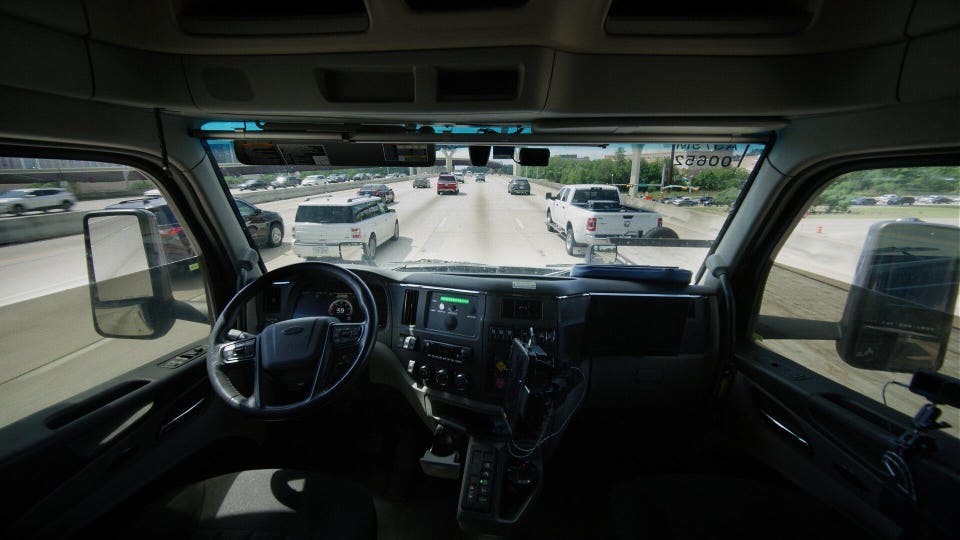
Aurora, a self-driving startup, announced they began fully autonomous class-8 truck deliveries for customers with nobody in the vehicle between Dallas and Houston. (Well, there was somebody in the vehicle on the first return trip, where Aurora founder/CEO--and former Waymo chief--Chris Urmson blogged his thoughts on the event from the back seat.)
It’s a big milestone for Aurora, which dropped as much as 6% in an up market, ending down roughly 3%. Aurora had promised they would begin service in April, but they held the announcement until May. Aurora was founded by Urmson, as well as executives from Uber ATG and Tesla Autopilot, and absorbed Uber ATG after a tragedy ended its operations.
While Aurora isn’t the first to autonomy, moving a class-8 semi-truck in real commercial operation is significant, because of the physics. Such a truck at 70mph and 80,000lbs has over fifty times the damage causing kinetic energy of a 40mph Waymo robotaxi. While Waymos have had crashes--and all vehicles will have crashes--the resulting consequences have been minor. (Waymo also released today new safety statistics showing they have been causing far fewer crashes than human drivers.) A crash with a 40-ton semi-truck can easily have very serious consequences, and Aurora has to work very hard to prevent that.
One way to prevent it is to drive the relatively simple conditions of a Texas freeway, though Aurora plans to operate in more complex environments. It drives non-freeway roads from the off-ramp to a depot as well, but at lower speeds. Waymo and all other robotaxi operators have resisted carrying passengers on the freeway out of the same fear, though Waymo has for some time been operating empty vehicles and vehicles carrying employees as passengers on the freeways. Aurora’s trucks won’t have passengers, except for the odd CEO, test engineer or demo, and damaging cargo has manageable costs--the big risk is to other road users.
Aurora has now completed about 1,200 miles with driver-out (a little more than 2 round-trips) but reports 10,000 loads and 3 million miles with safety drivers (and some interventions, as they have described in safety reports over the last few years.) They will haul loads for Uber Freight, which acts as a middleman to book loads, and the first load was with Hirschbach Motor Lines.
Automated freight presents a different value proposition from robotaxis. The latter promise to rewrite the rules of personal transportation and how our lives and cities work, as well as make it cheaper. Automated freight’s benefits are mostly for shippers, except the first:
- Reduce crashes from shipping (4,000 die each year in the USA in truck crashes, mostly drivers.)
- Make shipping more reliable. Drivers notoriously will “take a break” on a trip or not show up as scheduled.
- Make shipping faster. Drivers are limited to 11 hours of operation per day. Two drivers can drive 22 hours at higher cost. A robot still needs to refuel and do maintenance, but otherwise can operate 24/7.
- Reduce costs by not having to pay human drivers, though humans are needed at depots and for some other functions.
The 4th point has raised the ire of the Teamsters, who currently are sponsoring a law in Colorado, as they have in several other states, to require a human (ideally a Teamster) in the vehicle. (Satirists have wondered why not also mandate somebody to shovel coal into the engine.) While many have sympathy for the threat to jobs, few other jobs (other than medical doctor) cause so many deaths. Fortunately, at present there is a significant shortage of available truck drivers, so it will be quite some time before self-driving trucks threaten careers, though they do plan to alter economics much sooner.
Aurora’s trucks will not drive in high winds or heavy rain, or presumably snow on its rare arrivals in Texas. Over time they plan to improve that. Aurora trucks also have a system for remote monitoring and remote assistance. If Aurora is like any other self-driving company, it is doing full-time remote monitoring, and will for some time, of its early empty vehicle runs. (Aurora did not respond in time to a query about this.) The remote monitors presumably have an ability to command the vehicle to pull over into “minimum risk condition” or even emergency stop. The remote assistance operators can’t drive the trucks remotely, but can give them commands about pulling over, changing lanes, existing the road and making turns.
Aurora stated that though Urmson was in the back seat, he could not have intervened if he wished. This means Aurora must have disabled the normal systems such as the “big red button” emergency kill switch, and systems which disengage the vehicle if anybody grabs the wheel or presses the brake that are normally found in self-driving test vehicles.
Only Tesla has stated that if and when they deploy their robotaxis in public, as they have projected for June, that they will be driving “unsupervised,” ie. without humans (remote or in the vehicle) who can intervene.
Originally published at Forbes.com in Aurora Starts Self-Driving Commercial Trucking Service In Texas. Copyright © 2025 by Brad Templeton.


Add new comment