


Waymo Partners With Toyota For New Robotaxi. It Could Have Been Tesla
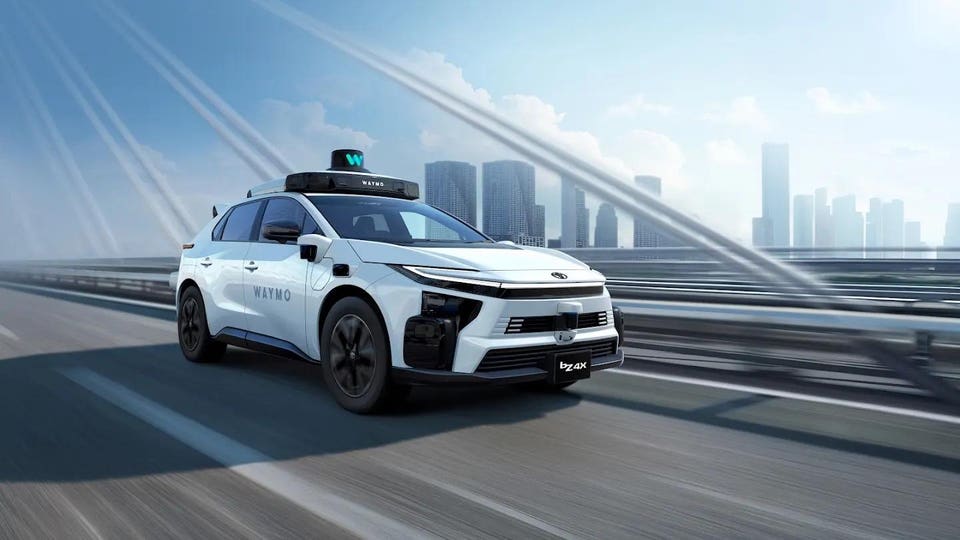
Waymo has announced its next Robotaxi platform will be a Toyota bZ4X with first application in their future deployment in Tokyo. While it makes sense to work with a Japanese automaker for deployment in Japan, this base will no doubt spread out into the world. Toyota will integrate the Waymo hardware into the vehicle right on the Toyota production lines.
Toyota is the world’s largest automaker. The very first Waymo prototype (other than the Caddy golf cart) was a Prius, which was followed by a Lexus. Toyota is also widely regarded as the highest quality automaker when it comes to build and reliability. Their vehicles overwhelmingly lead the list of vehicles that retain value. By many metrics, you can’t do better than this. But that’s not entirely true, and there is an interesting historical footnote that suggests it probably should have been Tesla, even though you would least expect them today.
I
n spite of Toyota’s perfect pedigree above, they have deliberately delayed their entry into BEVs, and are not a leader in that space. They are also not the leaders in price and value. The Chinese automakers have taken that crown, and the Korean automakers took it from Japan earlier. Waymo is using a vehicle made by Chinese automaker Geely, but that ended up coming with big downsides due to tariffs of 125% that were slapped on the Ojai and other political troubles. Waymo will also base a vehicle on the Hyundai Ioniq 5.
Cost is Less Important than you Think
Right now, the cost of the vehicle is a trivial part of the total expenses of any robotaxi company. They are all spending billions on development, so if you work out the cost per vehicle deployed right now, you can’t even see the vehicle price. That changes as fleets scale up to trying to be a real business. In time, they will, but even when it matures, and we only look at the cost of goods sold (COGS) for a robotaxi ride, we find that depreciation (ie. vehicle cost) is only about a third. Then, vehicle cost will be more important, but not overwhelming. Nobody is rushing to make robotaxis into a commodity business that competes mostly on price.
Reliability is Less Important than you Think
Toyotas are incredibly reliable. They don’t break down. That requires impressive engineering effort from Toyota. As a private car buyer, you crave that, because if your car breaks down it’s a crisis. You will need a tow, and to book service, and get a rental car or Ubers. It disrupts your life. You are angry at your carmaker. If a robotaxi has a mechanical problem (not safety related) it pulls over somewhere safe. Another robotaxi arrives in 5 minutes. You’re back on your way, and get a coupon for some free rides. It’s barely a blip in your life. The robotaxi fleet operator has to rescue and fix the car, so they care, but that’s just a number in the spreadsheet--did they save more money on the car than the breakdowns cost?
Would the Tesla Cybercab Have Been a Great Waymo?
Today, Tesla wants to be the main competitor for Waymo in robotaxis, so they are not likely to work together. On the other hand, Tesla could have been an obvious partner for Waymo. They are by far the most innovative, silicon-valley style automaker, just the sort of company Alphabet/Waymo likes to work with. And they have learned a lot about manufacturing, and have put all that into making the Cybercab for a price they say will be around $30,000 with the cameras.
Waymo would, in another universe, pay Tesla to add the Waymo sensor pack and computers to a vehicle like the Cybercab. It would make a fine 2-seater platform at a good price, but with the quality of Waymo’s self-driving system.
This would have happened because the companies used to be great friends. The founders of Alphabet/Google/Waymo used to be close friends with Elon Musk. I have seen this personally and it is well documented. Sergey Brin and Larry Page drove Teslas. They would stay at each other’s houses and hang out together. Brin invested in Tesla when it was in trouble, and there were major negotiations for Google to buy Tesla in 2013, since it’s always been debated whether Alphabet should just own a car company to complete the Waymo vision. The purchase of Tesla never happened--Musk was able to get the company through a major hard patch and back on its feet, for one. And later, their friendships ended over a variety of issues, some public, some private.
Private Car
Waymo and Toyota announced some time ago they might make a privately owned car with the Waymo driver. No news on this. Doing a private car is much, much harder than making a robotaxi. Tesla, which first stated its goal was to make the FSD system for private cars, recently said that when they do turn on “Unsupervised FSD” in a private car, “next year” it will only work to put your private car into the Tesla robotaxi fleet, for those who live in the robotaxi service area. Stay tuned next week for an article about why Tesla is doing that--there are several, but one of the strongest is that private car is so much harder to pull off and Tesla has finally officially admitted that.
The Future
As Waymo grows, it has the advantage of having one of the world’s richest companies as its parent. Alphabet could easily purchase almost any major automaker other than Tesla. If it makes sense to do vertical integration, they have the resources. For now, it’s possible to get even the biggest and best to work as contract manufacturers, modifying vehicles to spec. Amazon also has huge resources but Zoox plans to have custom vehicles. Uber is partnering with different companies like Lucid to make vehicles and Nuro to make self-driving. Tesla is a car OEM doing it all vertically. The Chinese ecosystem has different partnerships. Tensor plans to use Vinfast for contract manufacturing. Motional will use the cars of its parent company Hyundai (but so will Waymo and others.) Some big car OEMs like VW are trying to licence self-driving from suppliers (Mobileye originally, now possibly elsewhere). Just about every approach has value and is being tried, which is good for the marketplace.
Originally published at Forbes.com in Waymo Partners With Toyota For New Robotaxi. It Could Have Been Tesla. Copyright © 2026 by Brad Templeton.


Add new comment