


Nuro Switches From Delivery Business To ‘Driver’ Provider
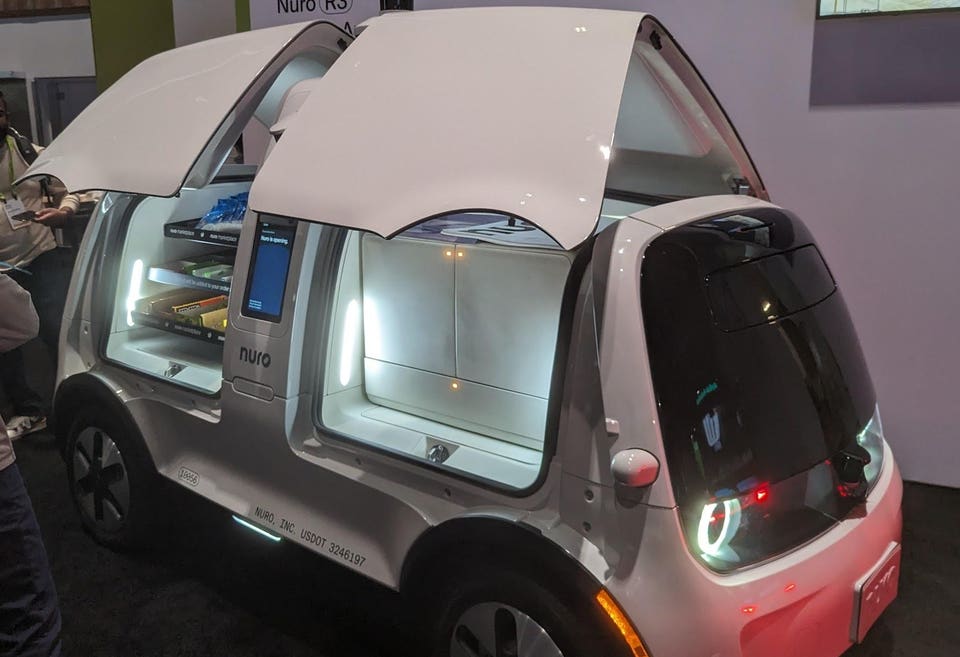
Nuro, which hoped to become a leading robotic last mile delivery company with a fleet of pod-sized modest speed delivery robots has announced it will switch to becoming a general autonomy stack provider, licencing that stack to other companies which want to make robocars, robotaxis, fancy driver-assist and other applications.
Nuro was begun by two of the leading developers I worked with at Google’s Car project, now Waymo. They knew they wouldn’t compete head-on with the skilled and well funded team back at Waymo, so they decided to go after the more tractable problem of last mile delivery. They raised considerable funding through Softbank, and designed and planned to manufacture a fleet of robotic pods, each the size of a small narrow car, which would have no room for a human driver on board and only carry cargo.
It’s easier to carry cargo than people. You don’t have to worry about the safety of the cargo (only that of those also on the road) and you’re not in a particular hurry, at least compared to passengers. You can go slower, and travel on more minor and less busy roads if you wish. If a left turn is too tricky, you won’t annoy anybody if you take an alternate route. You can limit your delivery area and otherwise constrain your problem so that it’s easier to solve. Of course, there’s a bit less money, and you have to design and build (or get built) a large fleet of specialized vehicles. While they don’t have to meet the safety standards of passenger vehicles, creating a new vehicle at scale from scratch is a very daunting problem, one that big carmakers have taken some time to get good at.
Now Nuro has switched to what was a very common business plan for many startups in the self-driving space. It’s the plan for any company that didn’t expect to have the immense funding needed to build their own fleet. Some companies who didn’t have that money simply expected that once they built a working self-driving system, they could more easily raise the money to build a fleet, but that’s become a harder thing to guarantee. There’s been a consolidation, and some of those companies are gone, and that could put Nuro in a good position to find customers, or an acquirer. Only a few automakers have competitive self-driving projects inside, namely GM, Hyundai and possibly Tesla. Daimler and BMW have ambitions but most companies have scaled back their efforts and focus mainly on driver-assist or freeway/traffic-jam self-driving.
The most prominent player is MobilEye, which is today mostly owned by Intel. (Intel recently announced it would try to sell off more of its stake in MobilEye.) MobilEye has an overwhelmingly dominant position supplying driver-assist to automakers and hopes to use that to sell them its self-driving suite. MobilEye also originally planned to operate a robotaxi fleet but cancelled those plans. MobilEye is the announced provider of the self-driving system for Rimac’s “Verne” robotaxi service.
Nuro may have concluded it’s easier to focus on one problem and sell the system to other companies that will build the fleets, making money today, rather than waiting to make money from delivery fees over the long life of a robot.
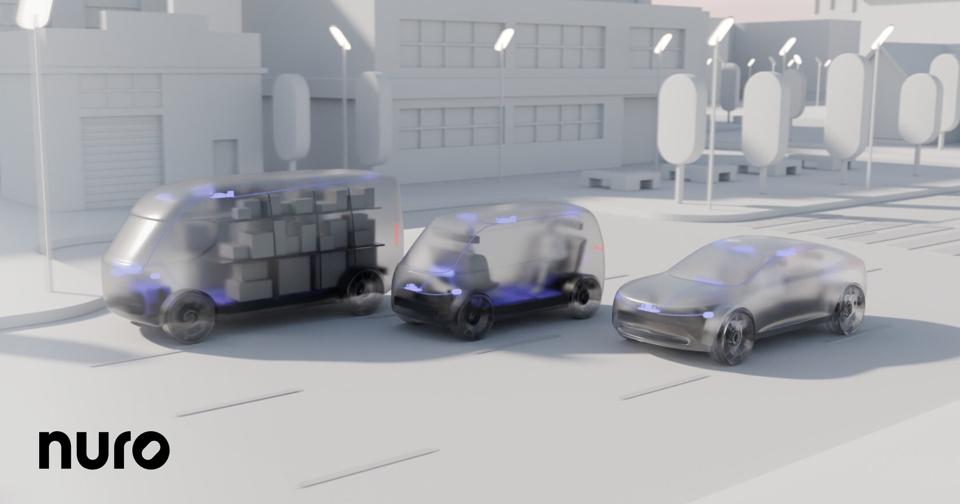
While Nuro built their system for lower-speed, easier suburban streets, it’s probably one of the most advanced street-based self-driving stacks. It should be able to compete well in this market. When Nuro began, it seemed as though there would be several well-funded companies, and OEM internal projects, working on that, but that space has shrunk, and delivery must have looked like it would not deliver. The other companies similar to Nuro, like Udelv and Clevon may revel at Nuro’s departure or fear they face the same problem. At the same time, many sidewalk delivery robot companies are growing. (Disclosure: I am a stockholder in Starship, the leader in this area, which has done over 7 million paid autonomous deliveries.)
An unexpected customer for Nuro might be Tesla’s hoped-for robotaxi service (supposedly to reveal some plans on Oct 10.) Tesla’s “Supervised FSD” system is still many years behind Waymo and Cruise and even Nuro as a robotaxi service, but Tesla has also pre-sold almost half a million customers a future-delivered self-driving system. Tesla hopes to do this with just the cameras they put in their cars today, but should it decide that path won’t deliver soon enough, it could readily acquire Nuro, though it would need to eat a fair bit of crow to put LIDARs on the cars as Nuro uses.
In contrast to all these, Zoox is continuing its efforts on top of their ground-up custom designed robotaxi. They predict they will offer rides to the public in Las Vegas this year. Zoox, like Nuro, wanted to build a custom vehicle from day one, though it knew that would eventually require immense capital. When that wasn’t forthcoming, they sold to Amazon, which has immense capital resources. It will be an interesting contrast between Zoox, with its custom-vehicle-centric approach compared to Nuro which has abandoned that plan. (It’s worth noting that the Nuro robot, while not fully symmetrical, could go in both directions, which is one of the key features touted for the Zoox robot.)
Waymo, the universally acclaimed leader, isn’t planning a ground-up custom vehicle, though their newest generation-6 vehicle is more custom than most of their others, but it starts with a Geely/Zeekr minivan platform from China. Waymo, as part of Alphabet, has more access to capital for big projects than almost anybody, and its parent recently pledged to put in another $5 billion. They have not ruled out partnering with automakers, but they are in no rush as they are part of a bigger company than the automakers. They recently announced expansion of their service to Austin and Atlanta, working with Uber to manager ride booking and vehicle depots.
That leaves the new Nuro with few competitors, particularly since the US plans to ban use of software from China in advanced U.S. cars. (There are at least 4 companies in China with well developed self-driving stacks.)
Originally published at Forbes.com in Nuro Switches From Delivery Business To ‘Driver’ Provider. Copyright © 2024 by Brad Templeton.


Add new comment