


Tesla Investor Day Offers Many Details, But Little Big News
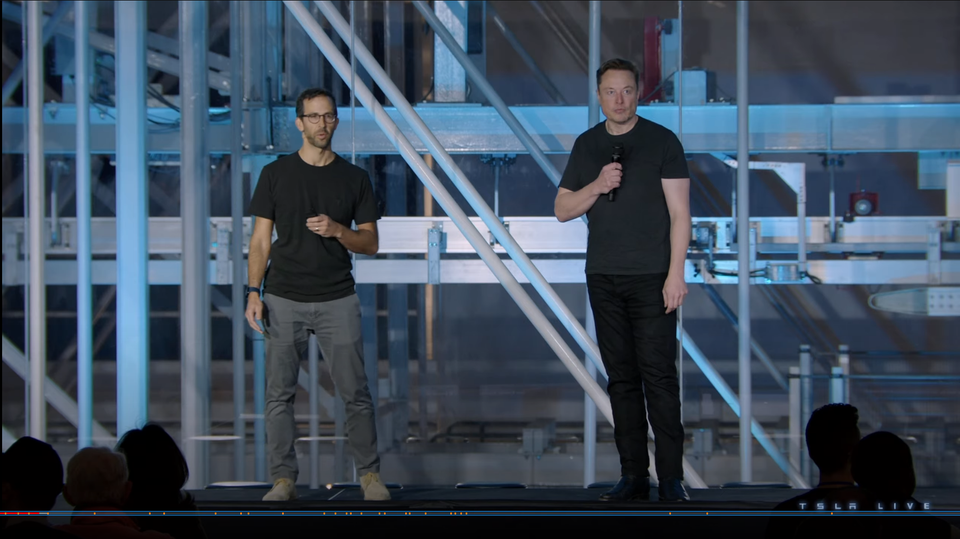
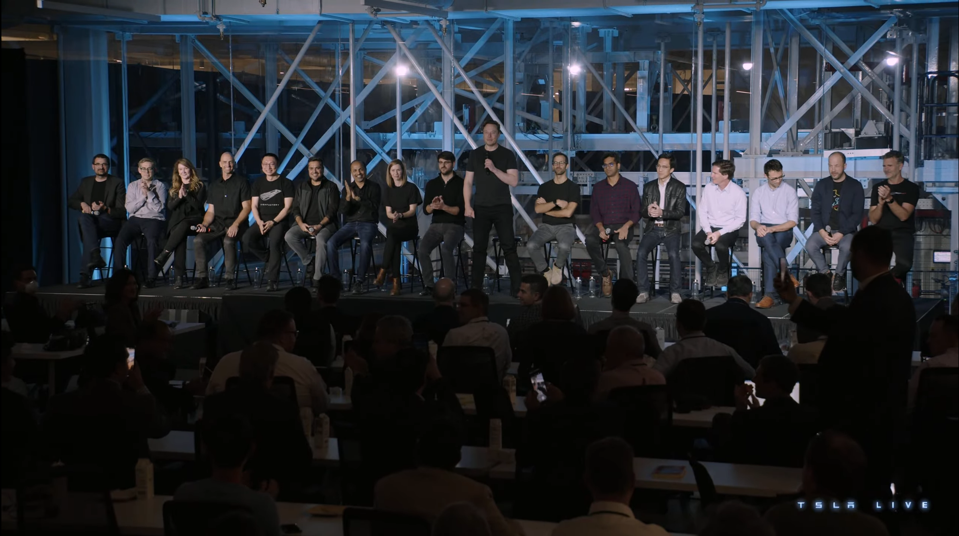
At Tesla’s “Investor Day” presentation today, Tesla revealed a lot of detailed information about their business, but there were not major shocking reveals, including no details on their next generation platform and the rumored low-cost “model 2.” Instead, 150,000 viewers got a new expanded master plan aiming for a totally renewable energy economy, and details on many aspects of Tesla vehicles and other elements of the business.
(Above you can watch our video analysis of the highlights of the program with much more commentary.)
Some of the more interesting revelations include:
- The new Master Plan 3 for a global renewable energy industry
- Improved powertrain development, removing the need for rare earths in motor manufacturing
- How much Tesla has moved in-house to avoid depending on suppliers
- The use of the computation in the car to assist with assembly
- Crash numbers for Tesla FSD similar to Autopilot
- How good Tesla’s cost numbers are on charging
- Multi-pass labeling that borders on HD maps, though they insist not.
- Efforts to manage an autonomous fleet
- Cybertruck troubles — but a promise of shipping this year
- A retail plan in Texas to offer drivers unlimited overnight car charging for just $30/month (from wind.)
- The announcement of making the 4 millionth car
- Tesla will build a new gigafactory in Mexico near Monterey.
Master Plan 3
Musk pushes the message of abundance — we can save the planet without austerity, we could handle many more people. While past master plans have always made mention of converting the world to renewable energy but mostly talked about how cars would do this. This new version of the plan talks about the entire energy economy. They outlined plans about how it’s not that hard or expensive to convert several major sectors of the economy to renewable forms with combinations of storage (batteries), renewable power (solar/wind) and manufacturing expense.
In particular they estimate the need for 240TWh of storage, 30TW of new solar/wind and about $10T — which is 10% of one year’s GDP, and would take less than 0.2% of the land for the solar. If $10T seems a lot, we’ve spent $14T in the last 20 years on the fossil fuel economy.
- Electrical generation — switch to solar/wind with storage
- Transportation — all electric (even rocket fuel)
- Heating and cooling — all heat pumps
- Industrial high heat and hydrogen/ammonia - renewably generated
- Less mining and environmental damage than we do today, in spite of need for battery materials
Others have worked out the math of a fully renewable energy economy before, but Tesla has actually done more real work to bring it about, so it’s good to see them dedicated to it. While it was rumored that they might produce a heat pump and it was hinted at as a potential future, but definitely not announced.
New Vehicles
The steel exo-frame of the Cybertruck was harder than expected, but it’s coming this year and they’ve been able to shrink the factory space for it.
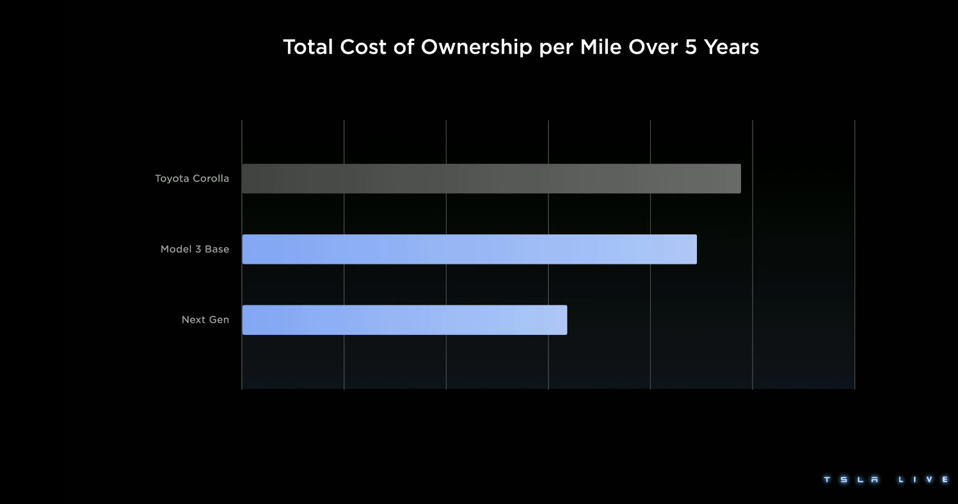
While they described their new manufacturing process that will reducing costs and time in manufacturing, they were not yet ready to announce their new model, in spite of rumors that this might be seen in this presentation. However, they did show a chart showing how much less the total cost of ownership will be for their new generation vehicle compared to a model 3 or Corolla, and the numbers were good.
They expect demand to go crazy when they reduce prices. The hard part is building the cars at that price, of course.
Power Train
Tesla builds and designs their motors and other components in house. They have created their own physics simulators to optimize motor design. They also announced that they plan to eventually make their motors without rare earths (which usually need to be sourced in or through China.)
Electronics & Software
Building their own controllers — now 100% internally designed in next vehicle. Weight has been reduced and supply constraints are eliminated. The focus everywhere is software controlled hardware. They’ve tried to make every component better, cheaper and lighter.
They plan a switch to 48v in the car this year to reduce wire size and handle more current. In addition, they are just using a general network bus rather than lots of individual wiring, beyond what Canbus has done.
Tesla doesn’t just have complete over the air software updating for all parts of their car, something the rest of the industry has been late to learn, they also do a lot of monitoring in order to design future cars. For example, they used the data they got from every crash with a Tesla to design the cars to do better in crashes. Every day, owners drive 123M miles and charge 1.9M times — and data on that helps them improve the car.
Tesla speakers repeatedly decried the standard method in the automotive industry of getting components and controllers from 3 tiers of suppliers who design and integrate products used by automakers to assemble the final car. Tesla tries to avoid that and build its own components, so it can learn from them and improve them.
Charging
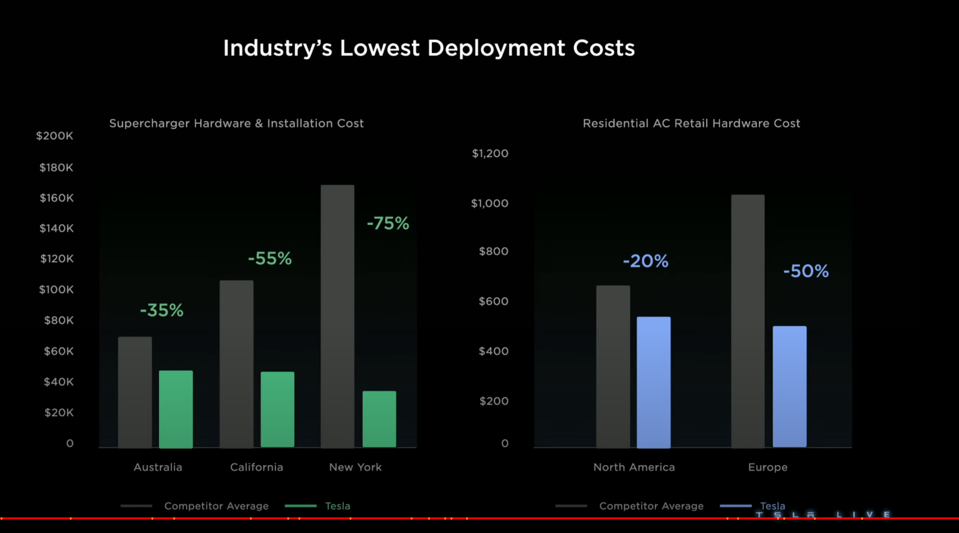
Tesla confirmed deployment of chargers in the USA that can charge CCS cars. They promise their new V4 chargers (now being deployed in Europe) will have longer cords that can reach more cars. They also disclosed numbers on how much cheaper their systems are to install, adding more irony to the way the USA government is working hard to subsidize poor quality high cost chargers instead of Tesla, in spite of the fact that most EV owners own Teslas.
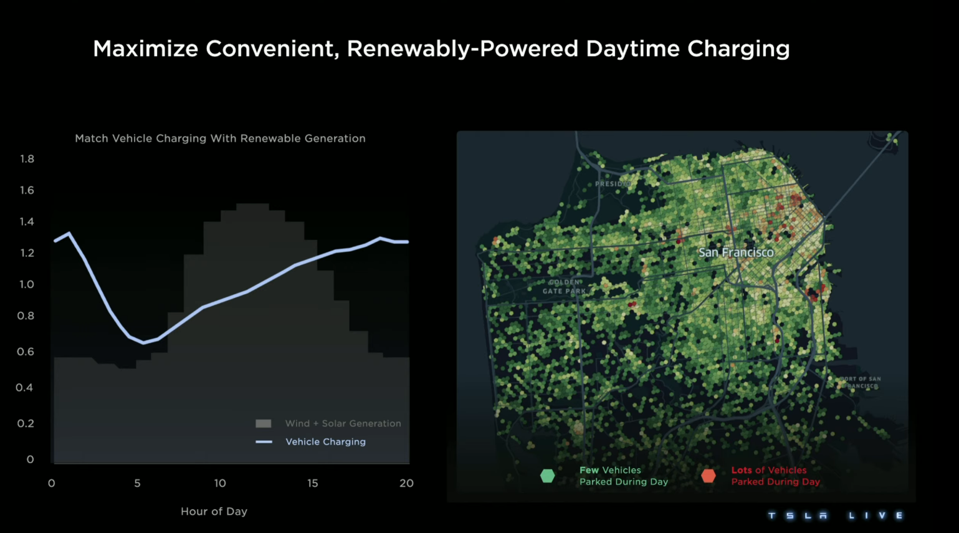
Tesla also announced a new plan in Texas that gives unlimited night charging of EVs from wind power for a flat rate of $30/month.
FSD
Tesla showed how they are leveraging their fleet to train their AI. In particular, they indicated how they now will gather data from many passes over an area by customer cars to aggregate it. While they said this was to generate training data, it was clear from the graphics that they are also building high-definition maps this way, something they have stated they don’t plan to do and denied doing in Q&A.
Tesla claims FSD users are having one crash per 3.2M miles, and they compare it to 500,000 miles for ordinary drivers, but this is similar to the report they give on Autopilot, which is essentially a lie, because they report airbag deployments for Autpilot, while the 500,000 mile number is for police reported crashes. If this is indeed airbag deployments, the numbers for FSD are worse than for Autopilot (where they report 6.2 million miles between airbag deployments.) However, Autopilot is used almost entirely on freeways (100% if the user has FSD) and freeways have a much lower rate of crashes than city streets, FSD needs many more interventions than Autopilot, but because of that, drivers are supervising it more carefully, from all appearances.
V2G
Tesla indicated that their charge ports should become bidirectional in 2 years time, but Musk felt people would not do much V2G because of the inconvenience of a system to power your home that fails if the car is not plugged in — he believes home battery banks make more sense.
Originally published at Forbes.com in Tesla Investor Day Offers Many Details, But Little Big News. Copyright © 2023 by Brad Templeton.


Add new comment