


Tesla Robotaxi In June: What Does Musk Mean By “Toe In The Water?”
Elon Musk promised during the Tesla Q4/24 Earnings Call that Tesla would launch a Robotaxi service in Austin, TX by June. However, he placed a number of caveats on this, and warned that the initial service would be “putting our toe in the water, gently at first, just to make sure everything is cool.” He repeated this 3 times, adding, “we’re just putting our toe in the water, then a few toes, then a foot, then leg, then make sure everything is cool.”
At the same time, Musk claimed this service will be “unsupervised full self-driving as a paid service in Austin in June” and “We feel confident in able to do an initial launch of unsupervised, no one in the car, full self-driving…” and that “these Teslas will be in the wild with no one in them” all in June. (Emphasis added.) He also stated “we’re looking for a safety level … not just a little bit safer than human, way safer than human.”
Many critics, including my self, have noted that Tesla has not demonstrated a safety level remotely close to that. Tesla has not released any numbers on safety for unsupervised systems, and independent Tesla drivers report needing to do a “critical intervention” roughly every 400 miles, which is a level anywhere from 50 to 250 times worse than the average human, depending on what a critical invention is. Companies that have deployed pilot robotaxi services without a safety driver have needed several years to get from matching human safety levels to operations, so Tesla’s claim they can get from distantly sub-human to deployment in 5 months are extraordinary, to say the least. The average human is suspected to have a minor incident about every 100,000 miles (8-10 years of driving) and a police reported crash about every 600,000 miles, roughly once per lifetime of driving. Independent audit of Waymo’s operations calculated a liability incident (ie. Waymo at fault for damage or injury) once every 2.3 million miles.
So, other than delivering at a progress rate far, far, far beyond what the rest of the industry has seen, what might Tesla try to do to meet this goal? How might they limit things to just put a toe in the water?
Very Limited Service Area
On the Call, Musk pointed out twice how Tesla is currently moving cars within their factories using the FSD software with nobody on board. This is true, and useful, but an odd comparison. Operation of cars on private property is something many players have done, and it’s been a common thing for close to two decades. Waymo made an on-campus vacant robotaxi on the Google Campus in 2009, for example. Tesla’s factory delivery shuttle uses a more sophisticated system than others, but at its core it doesn’t demonstrate any ability to operate “in the wild” and with “paid” customers on board. The Waymo system did do some operation on public streets and carried employees, but in a very limited way. In October, Tesla did a demo on a closed movie set for invited guests. It is possible that “in the wild” will not be that wild at all. Which means they will need to get a leg in the water before actually doing something new.
Tesla prides itself on not having general high-detail maps. But it does use maps with decent detail in certain areas. It may decide to put above average mapping effort into the “toe” region.
Perhaps Tesla will find a small set of Austin streets with few to no pedestrians and cyclists, combined with some private streets, all with low speed limits and low complexity, test it extensively, map it and declare it to be the toe in the water.
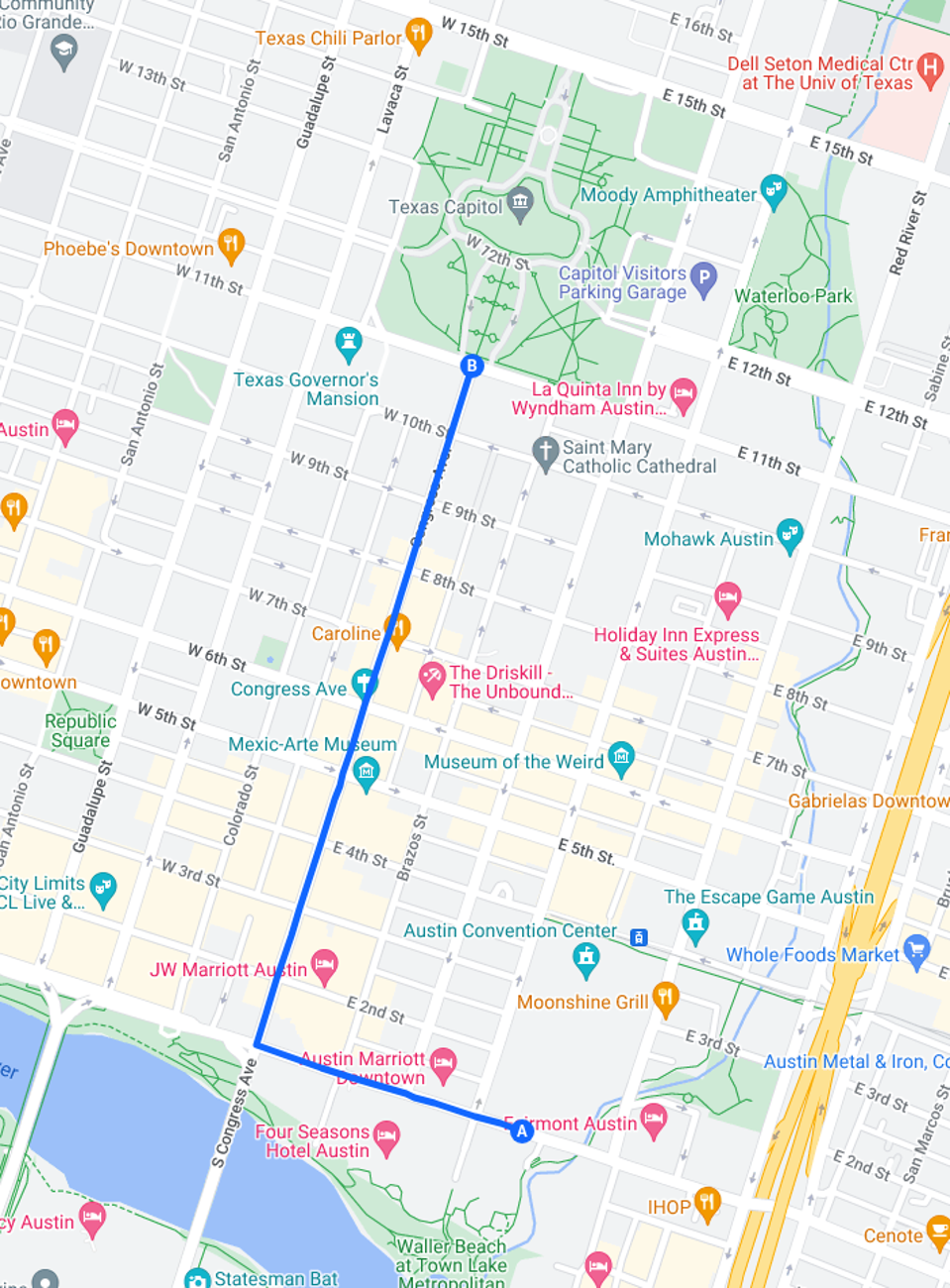
Some rumors suggest Tesla hopes for a fairly busy and challenging route between the Convention Center, busy 6th St and the Capitol, though with just a few streets. Even with extensive mapping and testing, this would be a stretch goal.
Tesla could, and should, do an in-depth focus on data from 100,000 drives of this short route by Tesla staff and ordinary Tesla owners (including from the past) to gain confidence and experience with all that happens on this path. This would not necessarily scale, nor solve issues like the perception limitations of computer vision, and what happens when cameras get disabled by weather. (For a short route, they could have staff in place to drive over and clean them, or shut down in rain.)
Other potential areas could be a closed campus, like around the airport, or at UT-Austin. (University campuses have several times been used as pilot areas for self-driving shuttles, dating back over a decade, so this would not be so novel.)
Remote Supervision or Driving
Some have suggested Tesla might plan to just have remotely driven cars, or have cars under constant remote supervision. Last year, Tesla advertised to hire engineers to work on remote driving systems for the cars and robots. All self-driving teams have “remote assistance” centers, where employees give advice to cars about how to handle unusual situations that confuse them. Most do not support remote driving--rather the vehicle stops when it doesn’t understand, and a human gives it a strategic plan for what to do, with commands like “take the 2nd left” or “go between those two cars.” Remote operators, watching a vehicle may also be able to tell it to stop, and then give it advice. It is commonly suspected that existing teams began their no-safety-driver operations with constant monitoring of this sort, then graduated to intermittent monitoring and assistance.
However, Musk has explicitly said the system will be “unsupervised.” That rules out constant monitoring or remote driving, unless that’s a falsehood. It wouldn’t be the first falsehood from Musk, however. There are companies that do remote driving. Vay operates a service in Las Vegas that delivers a rental car (which you drive) through remote driving. This is done at low speed on limited streets. Such services tend to have limited driver-assist/safety systems in the cars which will avoid unsafe actions and crashes should the remote driver make a mistake--or become disconnected due to network problems. Alternately, in theory a remote supervisor could watch Tesla FSD doing the driving, and intervene, the way drivers sitting in the cars do. Due to latency, network problems and limited visibility, that could create significant risk--and it would not be unsupervised. At the same time, since FSD failures and remote driving problems are independent factors, together they might have a safety record that’s good enough to be a toe in the water. Of course, having full time remote drivers or monitors is not much more economical than just being like Uber with a person in the car, so it’s not a long term solution.
He’s Wrong… Again
Elon Musk and Tesla have predicted that their FSD system will soon reach superhuman levels of safety within a year many times before. For over a decade, this has been said, even declared to be “certain” and it has yet to happen. As such, the most likely explanation is that the goal simply won’t be met. Musk is highly distracted at present, attempting to run many companies and part of the US government. We don’t know what his team is telling him, but his conclusions aren’t based on spending significant amounts of time in the trenches with his team.
Special Infrastructure
Musk declared that the cars are ready to drive everywhere, but will start with a smaller service area. However, this could also be incorrect, as one solution is to do special work on the service area. Extensive testing and fixing bugs for that service area is one obvious step. With Waymo’s “Caddy” project, they had a box at a couple of street corners with radar that helped the cars (which had few sensors) know it was safe to turn onto public streets. That’s not at all what Tesla says it would do, but it could be done to put a toe in the water.
Tesla also has a small fleet of LIDAR equipped Teslas used for gathering training data. It’s possible that this could be used to speed up being ready to deliver a limited route, but would require eating a lot of crow after declaring LIDAR to be a crutch and “fool’s errand.” It is, however, what any other team would do in this situation with a tight deadline.
Austin is a fairly liberal-leaning town, and Musk’s recent political activities may be polarizing there, and hurt the service in competition with Waymo, which also operates. However, the novelty of the service will probably overcome that.
Originally published at Forbes.com in Tesla Robotaxi In June: What Does Musk Mean By “Toe In The Water?”. Copyright © 2025 by Brad Templeton.


Add new comment