


Waymo Builds A Vision Based End-To-End Driving Model, Like Tesla/Wayve
Waymo’s self-driving robotaxis currently drive with an array of sensors and an array of AI tools (including lots of machine learning and an Large Language Model (LLM) known as the Waymo Foundation Model.) Waymo just announced Oct 29 that they are now doing 150,000 real self-driving rides per week for paying customers, so they are doing a superb job.
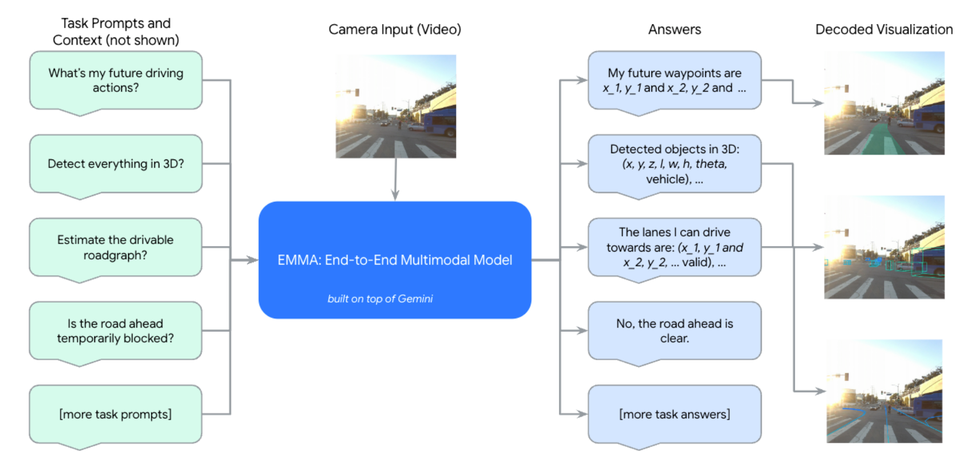
Waymo also has an internal research team which just released a new paper (Summarized in a blog post) on a very different project—an effort to build a driving system with fairly different techniques, techniques with some similarities to those used by others (Tesla, or more closely Wayve) but based on sister company Google’s Gemini LLM. They report it drives well, though still needs improvement.
The new tool, named EMMA starts with Gemini. This is a text-based LLM, similar to chatGPT, which is trained on a huge corpus of general text to give it knowledge of the world and of human natural language. That training includes lots of text about roads and driving and lots of other general knowledge. To this they add “end-to-end” training based on videos of driving.
A pure “end to end” model takes in sensor data (in this case, camera images) and outputs a driving plan. Programmers do not craft internal structure or do smart heuristic optimizations based on their knowledge of the driving task. This is what Tesla, Wayve and some other self-driving projects claim to do. In addition, like those projects, EMMA does not use high-definition maps, but rather just navigation maps. In fact, because it is based on a natural language LLM, navigation is provided to the system literally by text commands like “Turn left.” The system is told, in English, what the road looks like, what the weather is, and what features and seen in the map of the road.
As such, it should not be interpreted that EMMA works as Tesla’s or Wayve’s systems do. It makes much more use of text and Gemini. What it shares is:
- The use of only cameras
- The use of self-supervised training (no labeling of data)
- End-to-end learning and operation
- The integration of a text LLM with explanation ability (similar to Wayve)
Like the Wayve system, EMMA is able to explain in English what it is planning and why. (In fact, that’s how it outputs its predictions for a good path plan.) Wayve uses this approach to help get a better window into how their system works and in the hope of giving confidence to riders. The EMMA system’s perception abilities were also evaluated by querying it to describe (in text) what it sees and what it predicts for the future motion of all obstacles. It also was asked to describe the road graph (ie. on the fly mapping of the road it sees.)
The team reports that they have run this system on various publicly available datasets (including the Waymo Open Motion Dataset, a package Waymo donated for public research) and also on an internal dataset. They claim it outperformed other driving engines in the research literature, but did not compare it to commercial driving models, such as the current Waymo driver, or Tesla FSD. It did its best when trained with Waymo’s own internal data.
The system was limited by many factors, and did not handle LIDAR data. Waymo and others have found it difficult to use non-camera data in end-to-end systems as it’s much lower resolution and different in character.
The work is complex and not fully explained by the above summary. Those inclined whould read the actual Waymo paper as well as their summary. Nonetheless, it reveals some interesting conclusions:
- The power of the giant-text LLMs like Gemini continues to impress. In effect, Gemini has “read” lots of text about driving and how it works, and is able to drive based on that.
- While Waymo is famous for their composite AI approach, which mixes both LLM and machine learning approaches with classic code, and has attained an unmatched safety level, they are also researching other approaches in parallel, though it’s not clear this work will even be commercialized.
- This work is still more academic than practical. They also had to use the smallest Gemini model and it still took a fair bit of compute resources and so use had to be limited.
Waymo’s Other Abilities
Waymo co-CEO Dmitri Dolgov recently revealed in an interview that the main Waymo driver is able to drive with just vision, but they do not feel it meets their safety standards fully. They have designed the vehicle to withstand the loss of most components, including the failure of sensors like the main LIDAR. In addition, Waymo regularly drives in construction zones and other areas where its map is no longer correct. This it does at a sufficiently safe level. Together this leads to the conclusion that in spite of the fact that frequent comparisons between Tesla FSD-Supervised and the Waymo driver criticize Waymo for needing a map to drive, or needing more expensive sensors like LIDAR, it seems likely that Waymo could probably perform better—likely a great deal better—than a Tesla if they thought it were worth making a vehicle with only cameras, or one wanted to drive on all roads with a supervising driver.
With the new milestone of one million miles/week (with very few reports of at-fault crashes) Waymo is now on the way to scaling. It recently announced operations in Atlanta and Austin, so the world awaits news of even more cities.
Originally published at Forbes.com in Waymo Builds A Vision Based End-To-End Driving Model, Like Tesla/Wayve. Copyright © 2024 by Brad Templeton.


Add new comment