


Waymo’s New Safety Data Is Impressive And Teaches A Lesson
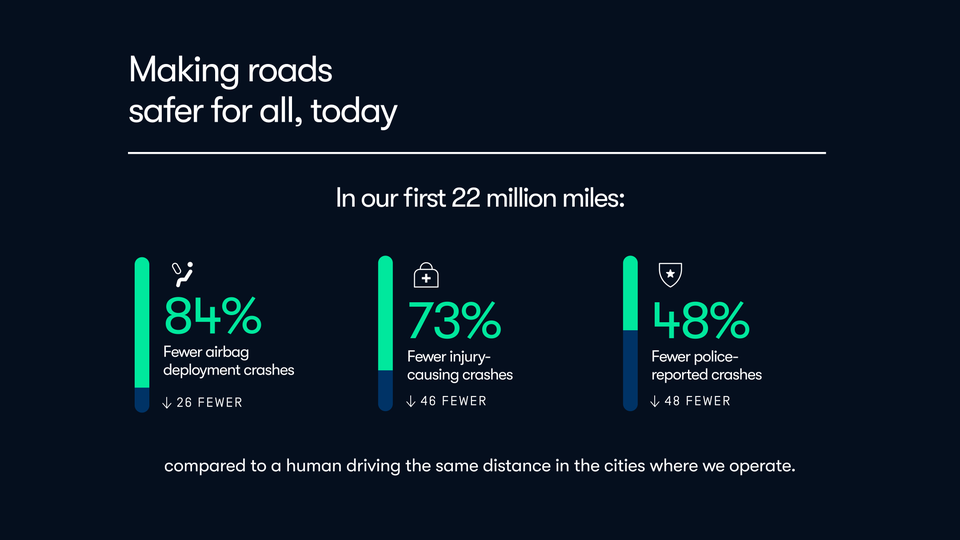
Waymo, the robotaxi unit of Alphabet/Google, has released a new analysis of their crash data. The Waymo study claims that after 22 million miles of operation with nobody behind the wheel, mostly in Phoenix but with a fair chunk in San Francisco, that their vehicles have far few crashes of three types than human drivers driving the same number of miles on the same regions and roads.
In particular, Waymo reports 84% fewer airbag deployment crashes, 73% fewer injury crashes and 48% fewer police reported crashes. They also claim that just under half of their recorded crashes took place with less than 1mph speed difference with the other entity (such crashes being unlikely to involve airbags, injury or police.)
They have published research papers on this which have passed peer review. That's not perfect but is a step up over what we've seen in the past. There is a strong temptation for all self-driving teams to want to present their safety statistics in the most positive light. Tesla has gone so far in that direction as to publish extremely misleading numbers. The gold standard would be review by independent 3rd parties, but peer reviewed results are a step up.
It's all about risk
Waymo's reporting throws down a gauntlet to all operators, and I hope they will accept it. More to the point, when they don't accept it and publish their own numbers with similar candor, it creates a strong impression that they might have a reason not to publish, because their numbers are not as good, and that they possibly are quite bad.
Regulators and the public need to understand these numbers because to understand whether robocars make sense, and whether they are dangerous, it is a mistake to look at individual incidents. Each incident (at least if the self-driving system was at fault) represents a problem which should not happen, and this has led many, afer a single incident to state the opinion that "these vehicles are not ready" or that they should be barred from the roads. No single incident, even a tragic one, can tell us that.
What we want to understand is risk. All driving creates risk. Some creates more risk than others. When we speed, we take risks (to others as well as ourselves.) When people drink they create a great deal of risk (even though most drunk drivers do actually make it home.) Every freshly minted teen driver creates more risk with each drive than typical mature drivers. We accept that risk in order to have mobility.
So while it would be wrong to put out a vehicle with a known serious flaw, it is acceptable to send a vehicle out that creates risk, as long as that risk is below a certain level. Even though Waymo knows that if they send their fleet out to drive 10 million miles, it's quite likely somebody will be hit, this is also true for Fedex when they send their drivers out, or Uber.
Ordinary people can't avoid a focus on incidents. It is the job of regulators to look at the big picture, and examine the risk.
Waymo's statistics are about all contact events for their vehicles, regardless of fault. It can sometimes be hard to determine fault, especially if you have a bias, but police do that thousands of times every day. Insurance companies do too, so Waymo earlier asked SwissRe, a large reinsurance company, to do a risk analysis of their results. This did involve judging fault because fault would trigger insurance liability claims. Impressively, this report found no liability for Waymo from any of the injury crashes, meaning they were not at fault. (This study covered 4 million miles, not 22 million.)
While most of Waymo's miles are on the easy streets of Phoenix, having no injury liability in a large pool of miles is a very impressive result, particularly when coming from a 3rd party. As regulators and legislators puzzle over how to regulate self-driving, the answer is probably here. Get experts like insurers to calculate the risk, and as long as that risk is not worse than human drivers, allow the vehicles to get out there, learning and improving. In future their risk levels will be even better, and we don't want to delay the arrival of that day.
While Cruise has not published data as good as Waymo's, they did publish an analysis comparing themselves to TNC drivers (Uber/Lyft) which showed them favorably. Let's see more of that. Cruise, of course, had the famous and tragic incident where a woman was hit by a hit and run human driver and thrown in front of their vehicle, but they then, after stopping, tried to pull over, dragging her and worsening her injuries. Fortunately she recovered, though it could easily have been worse. The California DMV reacted by quickly shutting Cruise down in California, pulling their permits. When they did so, they cited two large problems. The first was that Cruise was not safe enough (due to that incident and possibly others.) Perhaps bigger was that they briefly tried to hide important details. As usual, the cover-up becomes bigger than the original sin.
The DMV should clarify their reasons. At present, companies have to fear that one serious incident (even one started by a 3rd party) could get their fleet pulled from the roads, possibly derailing their whole project. Cruise has been delayed over a year They need to know where the bar is, and whether it's a serious incident, or a cover-up, or both. Cruise settled with fines over the cover-up (as cover-ups go it was oe of the shortest) but remains off the road. The DMV has not responded to multiple requests for comment on this question.
All teams around the world should match or exceed Waymo in publishing data to help us determine what risk they are generating. While companies work for profit rather than the public interest, the key to regulating them is to find ways to make them put the public interest in their financial interest. All the companies declare this, saying they are safety first, but the proof is in pudding like this. For regulators, making all the roads safer for all users is their duty, and robocars present a way to do that, as long sa the focus is on statistics like these and, as hard as it is, not on the horrors of particular incidents.
Originally published at Forbes.com in Waymo’s New Safety Data Is Impressive And Teaches A Lesson. Copyright © 2024 by Brad Templeton.


Add new comment