


In 2009, Waymo’s “Caddy” Was A Campus Robotaxi Long Before Cybercab
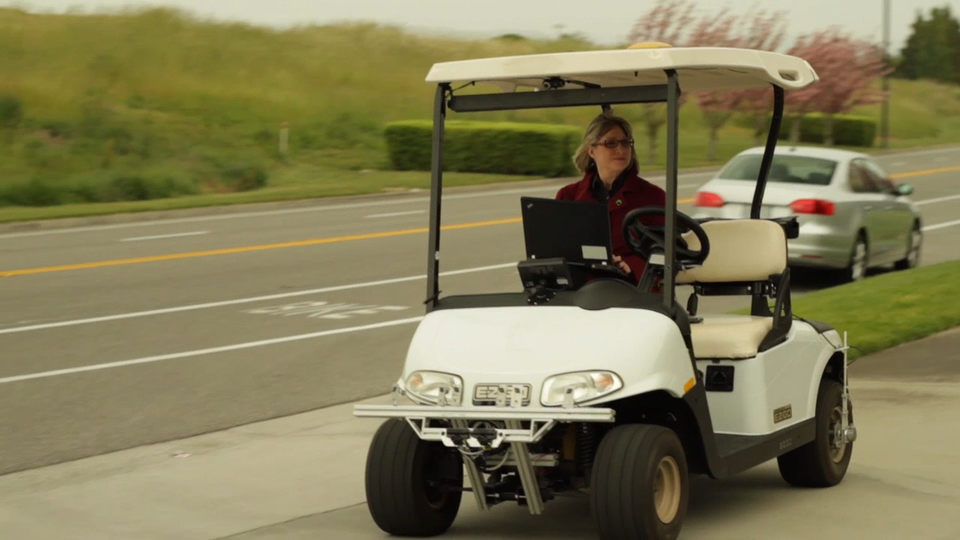
Tesla recently held its much-hyped “We Robot” demonstration day to show off its concept robotaxi, giving rides to guests on a closed course at the Warner Brothers’ studio lot. In a lost piece of history, it turns out that 15 years ago, in 2009. Google Chauffeur, the project that is now Waymo, did a demo with many similarities, based on low-cost golf carts and with the golf-inspired name of “Caddy.”
Caddy was effectively the zeroth-generation Waymo vehicle. (I joined the Chauffeur team as the Caddy project was winding down.) It was a side experiment in a very low-cost vehicle, with just one full time engineer and part-time-assist from other members of the 15 person team. They equipped golf carts with a low cost and simple package of low-end cameras, ultrasonics, a wheel encoder, IMU/GPS and 2009-era computers. No Deep Learning or Transformers or LIDARs—the AI didn’t exist yet and the LIDARs cost more than a dozen golf-carts and were deliberately avoided to learn what could be done without them.
You can watch a video of Caddy in action here:
Caddy had a series of pick-up points around the Google campus. Users could summon a vehicle to their stop with a web site or an app—Android itself was just a year old at the time—and a cart would come. The cart could drive them autonomously on a limited number of non-public routes. The users could also manually drive the cart outside that route map or on public roads to get to other destinations on campus. In order to cross public streets, the carts could also communicate with boxes at intersections with radars and a camera which could verify no other traffic was coming. At the time, even radars were expensive compared to golf carts.
Caddy was just a demonstration project to see what could be done with low cost hardware. The stereo vision cameras were literally taken out of a Playstation. The higher-cost Prius was also developed at the same time by the main team. Caddy was not used by many people, and it never went into production. It did autonomous operation on just a few routes, mainly on sidewalks and golf cart paths, but it could do this with no supervising “safety driver.” As it happened 15 years ago, it only had a fraction of the sophistication of a system like Tesla FSD that drove the cars used at the Tesla “We Robot” demo.
At the same time, what it demonstrated—a working robotaxi service running fixed routes on a mostly closed campus, summoning and controlling the taxis with a mobile phone app—is not greatly different from the capability demonstrated by Tesla, or by other similar demos that have appeared over the years. While the team members, such as lead Nathaniel Fairfield and perception engineer Jiajun Zhu (now CEO of Nuro) are among the most skilled engineers I’ve had the chance to work with, the real lesson of Caddy is just how far you have to go even after producing such a demo. Fifteen years on, Waymo is on its sixth generation vehicle and just starting to scale up over multiple cities, and it all began with Caddy and the 1st generation Prius-based vehicle. They are now in 3 cities with 3 more announced.
Infrastructure sensors, such as the intersection radars used by Caddy remain a subject of debate in the industry even to today. In theory they can create a cheaper solution and see things cars can’t see, but they limit the vehicles to driving only where the infrastructure has been installed. That suffers from the problem that infrastructure changes take place on a pace of decades, and tend to be obsolete before they are finished being installed. Nonetheless, Baidu has plans for solutions like this in China, where they build infrastructure faster and most of their infrastructure is new. Most robocar teams have ended up following the path of “you drive on the road you’re given, you don’t try to change the world to serve your vehicle.” I’ve even called this the “First Law of Robocars.” Nonetheless, there are projects (such as Cavnue in Michigan) hoping to make roadside infrastructure work.
Waymo’s first generation vehicle was based on a Prius, using the expensive Velodyne LIDAR, as well as many other sensors. The LIDAR did all the heavy lifting—the camera was mainly needed to see the color of traffic lights. It drove well enough to handle 1,000 miles of different types of road, and 100,000 miles of operation to meet Larry Page’s first milestone, though with many interventions from safety drivers. Today, Waymo’s 5th generation vehicles are giving 150,000 rides/week to members of the general public with nobody behind the wheel to intervene if anything went wrong, which fortunately is extremely rare.
Originally published at Forbes.com in In 2009, Waymo’s “Caddy” Was A Campus Robotaxi Long Before Cybercab. Copyright © 2024 by Brad Templeton.


Add new comment