


Tesla Wireless Charging, Swap And Robots—How Will Robotaxis Recharge?
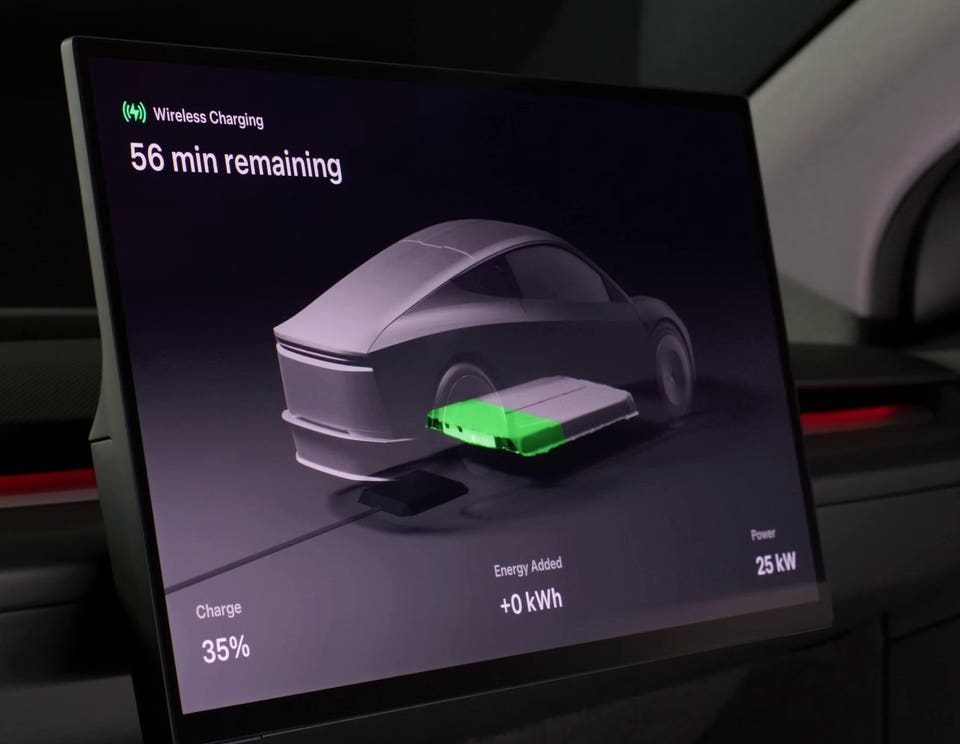
On October 10, Elon Musk stated that Tesla’s new Robotaxi / Cybercab, if and when it goes into production, will recharge only with wireless charging. There won’t be a traditional charge port and they won’t be able to use Tesla’s well-loved supercharger network, creating yet another new charging standard, just after Tesla’s own “NACS” plug won the charge plug wars.
The charging needs of robotaxis are different from privately owned robocars, and those are different from regular personal electric cars. Both wireless charging and battery swap, which have never made much sense for personal cars, could make good sense for robotaxis. In addition, “robotic plug in” can also make sense, even for personal cars.
Wireless
The big advantage of wireless (also known as “inductive”) charging is that you don’t need a human to plug the vehicle in, so it can just drive on top of the charging coil and start charging. This is also true of battery swap and robotic plug in, but wireless doesn’t require any moving parts except the car, which is already a moving part. Robotic cars can position themselves precisely to assure a good inductive link. Wireless charging has losses—Tesla says theirs will be “well over 90% efficient”—and those losses mean heat. Wireless coils also come at some expense and if you want to fast charge, there’s a very serious heat issue with even a few percent of loss.
Wireless has never caught on because it’s pricey and not standard, and just provides a nice convenience for the driver. For a robocar, it’s more than convenience as the current alternative is a human plug jockey which is very expensive. Tesla claims their system will provide 25kW, which is quite a bit more than the 7kW ordinary cars use, but quite a bit less than the 250kW or more of fast charging. 25kW, which means restoring around 100 miles of range per hour of charging, should perhaps do the job but it may be a bit long of a way for the robotaxis needing a mid-day charge that don’t want to take an hour of downtime.
(Cabs don’t take road trips so they don’t need to supercharge. If they did take a road trip they would swap cabs rather than make a customer wait.)
After having won the charge plug wars, starting from scratch with wireless charging forgoes the huge advantage Tesla has as owner of the biggest charging network. On the other hand, they are very experienced at installing new charging infrastructure, and putting inductive coils at their existing facilities would be something they can readily do.
Battery Swap
Battery Swap has also never caught on, certainly not for private cars. There, it’s a classic example of “gasoline thinking,” which tries to duplicate the fill-up experience. It can make sense for fleets, however. One interesting capability of battery swap is you can charge the batteries while the cars out out working, in particular during the day when surplus solar power is abundant. That’s not just green, in some cases, noon power prices are going near free or even negative (they pay you to take the power!) so this can cause a major reduction in energy costs which justifies needing extra batteries and swap equipment. (Most robotaxis will be working mid-day and not be able to take advantage of these negative prices.)
Because swap is fast, you don’t need a lot of swap stations to handle a large fleet. For inductive or even fast charging, you have to install massive charging facilities at many depots. That’s expensive, and it can be hard to get the power company to provide the power. Cruise had a depot where they were trucking in hydrogen to run fuel cells because it was going to be a year for the power utility to set things up. You can also charge the batteries in a different location and truck them to the robotaxi service depot.
Swap is so fast that you can actually put smaller batteries in the cars. Some cars will still manage to do a day’s service on one charge, but those that put in the most miles can stop for a quick swap of some or all of their battery. If you can swap partial packs you can actually get away with a lower battery cost per vehicle. (With full pack swap you need more batteries than you have vehicles, which adds cost as the battery is the most expensive component of an EV.)
Swap also has virtue if your cars last longer than your batteries, as you have made the two lifetimes independent.
Robotic Plug In
Several companies have tried to built robots that can put a traditional plug into an EV. Tesla famously showed off their “snake” many years ago and there are others. The best plan, though is to take advantage of the fact that a robocar is already a robot. If you put the receptacle on the front or back of the vehicle, the car can plug itself in to a fixed plug if it’s at the right height. If not that, the plug can require only cheap and minimal robotics while the car does most of the work. This can be cheap, does not have inductive losses and uses standard plugs.
Private Cars
There are benefits for robotic charging of private cars, too. Getting good charging is the biggest barrier to EV adoption. If cars can “charge themselves” the problem of charging infrastructure vanishes. You don’t need to be able to install charging at home. Your car, when parked for a while at places like your apartment or office, just wanders off to a charging stall. That’s a much simpler self-driving problem—slow travel on quiet streets, often at night. While Tesla is many years from having a “robotaxi” safe enough to bet your life on, it’s demo at Warner Studios suggests they might be able to make a car do a planned and mapped recharging trip at night very soon.
The result would be magic—a car that’s simply charged all the time, you don’t even know how. (It would still need to fast charge for road trips, though, with something like the supercharger.)
Originally published at Forbes.com in Tesla Wireless Charging, Swap And Robots—How Will Robotaxis Recharge?. Copyright © 2024 by Brad Templeton.


Add new comment