Non Forbes

More World Tour: Dubai, Singapore

The Robocars world tour continues. Monday I will speak on robocars at the UAE Government conference in Dubai, where I just landed. Then it's off to talk about them at a private event in Singapore, but I'll also visit teams there. If I have time, I will check out Masdar -- what was originally going to be the first all-robocar city -- while in the UAE.

End the redirect wrapper on links

A lot of sites, most notably search engines like Google, like to rewrite all the links on their pages. So search for this page and instead of http://ideas.4brad.com, the link Google gives you is http://www.google.com/url?sa=t&rct=j&q=&esrc=s&source=web&cd=1&cad=rja&ved=short-string&url=http%3A%2F%2Fideas.4brad.com%2F&ei=med-string&usg=huge-string&bvm=short-string or similar. (I have redacted the actual codes.)

Topic: 

Satoshi, is now the time to consider donating lots of bitcoin to charity?

I don't know who the person or people are who, under the name Satoshi Nakamoto, created the Bitcoin system. The creator(s) want to keep their privacy, and given the ideology behind Bitcoin, that's not too surprising.

There can only be 21 million bitcoins. It is commonly speculated that Satoshi did much of the early mining, and owns between 1 million and 1.5 million unspent bitcoins. Today, thanks in part to a speculative bubble, bitcoins are selling for $800, and have been north of $1,000. In other words, Satoshi has near a billion dollars worth of bitcoin. Many feel that this is not an unreasonable thing, that a great reward should go to Satoshi for creating such a useful system.

For Satoshi, the problem is that it's very difficult to spend more than a small portion of this block, possibly ever. Bitcoin addresses are generally anonymous, but all transactions are public. Things are a bit different for the first million bitcoins, which went only to the earliest adopters. People know those addresses, and the ones that remain unspent are commonly believed to be Satoshi's. If Satoshi starts spending them in any serious volume, it will be noticed and will be news.

The fate of Bitcoin

Whether Bitcoin becomes a stable currency in the future or not, today few would deny it is not stable, and undergoing speculative bubbles. Some think that because nothing backs the value of bitcoins, it will never become stable, but others are optimistic. Regardless of that, today the value of a bitcoin is fragile. The news that "Satoshi is selling his bitcoins!" would trigger panic selling, and that's bad news in any bubble.

If Satoshi could sell, it is hard to work out exactly when the time to sell would be. Bitcoin has several possible long term fates:

  1. It could become the world's dominant form of money. If it replaced all of the "M1" money supply in the world (cash and very liquid deposits) a bitcoin could be worth $1 million each!
  2. It could compete with other currencies (digital and fiat) for that role. If it captured 1% of world money supply, it might be $10,000 a coin. While there is a limit on the number of bitcoins, the limit on the number of cryptocurrencies is unknown, and as bitcoin prices and fees increase, competition is to be expected.
  3. It could be replaced by one or more successors of superior design, with some ability to exchange during a modest window, and then drifting down to minimal value
  4. It could collapse entirely and quickly in the face of government opposition, competition and other factors during its bubble phase.

My personal prediction is #3 -- that several successor currencies will arise which fix issues with Bitcoin, with exchange possible for a while. However, just as bitcoins had their sudden rushes and bubbles, so will this exchange rate, and as momentum moves into this currency it could move very fast. Unlike exchanges that trade bitcoins for dollars, inter-cryptocurrency exchanges will be fast (though the settlement times of the currencies will slow things down.) It could be even worse if the word got out that "Satoshi is trading his coins for [Foo]Coin" as that could cause complete collapse of Bitcoin.

Perhaps he could move some coins through randomizing services that scramble the identity association, but moving the early coins to such a system would be seen as selling them.

Tags: 

Surprising math on Obamacare levels: Go for the Bronze!

Recently I learned from health.net, the insurer which did my individual plan, that they were canceling it. I'm one of those who lost his health plan with the switch to the ACA (Obamacare) plans, so I need to shop in the healthcare marketplace and will likely end up paying more.

What surprised me when I went to the marketplace was the math of the plans. For those who don't know, there are 4 main classes of plans (Bronze, Silver, Gold, Platinum) which are roughly the same for all insurers. There is also a 5th, "Catastrophic" plan available to under-30s and hardship cases, which is cheaper and covers even less than Bronze. Low income people get a great subsidized price in the marketplace, but people with decent incomes get no subsidy.

The 4 plans are designed so that for the average patient, they will end up paying 60% (Bronze), 70% (Silver), 80% (Gold) or 90% (Platinum) of health care costs, with the patient, on average, bearing the rest. All plans come with a "Maximum out of pocket" (MOOP) that is at most $6,350 for all plans but $4,000 (or less) for the Platinum.

Here's some analysis based on California prices and plans. The other states can vary a fair bit. Insurance is much cheaper in some regions, and there are plans that use moderately different formulae. In every state the MOOP is no more than $6,350 and the actuarial percentages are the same.

As you might expect, the Platinum costs a lot more than the Bronze. But at my age, in my early 50s, I was surprised how much more. I decided to plug in numbers for Blue Cross, which is actually slightly cheaper than many of the other plans. I actually have little information with which to compare the companies. This is quite odd -- my health insurance is going to be by biggest annual expenditure after my mortgage. More than my car -- but there's tons of information to help you choose a car. (Consumer Reports does have a comparison article on the major insurance companies before the ACA for their subscribers.)

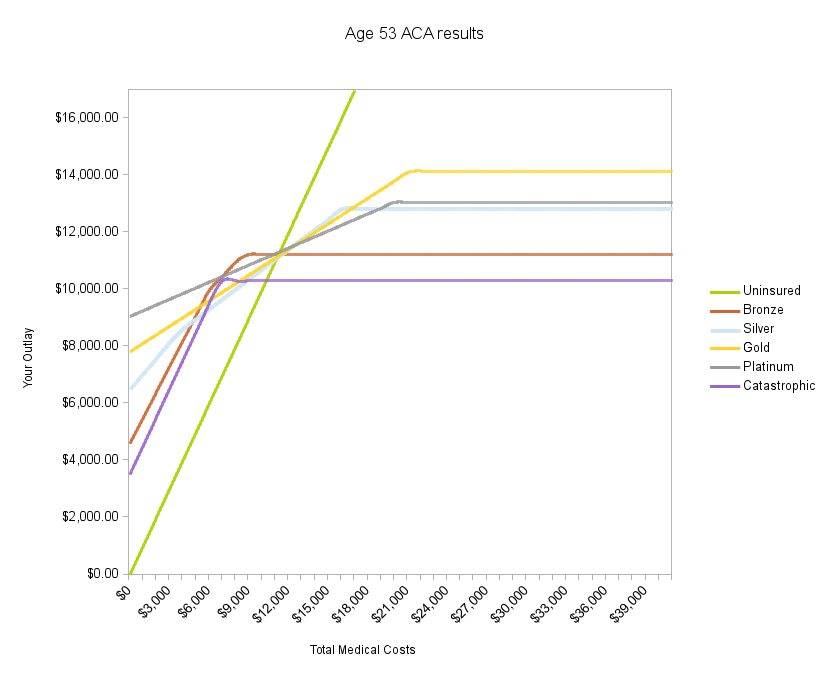
The Platinum plan costs $350/month extra over Bronze, $4200/year. Almost as much as the MOOP. So I decided to build a spreadsheet that would show me what I would end up paying on each plan in total -- premiums plus my personal outlays. Here is the sheet for me in my early 50s:

The X axis is how much your health care actually cost, ie. what your providers were paid. The Y axis is how much you had to pay. The green line is unity, with your payout equal to the cost, as might happen in theory if you were uninsured. In theory, because in reality uninsured people pay a "list price" that is several times the cost that insurance companies negotiate. Also in theory because those uninsured must pay a tax penalty.

All the plans go up at one rate until they first hit your deductibles (Bronze/Silver) and then at a slower rate until you hit your MOOP. After the MOOP they are a flat line almost no matter what your health spending does. The Silver plan is the most complex. It has a $250 drug deductible and a $2000 general deductible and the usual $6,350 MOOP. In reality, these slopes will not be smooth lines. For example, on the silver plan if you are mostly doing doctor visits and labs, you do copays, not the deductible. If you hit something else, like MRI scans or hospitalization, you pay out the full cost until you hit the deductible. So each person's slope will be different, but these slopes are meant to represent an estimate for average patients.

The surprising thing about this chart is that the Bronze plan is pretty clearly superior. Only for a small region of costs does your outlay exceed the other plans, and never by much. However, in the most likely region for most people (modest health care) or the danger zone (lots of health care) it is quite a bit cheaper. The catastrophic plan, if you can get your hands on it over 30, is even better. It almost never does worse than the other plans.

I will note that the zone where Bronze is not the winner is around the $8,400 average cost of health care in the USA. However, what I really want to learn is the median cost, a statistic that is not readily available, or even better the median cost or distribution of costs at each age cohort. The actuaries obviously know this, and I would like pointers to a source.

Premiums are tax deductible for the self-employed, as are large medical expenses for all, but the outlays above premiums can also come from a Health Savings Account (HSA) which is a special IRA-like instrument. You put in up to around $3K each year tax-free, and can pay the costs above from it. (You also don't pay tax on appreciation of the account, and can draw out the money post-retirement at a decent rate.) If you are self-employed, depending on your tax bracket, this can seriously alter the chart and push you to a more expensive plan, because the premium money comes from pre-tax dollars and the health expenses don't, unless they are more than 10% of your total income.

The chart suggests the Bronze plan is the clear winner unless you know you will be in the $6K to $10K zone where it's a modest loser. It seems to beat the Platinum all the time (at least in this simplified model) but might have minor competition from the Silver. The Gold is essentially always worse than the Silver.

If we move to age 60, now the win for Bronze is very clear. At age 60, the $5500 extra premium for Platinum almost exceeds the MOOP on the Bronze -- the Bronze will always be cheaper. This makes no sense, and seems to be a result of the fact that the MOOP remains the same no matter how old you are (and is also the same for B/S/G/Cat.) Perhaps varying deductibles and the MOOP over time would have made more variety.

Here the Gold is clearly a loser to the Silver if you were thinking about it. Nobody in this age group should buy the Gold plan but I doubt the sites will say that. Platinum is almost as clearly a loss.

Thinking about money every time you use health care

With the choice for the older person so obvious, this opens up another question, namely one of psychology. The rational thing to do is to buy the Bronze plan. But with its $5,000 deductible, you will find yourself paying out of pocket for almost all your health care except in years you need major treatments and hospitalizations.

Michigan to build fake-downtown robocar test site

I'm working on a new long article about advice to governments on how they should react to and encourage the development of robocars.

An interesting plan announced today has something I had not thought of: Michigan is funding the development of a fake downtown to act as a test track for robocar development. The 32 acre site will be at the University of Michigan, and is expected to open soon -- in time for the September ITS World Congress.

Topic: 

Electric cars as peak grid power? Not small ones, but perhaps the Tesla

An article in the LA Times suggests an idea I've seen frequently -- use electric car batteries to meet peak power demand on the grid. After all, you have a car, and it's plugged in, and it has a big battery, so instead of just charging it, have it send juice back to the grid when it most needs it.

Topic: 

The Valley of Danger -- medium speed roads for robocars

With last week's commercial release of the Navia, I thought I would release a new essay on the challenges of driving robocars at different speeds.

As the Navia shows, you can be safe if you're slow. And several car company "traffic jam assist" products say the same thing. On the other end, we see demos taking place at highway speeds. But what about the middle range -- decent speeds on urban streets?

Topic: 

Induct's "Navia" officially for sale for $250,000

A significant milestone was announced this week. Induct has moved their "Navia" vehicle into commercial production, and is now taking orders, though at $250,000 you may not grab your wallet.

This is the first commercial robocar. Their page of videos will let you see it in operation in European pedestrian zones. It operates unmanned, can be summoned and picks up passengers. It is limited to a route and stops programmed into it.

Topic: 

Pages