


Robocars
The future of computer-driven cars and deliverbots
Would we ever ban human driving?
Submitted by brad on Thu, 2014-03-06 14:41I often see the suggestion that as Robocars get better, eventually humans will be forbidden from driving, or strongly discouraged through taxes or high insurance charges. Many people think that might happen fairly soon.
It's easy to see why, as human drivers kill 1.2 million people around the world every year, and injure many millions more. If we get a technology that does much better, would we not want to forbid the crazy risk of driving? It is one of the most dangerous things we commonly do, perhaps only second to smoking.
Topic:
What governments should do to help and regulate robocars
Submitted by brad on Mon, 2014-03-03 12:07In my recent travels, I have often been asked what various government entities can and should do related to the regulation of robocars. Some of them want to consider how to protect public safety. Most of them, however, want to know what they can do to prepare their region for the arrival of these cars, and ideally to become one of the leading centres in the development of the vehicles. The car industry is about to be disrupted, and most of the old players may not make it through to the new world.
Topic:
Tags:
US push to mandate V2V radios -- is it a good choice?
Submitted by brad on Mon, 2014-02-17 10:06It was revealed earlier this month that NHTSA wishes to mandate vehicle to vehicle radios in all cars. I have written extensively on the issues around this and regular readers will know I am a skeptic of this plan. This is not to say that I don't think that V2V would not be useful for robocars and regular cars. Rather, I believe that its benefits are marginal when it comes to the real problems, and for the amount of money that must be spent, there are better ways to spend it. In addition, I think that similar technology can and will evolve organically, without a government mandate, or with a very minimal one. Indeed, I think that technology produced without a mandate or pre-set standards will actually be superior, cheaper and be deployed far more quickly than the proposed approach.
The new radio protocol, known as DSRC, is a point-to-point wifi style radio protocol for cars and roadside equipment. There are many applications. Some are "V2V" which means cars report what they are doing to other cars. This includes reporting one's position tracklog and speed, as well as events like hitting the brakes or flashing a turn signal. Cars can use this to track where other cars are, and warn of potential collisions, even with cars you can't see directly. Infrastructure can use it to measure traffic.
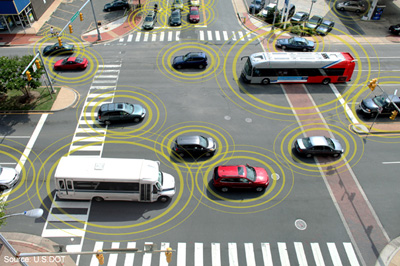 The second class of applications are "V2I" which means a car talks to the road. This can be used to know traffic light states and timings, get warnings of construction zones and hazards, implement tolling and congestion charging, and measure traffic.
This will be accomplished by installing a V2V module in every new car which includes the radio, a connection to car information and GPS data. This needs to be tamper-proof, sealed equipment and must have digital certificates to prove to other cars it is authentic and generated only by authorized equipment.
Robocars will of course use it. Any extra data is good, and the cost of integrating this into a robocar is comparatively small. The questions revolve around its use in ordinary cars. Robocars, however, can never rely on it. They must be be fully safe enough based on just their sensors, since you can't expect every car, child or deer to have a transponder, ever.
One issue of concern is the timeline for this technology, which will look something like this:
- If they're lucky, NHTSA will get this mandate in 2015, and stop the FCC from reclaiming the currently allocated spectrum.
- Car designers will start designing the tech into new models, however they will not ship until the 2019 or 2020 model years.
- By 2022, the 2015 designed technology will be seriously obsolete, and new standards will be written, which will ship in 2027.
- New cars will come equipped with the technology. About 12 million new cars are sold per year.
- By 2030, about half of all cars have the technology, and so it works in 25% of accidents. 3/4 of those will have the obsolete 2015 technology or need a field-upgrade. The rest will have soon to be obsolete 2022 technology. Most cars also have forward collision warning by this point, so V2V is only providing extra information in a tiny fraction of the 25% of accidents.
- By 2040 almost all cars have the technology, though most will have older versions. Still, 5-10% of cars do not have the technology unless a mandate demands retrofit. Some cars have the equipment but it is broken.
Because of the quadratic network effect, in 2030 when half of cars have the technology, only 25% of car interactions will be make use of it, since both cars must have it. (The number is, to be fair, somewhat higher as new cars drive more than old cars.)
Topic:
Tags:
Michigan to build fake-downtown robocar test site
Submitted by brad on Tue, 2014-01-14 22:44I'm working on a new long article about advice to governments on how they should react to and encourage the development of robocars.
An interesting plan announced today has something I had not thought of: Michigan is funding the development of a fake downtown to act as a test track for robocar development. The 32 acre site will be at the University of Michigan, and is expected to open soon -- in time for the September ITS World Congress.
Topic:
The Valley of Danger -- medium speed roads for robocars
Submitted by brad on Fri, 2014-01-10 11:19With last week's commercial release of the Navia, I thought I would release a new essay on the challenges of driving robocars at different speeds.
As the Navia shows, you can be safe if you're slow. And several car company "traffic jam assist" products say the same thing. On the other end, we see demos taking place at highway speeds. But what about the middle range -- decent speeds on urban streets?
Topic:
Induct's "Navia" officially for sale for $250,000
Submitted by brad on Wed, 2014-01-08 17:44A significant milestone was announced this week. Induct has moved their "Navia" vehicle into commercial production, and is now taking orders, though at $250,000 you may not grab your wallet.
This is the first commercial robocar. Their page of videos will let you see it in operation in European pedestrian zones. It operates unmanned, can be summoned and picks up passengers. It is limited to a route and stops programmed into it.
Topic:
CES Robocar News
Submitted by brad on Tue, 2014-01-07 14:47CES has become a big show for announcing car technology. I'm not there this year due to other engagements, but here's some of what has been in the news.
Topic:
Ford's solar charging robocar design
Submitted by brad on Thu, 2014-01-02 13:47One of the silly ideas I see often is the solar powered car. In 2011, I wrote an article about the solar powered robocar which explained some of the reasons why the idea is anti-green, and how robocars might help.
I was interested to see a concept from Ford for a solar charging station for a robocar which goes further than my idea.
Topic:
UK, Michigan & Sweden push robocars, Toyota doesn't -- and Amazon delivery drones
Submitted by brad on Fri, 2013-12-06 14:55The past few weeks have been rife with governments deciding to throw support behind robocars.
I wrote earlier about the plan for pods in Milton Keynes, NW of London. The UK has also endowed a a £10m prize fund to build vehicles and for a town to adapt to them. This will be managed in part by the Oxford team which has built a self-driving Wildcat and Nissan LEAF.
Topic:
More Robocar Updates and Press
Submitted by brad on Tue, 2013-11-19 15:36Back from Budapest, tomorrow I head to Buenos Aires to talk cars and security to city officials. (I wondered if I am ending up touring the world in alphabetical order.)
In the meantime, some interesting tidbits and press:
Topic:
Robocars in Milton Keynes, more surveys and studies
Submitted by brad on Tue, 2013-11-12 18:40I'm back from one European tour and this weekend back in Budapest for our "Singularity University Summit" on the 15th and 16th. If you are nearby, come check it out.
While I've been away, a few news items.
Topic:
Robocars European Tour: London, Milan, Lecce, Vienna, Budapest
Submitted by brad on Fri, 2013-10-11 23:23I'll be back and forth to Europe in the next month giving a number of talks, mostly about robocars. Catch me at the following events:
Topic:
Enough with the Trolley problem, already
Submitted by brad on Thu, 2013-10-10 15:15More and more often in mainstream articles about robocars, I am seeing an expression of variations of the classic 1960s "Trolley Problem." For example, this article on the Atlantic website is one of many. In the classical Trolley problem, you see a train hurtling down the track about to run over 5 people, and you can switch the train to another track where it will kill one person.
Topic:
Tags:
The robocar and the bicycle
Submitted by brad on Sat, 2013-09-28 14:42I've written about the issues relating to robocars and walking before. On one hand, some people may find themselves hardly ever walking with convenient door-to-door robocar transportation. Others may find the robocars may enable walking by allowing one-way waking trips, or enabling trips that that allow drive-walk-drive (eliminating short driving trips done just to save the trouble of walking back to get the car.)
Topic:
Will EV recharging soar to very high costs?
Submitted by brad on Thu, 2013-09-26 19:45I recently read a complaint by an EV driver that the charging station at De Anza College cost 55 cents/kwh. The national average price for electricity is around 10 cents, and at that price a typical electric car costs under 3 cents/mile for electricity. Gasoline costs about 8 cents/mile in a Prius, about 13 cents in a decent non-hybrid and 18 cents/mile in the average car which gets 22mpg. (At least here in California.) But the college's charger's electricity is almost 15 cents/mile in most electric sedans today, which is more than the gasoline in any gasoline car an eco-conscious person is likely to buy. (California Tier III electricity is 30 cents/kwh and thus almost as much.)
The price of charging stations varies wildly. A lot of them are free still, financed by other motivations. Tesla's superchargers are free -- effectively part of the cost of the car. It's not uncommon for parking lots to offer free charging if you pay for parking, since parking tends to cost a fair bit more. After all, you won't put more than 20kwh in a Leaf (and probably a lot less) and that costs just $2 at the average grid price.
 This got me thinking of how the economics of charging will work in the future when electric cars and charging stations are modestly plentiful. While the national grid average is 10 cents, in many places heavy users can pay a lot more, though there are currently special deals to promote electric cars. Often the daytime cost for commercial customers is quite a bit higher, while the night is much lower. Charging stations at offices and shops will do mostly day charging; ones in homes and hotels will do night charging.
Unlike gasoline pumping, which takes 5 minutes, charging also involves parking. This is not just because charging takes several hours, but because that is enough time that customers won't want to come and move their car once full, and so they will take the space for their full parking duration, which may be 8 or more hours.
Charging stations are all very different in utility. While every gasoline station near your route is pretty much equivalent to you, your charging station is your parking spot, and as such only the ones very close to your destination are suitable. While a cheap gas station 2 miles off your route would have a line around the block, a free charging stations 2 miles away from your destination is not that attractive! More to the point, the charging point close to your destination is able to command a serious premium. That have a sort of monopoly (until charging stations become super common) on charging at the only location of value to you.
Put another way, when buying gasoline, I can choose from all the stations in town. When picking an EV charge, I can only choose from stations with an available spot a short walk from my destination. Such a monopoly will lead to high prices in a market where the stations are charging (in dollars :-) what the market will bear.
The market will bear a lot. While the electricity may be available cheap, EV owners might be easily talked into paying as much for electricity as gasoline buyers do, on a per-mile basis. The EV owners will be forgetting the economics of the electric car -- you pay the vast bulk of your costs up front for the battery, and the electrical costs are intended to be minor. If the electricity cost rivals that of gasoline, the battery cost is now completely extra.
Naturally, EV owners will do at least half their charging at home, where they negotiate the best rate. But this could be worse, as they might well be talked into looking at the average. They could pay 80 cents/kwh in the parking lot and 10 cents/kwh at home, and figure they are getting away with 45 cents and "still beating gasoline." They would be fooling themselves, but the more people willing to fool themselves, the higher prices will go.
There is another lack of choice here. For many EV drivers, charging is not optional. Unless they have easy range to get back home or to another charging place they will spend lots of time, you must charge if you are low and the time opportunity presents itself. To not do so is either impossible (you won't get home) or very foolish (you constrain what your EV can do.) When you face a situation where you must charge, and you must charge in a particular place, the potential for price gouging becomes serious.
Topic:
A Tesla self-driving car?
Submitted by brad on Wed, 2013-09-18 22:24It began with reports on a job ad at Tesla for an ADAS engineer to work on self-driving systems, and now there is a declaration from Elon Musk of a desire for a semi-automated car in three years. Musk says he expect the car to be "90% automated" which I will interpret as meaning it does highway driving.
Topic:
Mercedes and Vislab release videos of their real-road tests
Submitted by brad on Thu, 2013-09-12 17:50Videos have been released on some real-world tests of robocars. The most notable is from Mercedes.
As a nice reflection on the past, Mercedes drove the 100km route done by Bertha Benz in the first automotive road trip 125 years ago. You will also find that this alternate video is much better at talking about the technical details of the vehicle.
Topic:
Daimler, Nissan both predict they will sell robocars in 2020
Submitted by brad on Sun, 2013-09-08 14:17Recent news has been big. First, Nissan announced it would sell robocars by 2020 and now today Daimler has announced the same. (Note that the 2014 S-class is the first car with a self-driving feature, a "you must still pay attention" traffic jam autopilot.)
Topic:
The new car stereo is -- the noise cancelling headphone
Submitted by brad on Mon, 2013-08-19 17:59Probably the most expensive add-on that people get in their cars today is the stereo. Long ago, cars often came without stereos and there was a major aftermarket. The aftermarket is still here but most people elect for factory stereos which fit in seamlessly with the car and often cost a huge amount of money.
Topic: