


A Night In A Pebble Electric Trailer Speaks To The Future Of RVs
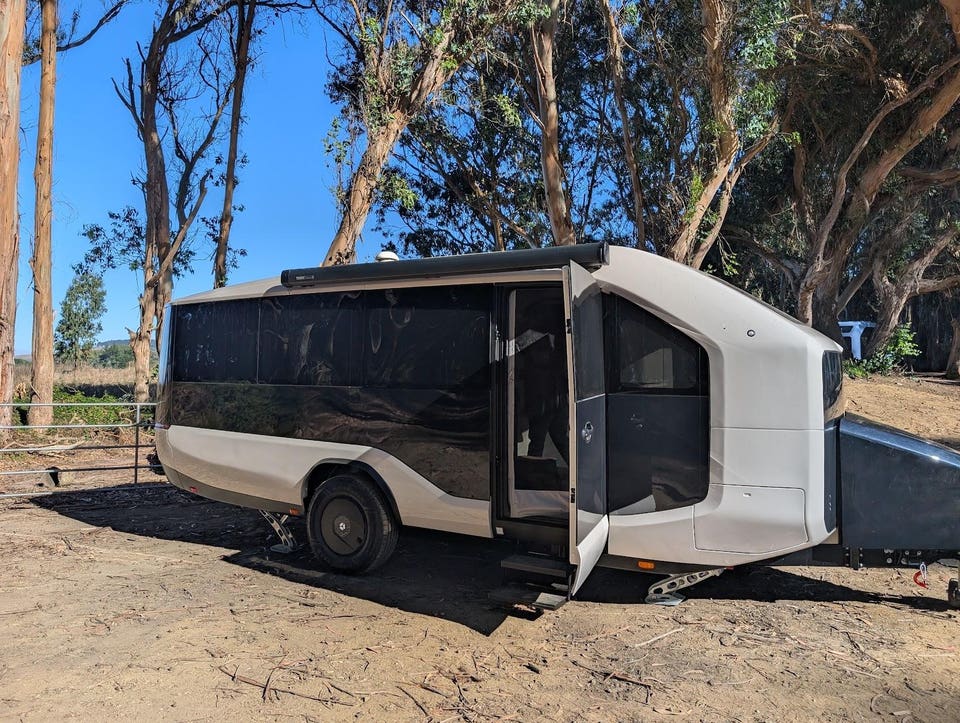
I recently got to spend a night in the Pebble Flow Electric trailer. Several companies are making travel trailer RVs for the electric era, and the Pebble is the first to deliver. The Pebble realizes most of the key advantages of electric design, but has tried to do go beyond, and fix many of the problems and hassles of standard travel trailer life. While the company is new, they’ve done a good job.
In 2019, I outlined a vision of what could be possible in an Electric RV, and was pleased to get positive feedback from the major RV makers. Pebble has made it (and more) real, though all the players have very high-end prices to start. The Flow starts at $159K and goes over $190K with options.
The key features of an electric RV include:
- Electric motors on the wheels, which allow the trailer to propel itself for easier towing load, as well as stabilize itself from sway. They can also move the trailer at low speed for positioning at a campsite and hitching and unhitching.
- A large EV-sized battery which provides power for all that and makes it possible for an EV to tow the trailer without having the range cut in half or worse. On ICE towing vehicles, it can save a lot of gasoline from being burned.
- That battery powers electric appliances, so no propane for heat or the fridge or hot water, and no noisy generator which disrupts the serenity of nature or an RV park. A heat pump provides AC and heating, the range is inductive and there’s constant quiet power for electric appliances like a microwave, air fryer, Starlink and of course your own devices. The 44kWh battery offers enough for several days off-grid if you arrive full, and can be boosted with solar.
- In the Pebble, all sorts of electric features exist, such as windows you can switch from clear to opaque to the outside and in the bathroom, electric auto-leveling and stabilization, a sewage macerator and pump and the auto-hitch. All trailers have an electrical system and electric-powered features, but few go this far.
- Ability to plug the EV into the trailer to recharge the EV, or run other high-power devices, and the ability to power a regular fixed home during a power outage.
- It should be noted more and more RVs today have boosted their batteries, added solar, and switched to electric fridges and other electric appliances. The batteries are much smaller though. Electric fridges are superior and keep cold better than thermal propane-powered ones. (The one in my Pebble was set too strong, and froze the things I put in it overnight, though!)
That’s a lot. For EV owners, the tow assist is the killer app. EVs are superior to gasoline cars on many fronts, but the towing experience is not one of them. It’s not the fault of the EVs, it’s the fault of the trailers, which are big and heavy and add tremendous drag. They cut the range of gasoline tow vehicles almost in half too, but that’s not that big a burden because it’s quick to fill up gasoline, though it’s still very expensive. EV’s are so efficient that the extra burden of a trailer on efficiency is felt much more strongly. Getting 100-150 miles of range can be a trip-killer, and the tow assist reduces that to something you can handle.
That comes at a cost, though. With full tow assist, the trailer’s battery gets eaten up. If you plan to use it to climb a mountain pass and camp at the top, it will be a breeze climing the hill, but you won’t have that big battery to run all your electric features for days. If you go to an RV park it’s not a problem, or if there is charging just before your campsite. Alternately, you can (in the new 2027 model) hook up external solar panels to try to regain that juice.
The tow assist is great, but the gross weight of 6,800lbs (thanks to that battery) rules out all but a few large SUVs and 1/2 ton trucks for towing it due to safety. The tongue weight is, as always, the hidden limit that tow assist can’t fix.

Removing The Pain Points
Pebble didn’t stop at the benefits of electric motors. They set out to see what they could do about most of the things that people don’t like about travel trailer life. The troubles of towing were just the first part. A lot of them were related to the burden of setting up and tearing down a trailer at a campsite. It’s not like a motorhome which you can park and immediately start camping.
- It’s work to position the trailer in the campsite just where you want it. The Pebble’s motors let you drive it with a tablet like an RC car to quickly put it where you want it, and bring it back to your tow vehicle when it’s time to go.
- It’s work to unhitch the trailer and re-hitch it. Pebble uses those motors, along with a camera and some simple EV tools to have the trailer steer itself to position the tongue over the hitch-ball, and lower onto it. Or to lift off and back away. You still have to connect and disconnect chains and weight distribution bars and double check, tough.
- On a non-flat campsite, you must level your trailer. Most people drive one of the wheels onto blocks of various heights until it’s level, then adjust the tongue jack, though that’s often motorized now. The Pebble has its own internal jacks which extend out, so you level it with the press of a button. In addition…
- After you level it, you need to put down further jacks to make sure it doesn’t wobble. Pebble has motorized them and made them automatic. It’s all combined together to happen when you press “Auto Camp” on your control tablet.
- The toilet has a grinder which makes all sewage liquid, so you can drain it through a simple thin hose. They have automated the process of dumping sewage ("black" and “gray” water) so you just insert the hose end into the dump pipe and press a button. The manual process is not that complex, but nobody likes doing it.
Aerodynamics
Pebble cared a lot about aerodynamics. What’s odd is that most trailer vendors don’t, and make a square box that’s terrible. A few vendors do care, and they tend to have waiting lists to buy their trailers. Pebble both attempted for aerodynamic design and put an interesting nose cone on the trailer which can rise during travel to reduce the vortex between the tow vehicle and the trailer that adds a lot of drag. Trailering is hugely expensive in gas because of the poor aerodynamics. People just try to avoid thinking about it.
Pebble’s electric trailer competitor, the Lightship AE.1, does do that one better. Their trailer folds down to half-height for travel. A trailer you can stand up in will have a lot of drag, and there’s nothing to prevent that--except folding. The Lightship loses storage above the counter height as a price. I have yet to see it in person.
Another competitor is the Evotrex. It includes a range-extending generator. For those who want to be purist about fossil fuels, that’s a no-go, but otherwise there’s a lot of merit to it. It’s a big boost to towing range and boondocking (off-grid) time. Unlike a conventional RV generator, you can run the generator at a different time than when you use the power, avoiding noise at night, for example. The Aboard T4 will also have a range extending generator. Of course, nothing prevents taking a portable generator along with the Pebble to supplement the solar, except its fairly modest under-RV storage area.
Other Amenities
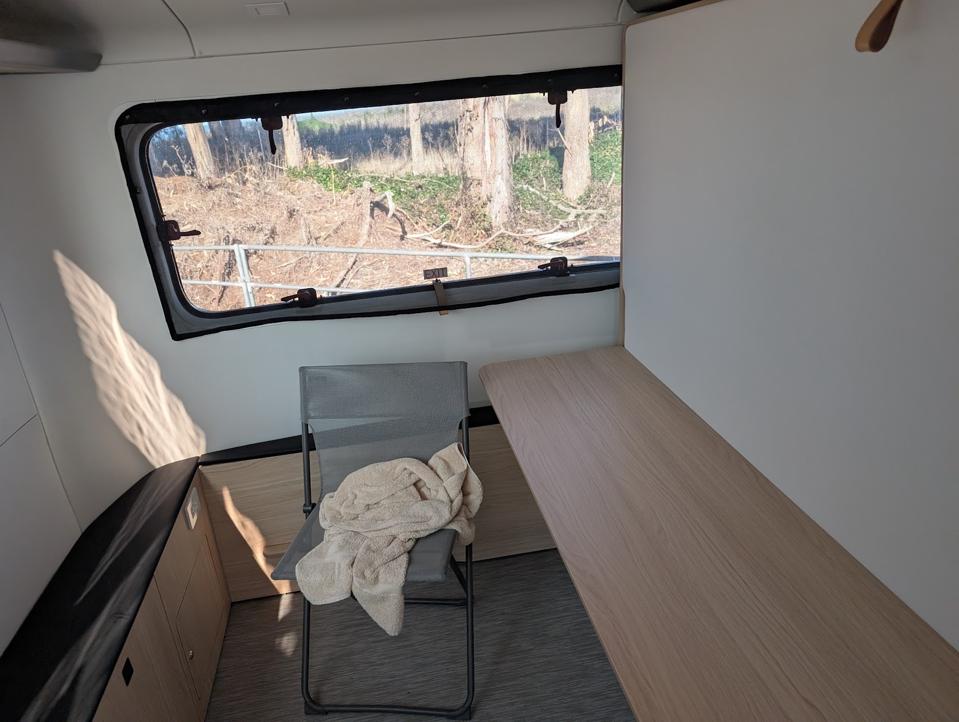
The Pebble comes with a well designed Murphy bed that converts into an office area. Unlike many RV Murphy beds, you can quickly fold it up without bending the mattress or taking off the sheets and blankets (you must store pillows.) Sadly, it takes the whole width of the rear of the trailer, so it must be entered from the bottom and crawled along to get in and out, for both people. I’m one of those who really likes getting in from the side, a challenge in a narrow trailer. An alternate design for 2027 offers two twin beds with storage underneath them, but not the nice office, though you can sit on the beds as daybeds. Pebble reports many owners are using that office as a home office, or the unit as a guest bedroom, when the unit is parked at their home.
The front dinette offers a movable table and as in all RVs, converts to an extra smaller bed. The kitchen/aisle are cramped as is usually the case in trailers with no slide-out. Generally, the various features and amenities are quality as would be expected in a higher-end unit.
About that Price
No question this is an expensive trailer starting at $159K, though there are other high-end trailers in this price range, but there are also ones much cheaper. Sadly, the largest trailer manufacturers have recently seen their quality reputations plummet post-Covid (any online search will quickly find the story.) Most pundits say that even though you can get a reasonably sized and equipped trailer from them for $20,000 to $40,000, the experience may well be a nightmare that isn’t compensated for by those savings. But smaller, quality lines can be had for $40,000 to $80,000. Buyers will need to decide if the Pebble’s electric features justify the price. Pebble is betting that features like their “insta-camp” which make a major change in the camping experience to bring people over. They point out that a large fraction of their customers have never owned an RV before, and are finally coming to the market because they could not get a great experience before at any price. They also report owners are using these trailers many more days than average trailers are, because, they say, they make camping that much more pleasant.
In addition, the trailer will save a lot of gasoline and even enable a no-gasoline trailer trip. Typical trailers and tow vehicles only get 10mph, often less. That’s 400 gallons/year, around $2,000 for the average owner.
Pebble’s challenge is they are a new company. The higher-priced, high-quality trailers in the market have proved their value over decades. You can buy an Airstream, for example, and know it will barely lose any value from depreciation, based on past history, even though it costs double or more what others cost. All these new brands can’t offer that assurance, and the harsh reality is that novel technology products, like the very EVs which presaged the Pebble, are notorious for suffering from fast depreciation. In many cases, not because the products are low quality and wear out, but because there is always hot new generation technology that’s even better. We all toss out perfectly functional cell phones in 2 years, their value gone. That’s not workable with a trailer.
The Pebble is well made, but being new, has a few rough edges. Many of those edges will be fixed with software updates, a practice completely normal in the Pebble’s home of Silicon Valley, but which Tesla had to teach to the traditional companies.
The Future
Many of these features should, with time become cheaper and standard on many trailers. I wonder if the ideal doesn’t blend ideas from all the new players--the Pebble conveniences, the Evotrex range extender, the Lightship folding profile. It could be a path to make RV travel not an ecological and cost extravagance. Later, I will present what may be an even better idea, namely a motorhome (possibly electric) with an electric, 4 wheel steering “toad.” The “toad” is a small, sometimes off-road short range car towed with a motorhome so you don’t have to use your house for road trips around your camping base. When it’s electric it not only is greener and better off-road, it would fix the curse of having a toad, by allow you to easily back up when ever you want.
Originally published at Forbes.com in A Night In A Pebble Electric Trailer Speaks To The Future Of RVs. Copyright © 2026 by Brad Templeton.


Add new comment