


Robocars 2024 In Review: Top Ten Stories And More
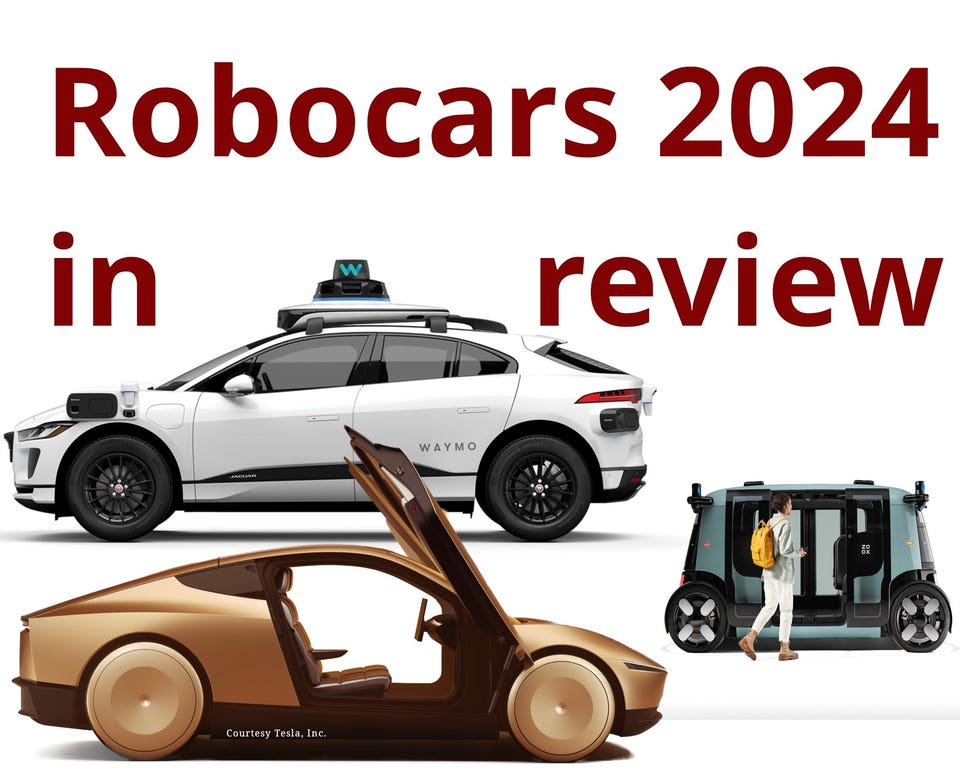
2024 was a year of tumult (again) for the self-driving industry, with growth and success for Waymo and Chinese players, middling results for a few others, and doom for some of the biggest. You can also watch a video version. Let’s count ‘em down:
Honorable Mention: The others
Our top 10 focus on the biggest players, but the next tier had a fair bit of action. Aurora kept improving their trucks and promises real, unmanned operation last year, but the world is now less interested in promises of next year and wants to know what you can really do.
We did see improvements though from them and other trucking players like Kodiak, Gatik and Plus. In China, WeRide announced it will also operate in the UAE and AutoX has been quiet with announcements. Pony, on the other hand, completed an IPO in the USA and said it would quadruple to 1,000 vehicles in 2025. On the other hand, new US laws effectively forbid Chinese cars from operating in the USA.
Israel’s MobilEye both canceled their internal LIDAR work and continued a shift away from planning its own robotaxi offering; it will instead work with partners. One notable partner was Rimac’s Verne dedicated robotaxi service which showed a nice custom robotaxi, but only as a concept.
At #10 was trouble at Motional, the MIT/Singapore based robocar startup that was funded by Hyundai and Aptiv after Aptiv bought it. It’s all Hyundai now, and the CEO/founder left. With the universal trouble at Automaker-based robocar projects, things look dim for Motional, but hope remains that they can pull something together.
At #9 was one of the year’s biggest shutdowns of a major project, as Apple killed its secretive Project Titan after many years. The world’s top tech company will stay out of self-driving, which is a shame as it has resources to match Google and Amazon (which remain in the game) and this takes that level of resources. For Apple, though, they will do just fine either way—in fact a large fraction of the world’s ride hails will still require Apple products to happen.
Nuro is the best funded of the self-driving pure startups, and it had a focus on delivery with its own custom small road-based robots. They’ve dropped that path and now plan to license their self-driving tech (which is one of the very few projects to put vehicles out on the road with nobody on board) to the various OEMs and others who will need it. Meanwhile, trucking companies, including small-truck operator Gatik, continue to focus on delivery, and sidewalk robots are going strong. Starship, a company I helped build, announced reaching 7 million autonomous deliveries, which is more autonomous trips than anybody else, including Waymo—though on sidewalks, not roads.
#7: The rise of new AI techniques has been the tech story of the decade, particularly the application of Google’s “Transformers” to Large Language Models. LLMs don’t just do language, though, they do anything that can be turned into a string of tokens, including the stream of events perceived by a car driving down the road and its future plans. Now every team is using both the deep learning networks of the 2010s as the key tool for perception and LLMs for prediction and planning, if they’re not going all the way to trying an “end to end” network which takes pixels/point clouds in and outputs driving commands. LLM planners are showing powerful abilities at producing natural driving and understanding situations, though they’ve also resulted in some surprising behaviors, including some crashes (though the teams don’t ever admit that.) Some believe in pure neural networks, others have found that they “plateau” and more complex approaches combining several methods are necessary. No pure machine learning vehicle has yet reached the bar of driving on its own without a safety driver.
#6: The Chinese leader is Baidu, which now claims to be doing 75,000 autonomous robotaxi rides per week, with 70-80% having no safety driver. That’s a clear #2 behind Waymo. They also announced their new custom Robotaxi design which they claim they can build for around $28,000 in China, including LIDARs and other extra gear. Shame the USA wants to slap a 100% tariff on imported Chinese EVs and ban Chinese software in them.
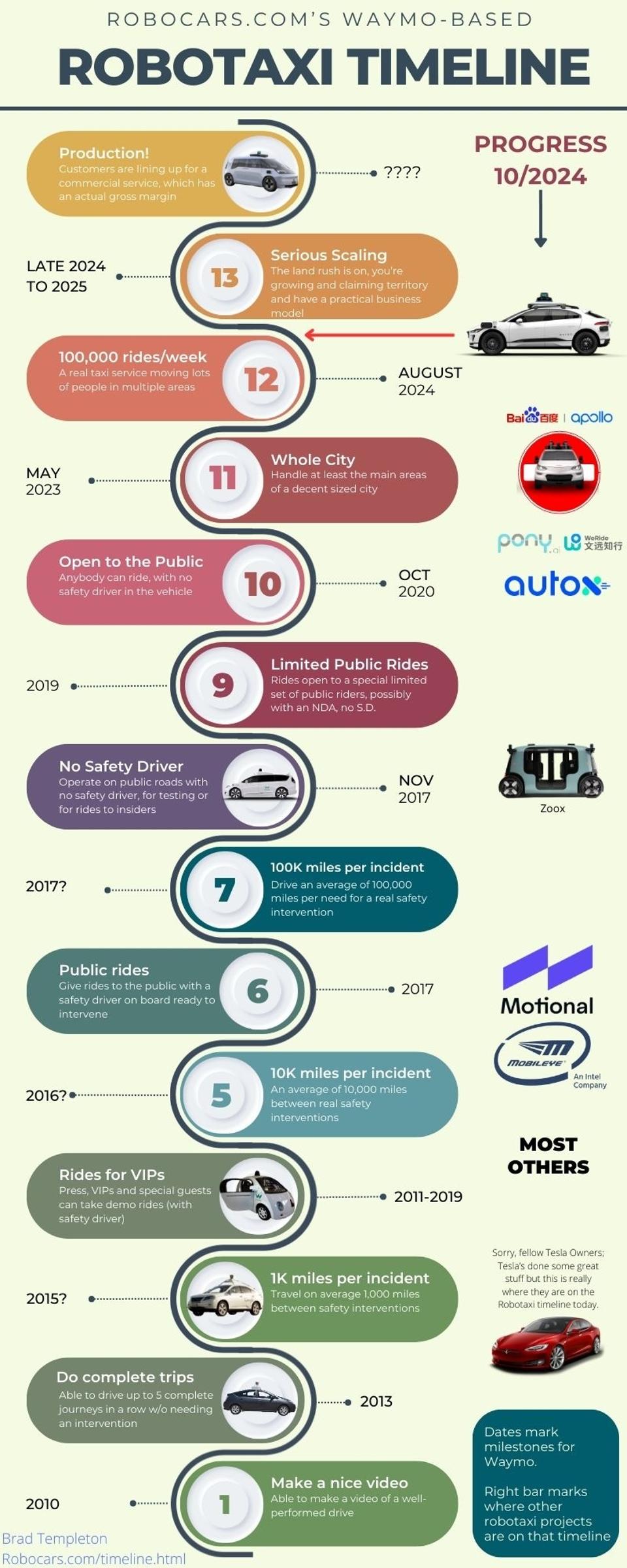
At #5 is Waymo’s growth, which includes doing 4 million autonomous rides in 2024, rising to do 150,000 per week, and expanding to more territory in Los Angeles (with access to the general public) and more in the SF Bay Area, with approval for the whole peninsula. They also announced they will open in 2024 in Atlanta and Austin with a new test relationship with Uber, which will handle ride-hail and depots and fleet management. (Uber is a ride-hail option in Phoenix.) They will also expand to Miami in 2026 with Moove doing depots and the Waymo One app doing exclusive ride-hail. This is the beginning of the long awaited scaling for Waymo. They’ve also published impressive safety data and cemented a clear leadership. This timeline infographic paints their progress and that of their competitors.
At #4, different news for Waymo. They had developed a 6th generation platform to replace the discontinued Jaguar, based on a minivan-like custom robotaxi design from China’s Geely/Zeekr. But US plans for a 100% tariff on Chinese EVs put a big barrier in the way, so Waymo also announced a partnership with Hyundai’s new advanced vehicle group to produce an alternate version of the 6th generation vehicle on top of an Ioniq 5. Tariffs won’t make the Chinese tiger go away for long, though, particularly globally.
#3: Elon Musk, armed with data from Twitter and an estimated quarter billion dollars bought deep influence in the U.S. government by backing the victory of Donald Trump, and being named to a new “Department of Government Efficiency.” That makes his companies, including Tesla, seemingly immune from regulation, which in turn suggests a massive change (and reduction) in regulation of self-driving cars, particularly Tesla FSD. Musk has always said the one thing he could not predict about when his technology would deploy is regulation, but now he practically controls it. Unless Musk gets deregulation only of Tesla, this should be good for all players, except the Chinese.
Musk is already the most distracted CEO in the world, though, and his governmental role won’t make that better.
#2: Tesla always makes news. Their FSD stack has shown significant improvement this year, though it’s still a very long way from being able to operate without supervision, though as he has for the last 7 years, Musk predicts that it will in just one year. Ironically, the rapid progress is a sign the product is still quite immature—a mature product won’t see much visible improvement in its last few years before deployment. If a new version appears much better, it means it was seriously flawed before and surely still is.
The hard reality is that Tesla FSD can complete only a few drives in a row without a problem, while Waymo is doing tens of thousands in a row. Waymo only drives a few cities because that’s the right plan, they could easily drive all cities at a level better than Tesla if that made sense, but it doesn’t.
That made Tesla’s big “We Robot” launch for the Tesla Robotaxi/Cybercab a bit of a non-event, because while the concept cars and van looked nice, the software still has far to go. It showed Tesla’s dedication to being a robotaxi company, and most of the event was Musk evangelizing the reasons—with a speech very similar to the ones I’ve been doing for over a decade.
The top story is a sad one: GM has shut down Cruise’s Robotaxi efforts, and will redirect what’s left of the company to work on ADAS tools for GM’s consumer cars. This wasn’t too shocking. Cruise had gone into semi-hibernation after being kicked off the California streets a year ago, and it put their custom Origin vehicle on the back-burner too. Signs of life were rare, but they kept spending money on the leaner company, which suggested they really wanted to bring it back to life—until they didn’t.
While it’s far from assured, there’s a distinct chance that this shutdown will be marked later in history as the moment GM died, afraid of the future. Yes, it will save money, as will Aptiv, Ford and others. Mercedes just got permission for their highway-only car to go 95 km/h in Germany, so it’s still in the game in a more limited way. Broadly though, the automaker-backed ventures have all faced trouble, though non-traditional automakers like Tesla and the Chinese EV makers aren’t flagging in their enthusiasm.
Of course, GM might be able to rejoin the game by licensing from Nuro or MobilEye or another provider. This was always the likely path for automakers, but leaves them not in control of what will become the most important component of their vehicles, not a place they wanted to be.
It will also be marked that Cruise and Uber, the two projects which have hit pedestrians to serious results, both received the corporate death penalty and were shut down as a result. In this case, the DMV played a large role, surely hastening Cruise’s end by removing them from the streets, in part for that incident. While some question whether robocar projects need more regulation, there’s also a compelling case for less, or at least better regulation, less likely to kill multi-billion dollar projects unless their failings are clear.
We enter 2025 with only Waymo operating a robotaxi service in the west. Zoox planned to open one but has delayed it until next year. May mobility has a limited shuttle service with no staffer on board, but full-time remote supervision. Chinese teams continue to advance. Tesla remains a wild card, many years behind Waymo and the others in safety performance, but trying different and brash approaches with the most unpredictable CEO behind the rudder, able to literally control governments to get his way. The trucking players are eager to go into production and many startups continue their quest.
The shakeout may not even be over, but 2025 will certainly offer interesting times.
Originally published at Forbes.com in Robocars 2024 In Review: Top Ten Stories And More. Copyright © 2024 by Brad Templeton.


Add new comment