Real Estate thoughts
Submitted by brad on Tue, 2007-07-31 15:26A friend asked for advice on selling real estate. I'm no expert, but I thought I would write up some of my thoughts in a blog post for everybody:
Topic:


Brad Templeton is Chairman Emeritus of the EFF, Singularity University founding computing faculty, software architect and internet entrepreneur, robotic car strategist, futurist lecturer, photographer and Burning Man artist.
This is an "ideas" blog rather than a "cool thing I saw today" blog. Many of the items are not topical. If you like what you read, I recommend you also browse back in the archives, starting with the best of blog section. It also has various "topic" and "tag" sections (see menu on right) and some are sub blogs like Robocars, photography and Going Green. Try my home page for more info and contact data.
A friend asked for advice on selling real estate. I'm no expert, but I thought I would write up some of my thoughts in a blog post for everybody:
At this point it seems only people in San Francisco want to see Barry Bonds break Aaron's all time home-run record of 755. He has 753 right now. In San Francisco, the crowds get on their feet every time he gets on deck, and that was even before he got on the cusp of the record. Outside SF, fans boo him, and it's commonly believed that should he tie or break the record in Los Angeles or many other cities, he will get booed for doing it. In SF there is a willing suspension of disbelief.
Something light hearted. I purchased, some time ago, a small Li-Ion battery for external power for my laptop and other devices. These batteries are great, getting down near $100, weighing very little and, with 110 watt-hours, able to keep a laptop going all day at a conference or over most of a transoceanic flight.
This particular battery, made in China, contains one of the more amusing bad-english warnings on the label, though, particularly item #3.

I'm quite impressed with Google's mobile maps application for smartphones. It works nicely on the iPhone but is great on other phones too.
Among other things, it will display live traffic on your map. And I recently saw, when asking it for directions, that it told me that there would be "7 minutes of traffic delay" along my route. That's great.
Ever since the first science fiction about cyberspace (First seen in Clarke's 1956 "The City and the Stars" and more fully in 1976's "Doctor Who: The Deadly Assassin") people have wanted to build online 3-D virtual worlds. Snow Crash gelled it even further for people.
For the fun of it, we joined a line at a local independent bookstore last Friday night to get a copy of Harry Potter and the Deathly Hallows. Here I will first review the series without reference to the final book, and then make some remarks about things that are missing from the series that could be viewed as very minor spoilers, because they refer to things that might have taken place in the final book, but did not -- but for which knowing they did not will not spoil the book in any meaningful way. However, if you want absolutely no knowledge of this sort, stop reading.
Well, this site is at a crawl now because the panorama I assembled of San Francisco in 1971 is on the digg.com front page. If you haven't seen it before it's on the San Francisco page, the panorama of SF from the top of the Bay Bridge in 1971.
In 1978, after finally saving up enough money, I got myself a Commodore PET computer. I became immersed in it, and soon was programming all sorts of things, and learning assembler to make things go really fast. I soon discovered the Toronto Pet User's Group, which grew over time to be perhaps the most prominent Commodore group in the world.
Earlier I wrote about the ability to find you from a DNA sample by noting it's a near match with one of your relatives. This is a concern because it means that if relatives of yours enter the DNA databases, voluntarily or otherwise, it effectively means you're in them too.
For various reasons, a wide variety of otherwise free wifi hotspots require you to go through a login screen. (This is also common of course with for-pay hotspots where you must enter an account or room number.)
We all hate waiting on hold, and we shouldn't have to. But companies don't do a lot to make it easier, do they?
Most people, I presume, when at their desks, put the hold music on speakerphone, and turn it low. The worst hold musics are ones where a human voice breaks in every 30 seconds or so to remind us that "all agents are busy" or tries to convince us to go to the web site or buy something else. These are the worst because we have to perk up and listen to the human voice to make sure it's not the agent finally getting to us.
This idea came to me via Al Chang. I'm shopping for a new smartphone, and I have been dismayed at how hard it is to get just what I want and not pay a huge fee for it. Right now I'm leaning towards the new HTC Mogul, in part because the Sprint SERO offer is just too good to pass up.
However, in the GSM world, one thing that's frustrating is that carriers only provide a limited number of phones, and in some cases, such as the Nokia E62, they actually rip useful features out of the phones before offering them. (The E61 has Wifi, the E62 removes it!) But the subsidy, which can be $200 to $300 is also too rich to pass up if you're signing up for new service. If they are going to force you into a 2 year contract -- which they do for anything, even just a change of plan -- you are foolish not to take this subsidy.
So here's Al's plan. Go out and buy the phone you want, unlocked (or locked to the carrier you plan to use) from whatever source you like, including cell dealers, Amazon, Dell or eBay.
Next go to your carrier's web site and find the most subsidized phone they sell which works with the plan you intend to use. Find the most subsidized phone by looking at the subsidy price, and comparing it to the typical "completed auction" price on eBay for a no-contract (locked or unlocked) phone. It is often the case, by the way, that there are eBay sellers who will sell you phones that cost $200 after subsidy in the carrier's store for $1 because they kick back to you the kickback they get from the carrier for selling you a fancy phone on a fancy plan. (I have not tried these sellers but they generally have top reputations and lots of happy comments from phone buyers so I presume it works. It does not, however, work with SERO.)
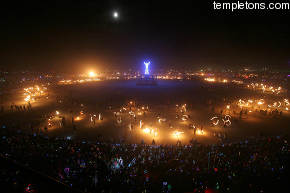
It's way late, but I finally put captions on my gallery of regular-aspect photos from Burning Man 2006.
For much of history, we've used removable media for backup. We've used tapes of various types, floppy disks, disk cartridges, and burnable optical disks. We take the removable media and keep a copy offsite if we're good, but otherwise they sit for a few decades until they can't be read, either because they degraded or we can't find a reader for the medium any more.
Steve Jobs of Apple Computer warned today that a rumoured cheap Chinese iPhone knockoff making its way toward America is an inferior product which lacks many of the important features of the iPhone. "It may look a bit like an iPhone, but when consumers discover all the great iPhone features that are missing from it, we think they'll still line up at Apple Stores for the genuine article," said Jobs in a released statement. Designed by software nerds, the knockoff, dubbed the "myPhone" by fans, has not yet been confirmed.

Apple released a list of features reported to be missing from the "myPhone."
MyPhones are predicted to sell for $350 without contract, $150 with a 2 year contract to the provider of your choice.
Hotels are now commonly sporting flat widescreen TVs, usually LCD HDTVs at the 720p resolution, which is 1280 x 720 or similar. Some of these TVs have VGA ports or HDMI (DVI) ports, or they have HDTV analog component video (which is found on some laptops but not too many.) While 720p resolution is not as good as the screens on many laptops, it makes a world of difference on a PDA. As our phone/PDA devices become more like the iPhone, it would be very interesting to see hotels guarantee that their room offers the combination of:
Earlier I wrote about the frenzy buying Plastation 3s on eBay and lessons from it. There's a smaller scale frenzy going on now about the iPhone, which doesn't go on sale until 6pm today. With the PS3, many stores pre-sold them, and others lined up. In theory Apple/AT&T are not pre-selling, and limiting people to 2 units, though many eBay sellers are claiming otherwise.
The going price for people who claim they have one, either for some unstated reason, or because they are first in line at some store, is about $1100, almost twice the cost. A tidy profit for those who wait in line, time their auction well and have a good enough eBay reputation to get people to believe them. Quite a number of such auctions have closed at such prices with "buy it now." If you live in a town without a frenzy and line it might do you well to go down to pick up two iPods. Bring your laptop with wireless access to update your eBay auction. None of the auctions I have seen have gone so far as to show a picture of the seller waiting in line to prove it.
eBay has put down some hard terms on iPhone sellers and pre-sellers. It says it does not allow pre-sales, but seems to be allowing those sellers who claim they can guarantee a phone. It requires a picture of the actual item in hand, with a non-photoshopped sign in the picture with the seller's eBay name. A number of items show a stock photo with an obviously photoshopped tag. In spite of the publicised limit of 2, a number of people claim they have 4 or more.
It seems Apple may have deliberately tried to discourage this by releasing at 6pm on Friday, too late to get to Fedex in most places. Thus all most sellers can offer is getting the phone Monday, which is much less appealing, since that leaves a long window to learn that there are plenty more available Monday, and loses the all-important bragging rights of having an iPhone at weekend social events. Had they released it just a few hours earlier, I think sales like this would have been far more lucrative. (While Apple would not want to leave money on the table, it's possible high eBay prices would add to the hype and be in their interest.)
As before, I predict timing of auctions will be very important. At this point even a 1 day auction will close after 18 hours of iPhone sales, adding a lot of rish. The PS3 kept its high value for much of the Christmas season, but the iPhone, if not undersupplied, may drop to retail in as little as a day. A standard 1 week auction would be a big mistake. Frankly I think paying $1200 (or a $300 wait-in-line fee) is pretty silly.
The iPhone, by the way, seems like a cool generalized device. A handheld that has the basic I/O tools including GSM phone and is otherwise completely made of touchscreen seems a good general device for the future. Better with a small bluetooth keyboard. Whether this device will be "the one" remains to be seen, of course.
Update:
If you go to the cities of Asia, one thing I find striking is how much more three-dimensional their urban streets are. By this I mean that you will regularly find busy retail shops and services on the higher floors of ordinary buildings, and even in the basement. Even in our business areas, above the ground floor is usually offices at most, rarely depending on walk-by traffic. There it's commonplace. I remember being in Hong Kong and asking natives to pick a restaurant for lunch.
Last week I talked briefly about self-driving delivery vehicles. I've become interested in what I'll call the "roadmap" (pun intended) for the adoption of self-driving cars. Just how do we get there from here, taking the technology as a given? I've seen and thought of many proposals, and been ignoring the one that should stare us in the face -- delivery. I say that because this is the application the DARPA grand challenge is actually aimed at. They want to move cargo without risks to soldiers. We mostly think of that as a path to the tech that will move people, but it may be the pathway.
Robot delivery vehicles have one giant advantage. They don't have to be designed for passenger safety, and you don't have to worry about that when trying to convince people to let them on the road. They also don't care nearly as much about how fast they get there. Instead what we care about is whether they might hit people, cars or things, or get in the way of cars. If they hit things or hurt their cargo, that's usually just an insurance matter. In fact, in most cases even if they hit cars, or cars hit them, that will just be an insurance matter.
A non-military cargo robot can be light and simple. It doesn't need crumple zones or airbags. It might look more like a small electric trike, on bicycle wheels. (Indeed, the Blue Team has put a focus on making it work on 2 wheels, which could be even better.) It would be electric (able to drive itself to charging stations as needed) and mechanically, very cheap.
The first step will be to convince people they can't hit pedestrians. To do that, the creators will need to make an urban test track and fill it with swarms of the robots, and demonstrate that they can walk out into the swarm with no danger. Indeed, like a school of fish, it should be close to impossible to touch one even if you try. Likewise, skeptics should be able to get onto bicycles, motorcycles, cars and hummers and drive right through the schools of robots, unable to hit one if they try. After doing that for half an hour and getting tired, doubters will be ready to accept them on the roads.