Non Forbes

Don't feed the radical right trolls by counter-protesting them

We're all shocked at the idea of a growing neo-Nazi movement, at the horrible attack in Virginia and the lack of condemnation by the President. It's making us forget that the neo-Nazi radical right are trolls with many parallels to online trolls. And the only thing to do is not to feed the trolls, and definitely don't attack the civil rights that they make use of.

A protest march has 3 main functions:

Your eclipse guide (with the things not in many eclipse guides)

I will be heading to western Idaho this weekend to watch my sixth total Eclipse. That makes me a mid-grade eclipse chaser, so let me tell you some important things you need to know, which are not in some of the other eclipse guides out there. For good general sites look at places like NASA's Eclipse Guide which has nice maps or this map.

Totality is everything

The difference between a total solar eclipse and a partial one -- even a 99% partial one -- is literally and metaphorically night and day. It's like the difference between sex and holding hands. They are really two different things with a similar sounding name. And a lunar eclipse is again something vastly different. This does not mean a high-partial eclipse is not an interesting thing, but the total eclipse is by far the most spectacular natural phenomenon visible on this planet. Beyond the Grand Canyon, Yosemite, Norway, etc. So if you can get to totality, get there. Do not think you are seeing the eclipse if you don't get into the zone of totality.

People debate about how deep into totality you want to be

Many people seek to get close to the centerline of the eclipse. This provides the longest eclipse for your area. You will only lose a modest number of seconds if you are within 15 miles of the centerline, so you don't have to get exactly there, and in fact it may be too crowded there.

On the other hand there are those who deliberately get close to the edge, giving up 30-40% of their eclipse time in order to see more "edge effects." Near the edge, the edge effects are longer and a bit more spectacular. In particular the diamond ring will be a fair bit longer, and you may see more prominences and chromosphere for longer. If this is your first eclipse, I am not sure you want to get too close to the edge. But try any of the map web sites that will tell you your duration, and get somewhere that has within 30-40 seconds of the centerline time.

You look at the total eclipse with zero eye protection

You've been hearing endless talk about eclipse glasses and how well made they are. Eclipse glasses are only for the boring partial phase. They give you a way to track the progress of the moon while waiting for the main event. Once totality is over, everybody packs up and does not even bother to watch the 2nd half of the partial eclipse, that's how boring the partial part is.

But don't be one of those people who, told about the danger of eclipses, does not watch totality with your bare eyes. In fact, use binoculars in addition to your naked eyes, and perhaps a short look through a telescope -- but not during the diamond rings or any partial phase.

Update: There is a nice large sunspot group that should still be there on Eclipse day, making the partial phase more interesting to those with good eyesight.

In totality you are looking not at the sun, but its amazing atmosphere -- the "corona" -- full of streamers, and many times the size of the sun or moon. You may also see jets of fire coming off the sun, and at the start and end of totality you will see the hot red inner atmosphere of the sun, known as the chromosphere.

If you are crazy enough to be outside the total zone but close to it, you sadly still can't look with your bare eyes at any part of the eclipse.

There are some cool things in a 99% partial eclipse (which you see just before and after totality.)

An eclipse is most glorious in the sky but a lot of other things happen around it. As it gets very close to total you will see the nature of the sunlight change and become quite eerie. Shadows of trees will turn into collections of crescents. About 20-60 seconds before and after totality, if you have a white sheet on the ground, you will see ripples of light waving, like on the bottom of a giant swimming pool. And the shadow. You will see it approach. If you are up on a mountain or in a plane this will be more obvious. It is going at 1,000 to 2,000 miles per hour.

Topic: 
Tags: 

Many different approaches to Robocar Mapping

Almost all robocars use maps to drive. Not the basic maps you find in your phone navigation app, but more detailed maps that help them understand where they are on the road, and where they should go. These maps will include full details of all lane geometries, positions and meaning of all road signs and traffic signals, and also details like the texture of the road or the 3-D shape of objects around it. They may also include potholes, parking spaces and more.

The maps perform two functions. By holding a representation of the road texture or surrounding 3D objects, they let the car figure out exactly where it is on the map without much use of GPS. A car scans the world around it, and looks in the maps to find a location that matches that scan. GPS and other tools help it not have to search the whole world, making this quick and easy.

Google, for example, uses a 2D map of the texture of the road as seen by LIDAR. (The use of LIDAR means the image is the same night and day.) In this map you see the location of things like curbs and lane markers but also all the defects in those lane markers and the road surface itself. Every crack and repair is visible. Just as you, a human being, will know where you are by recognizing things around you, a robocar does the same thing.

Some providers measure things about the 3D world around them. By noting where poles, signs, trees, curbs, buildings and more are, you can also figure out where you are. Road texture is very accurate but fails if the road is covered with fresh snow. (3D objects also change shape in heavy snow.)

Once you find out where you are (the problem called "localization") you want a map to tell you where the lanes are so you can drive them. That's a more traditional computer map, though much more detailed than the typical navigation app map.

Some teams hope to get a car to drive without a map. That is possible for simpler tasks like following a road edge or a lane. There you just look for a generic idea of what lane markings or road edges should look like, find them and figure out what the lanes look like and how to stay in the one you want to drive in. This is a way to get a car up and running fast. It is what humans do, most of the time.

Driving without a map means making a map

Most teams try to do more than driving without a map because software good enough to do that is also software good enough to make a map. To drive without a map you must understand the geometry of the road and where you are on it. You must understand even more, like what to do at intersections or off-ramps.

Creating maps is effectively the act of saying, "I will remember what previous cars to drive on this road learned about it, and make use of that the next time a car drives it."

Put this way it seems crazy not to build and use maps, even with the challenges listed below. Perhaps some day the technology will be so good that it can't be helped by remembering, but that is not this day.

The big advantages of the map

There are many strong advantages of having the map:

  • Human beings can review the maps built by software, and correct errors. You don't need software that understands everything. You can drive a tricky road that software can't figure out. (You want to keep this to a minimum to control costs and delays, but you don't want to give it up entirely.)
  • Even if software does all the map building, you can do it using arbitrary amounts of data and computer power in cloud servers. To drive without a map you can must process the data in real time with low computing resources.
  • You can take advantage of multiple scans of the road from different lanes and vantage points. You can spot things that moved.
  • You can make use of data from other sources such as the cities and road authorities themselves.
  • You can cooperate with other players -- even competitors -- to make everybody's understanding of the road better.

One intermediate goal might be to have cars that can drive with only a navigation map, but use more detailed maps in "problem" areas. This is pretty similar, except in database size, with automatic map generation with human input only on the problem areas. If your non-map driving is trustworthy, such that it knows not to try problem areas, you could follow the lower cost approach of "don't map it until somebody's car pulled over because it could not handle an area."

Levels of maps

There are two or three components of the maps people are building, in order to perform the functions above. At the most basic level is something not too far above the navigation maps found in phones. That's a vector map, except with lane level detail. Such maps know how many lanes there are, and usually what lanes connect to what lanes. For example, they will indicate that to turn right, you can use either of the right two lanes at some intersections.

Topic: 

Car Rental: Rent me a cooler and lots of other gear for road trips

Something I do from time to time is a road trip in a rental car. And while car rental companies much prefer the business customer who rents a big car at a high price, then just drives it to their meeting and back to the airport, they are not averse to the less profitable road trip business.

So here are some things they could do to make it better for that sort of customer.

Topic: 
Tags: 

Can't we make overbooking more efficient and less painful with our mobile devices?

I've written before about overbooking and how it's good for passengers as well as for the airlines. If we have a service (airline seats, rental cars, hotel rooms) where the seller knows it's extremely likely that with 100 available slots, 20 will not show up, we can have two results:

Topic: 

No, you don't need to drive a billion miles to test a robocar

Earlier I noted that Nidi Kalra of Rand spoke at the AVS about Rand's research suggesting that purely road testing robocars is an almost impossible task, because it would take hundreds of millions to a billion miles of driving to prove that a robocar is 10% better than human drivers.

(If the car is 10x better than humans, it doesn't take that long, but that's not where the first cars will be.)

This study has often been cited as saying that it's next to impossible to test robocars. The authors don't say that -- their claim is that road testing will not be enough, and will take too long to really work -- but commenters and press have taken it further to the belief that we'll never be able to test.

The mistake is that while it could take a billion miles to prove a vehicle is 10% safer than human drivers, that is not the goal. Rather, the goal is to decide that it's unlikely it is much worse than that number. It may seem like "better than X" and "not worse than X" are the same thing, but they are not. The difference is where you give the benefit of the doubt.

Consider how we deal with new drivers. We give them a very basic test and hand them a licence. We presume, because they are human teens, that they will have a safety record similar to other human teens. Such a record is worse than the level for experienced drivers, and in fact one could argue it's not at all safe enough, but we know of no way to turn people into experienced drivers without going through the risky phase.

If a human driver starts showing evidence of poor skills or judgments -- lots of tickets, and in particular multiple accidents, we pull their licence. It actually takes a really bad record for that to happen. By my calculations the average human takes around 20 years to have an accident that gets reported to insurance, and 40-50 years to have one that gets reported to police. (Most people never have an injury accident, and a large fraction never have any reported or claimed accident.)

Topic: 

Uncovered: NHTSA Levels of 1900 (Satire)

I have recently managed to dig up some old documents from the earliest days of car regulation. Here is a report from NHTSA on the state of affairs near the turn of the 20th century.

National Horse Trail Safety Administration (NHTSA)

Regulation of new Horse-Auto-mobile Vehicles (HAV), sometimes known as "Horseless carriages."

In recent years, we've seen much excitement about the idea of carriages and coaches with the addition of "motors" which can propel the carriage without relying entirely on the normal use of horses or other beasts of burden. These "Horseless carriages," sometimes also known as "auto mobile" are generating major excitement, and prototypes have been generated by men such as Karl Benz and Armand Peugeot, along with the Duryea brothers, Ransom Olds and others in the the USA. The potential for these carriages has resulted in many safety questions and many have asked if and how NHTSA will regulate safety of these carriages when they are common.

Previously, NHTSA released a set of 4, and later 5 levels to classify and lay out the future progression of this technology.

Levels of Motorized Carriages

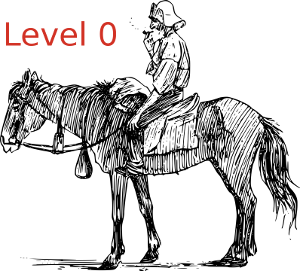
Level 0

Level zero is just the existing rider on horseback.

Level 1

Level one is the traditional horse drawn carriage or coach, as has been used for many years.

Level 2

A level 2 carriage has a motor to assist the horses. The motor may do the work where the horses trot along side, but at any time the horses may need to take over on short notice.

Level 3

In a level 3 carriage, sometimes the horses will provide the power, but it is allowed to switch over entirely to the "motor," with the horses stepping onto a platform or otherwise being raised to avoid working them. If the carriage approaches an area it can't handle, or the motor has problems, the horses should be ready, with about 10-20 seconds notice, to step back on the ground and start pulling. In some systems the horse(s) can be in a hoist which can raise or lower them from the trail.
Level 4

A Level 4 carriage is one which can be pulled entirely by a motor in certain types of terrain or types of weather -- an operating domain -- but may need a horse at other times. There is no need for a sudden switch to the horses, which should be pulled in a trailer so they can be hitched up for travel outside the operating domain.

Level 5

The recently added fifth level is much further in the future, and involves a "horseless" carriage that can be auto mobile in all situations, with no need for any horse at all. (It should carry a horse for off-road use or to handle breakdowns, but this is voluntary.)

Topic: 

News and commentary from AUVSI/TRB Automated Vehicle Symposium 2017

In San Francisco, I'm just back from the annual Automated Vehicle Symposium, co-hosted by the AUVSI (a commercial unmanned vehicle organization) and the Transportation Research Board, a government/academic research organization. It's an odd mix of business and research, but also the oldest self-driving car conference. I've been at every one, from the tiny one with perhaps 100-200 people to this one with 1,400 that fills a large ballroom.

Toyota Research VC Fund

Tuesday morning did not offer too many surprises. The first was an announcement by Toyota Research Institute of a $100M venture fund. Toyota committed $1B to this group a couple of years ago, but surprisingly Gil Pratt (who ran the DARPA Robotics Challenge for humanoid-like robots) has been somewhat a man of mixed views, with less optimistic forecasts.

Different about this VC fund will be the use of DARPA like "calls." The fund will declare, "Toyota would really like to see startups solving problem X" and then startups will apply, and a couple will be funded. It will be interesting to see how that pans out.

Nissan's control room is close to live

At CES, Nissan showed off their plan to have a remote control room to help robocars get out of sticky situations they can't understand like unusual construction zones or police directing traffic. Here, they showed it as further along and suggested it will go into operation soon.

This idea has been around for a while (Nissan based it on some NASA research) and at Starship, it has always been our plan for our delivery robots. Others are building such centers as well. The key question is how often robocars need to use the human assistance, and how you make sure that unmanned vehicles stay in regions where they can get a data connection through which to get help. As long as interventions are rare, the cost is quite reasonable for a larger fleet.

This answers the question that Rod Brooks (of Rethink Robotics and iRobot) recently asked, pondering how robocars will handle his street in Cambridge, where strange things like trucks blocking the road to do deliveries, are frequently found.

It's a pretty good bet that almost all our urban spaces will have data connectivity in the 2020s. If any street doesn't have solid data, and has frequent bizarre problems of any type, yet is really important for traversal by unmanned vehicles -- an unlikely trifecta -- it's quite reasonable for vehicle operators to install local connectivity (with wifi, for example) on that street if they can't wait for the mobile data companies to do it. Otherwise, don't go down such streets in empty cars unless you are doing a pickup/drop-off on the street.

Switching Cities

Karl Iagenemma of nuTonomy told the story of moving their cars from Singapore, where driving is very regulated and done on the left, to Boston where it is chaotic and done on the right.

Topic: 

Pages