Non Forbes

The super simple and cheap car of the future

With Mobility on Demand, you don't buy a car, you buy rides. That's certainly Uber's plan, and is a plan that makes sense for Google, Apple and other no-car companies. But even Daimler, with Car2Go/Car2Come, BMW with DriveNow and GM with Lyft plan to sell you a ride rather than a car, because it's the more lucrative thing to do.

So what does that car of the future look like? There is no one answer, because in this world, the car that is sent to pick you up is tailored to your trip. The more people traveling, the bigger the car is. If your trip does not involve a highway, it may not be a car capable of the highway. If your trip is up to a mountain cabin, it's more like an SUV, but you never use an SUV to go get a bottle of milk the way we do today. If it's for a cruise to the beach on a sunny day, the roof may have been removed at the depot. If it's for an overnight trip to a country home, it may be just beds.

I outlined many of these changes in this article on design changes in cars but today I will focus on the incredibly cheap and simple design of what should become the most common vehicle made, namely the car designed for a short urban trip by one person. That's 80% of trips and around 45% of miles, so this should be a large fraction of the fleet. I predict a lot of these cars will be made every year -- more than all the cars made today, even though they are used as taxis and shared among many passengers. What does it look like?

Small

A car for 1-2 people will be small. It will probably be around 1.5m wide, narrow enough that you can fit two in a lane, and have it park very efficiently when it has to wait. If it's for just one person, it won't be very long either. For two people, there will be a "face to face" configuration which is longer and an "tandem" configuration which is a bit shorter. The 2 person vehicles aren't a lot bigger or heavier than the one person, so they might be the most common cars, since you can serve a solo rider fairly efficiently with one, even if not perfectly efficient.

A car that is so narrow can't corner very fast. A wide stance is much more stable. There are a few solutions to that, including combinations of these:

  • The wheels bank independently, allowing the vehicle to lean like a motorcycle when in corners. This is the best solution, but it costs some money.
  • Alternately it's a two wheeler, which is also able to lean, but has other tricks like the LIT Motors C-1 to stay upright.
  • It's electric, and has all the batteries in the floor, giving it a very low center of gravity. (One extreme example of this is the Tango, which uses lead batteries deliberately to give it that stability.)
  • It never goes on fast roads, so it never needs to corner very fast, and its precision robot driving assures it never corners so fast as to become unstable, and it plans its route accordingly.

Not super aerodynamic

The car already has a big win when it comes to aerodynamic drag by only being half-width. The non-highway version probably gives back a bit of that because you don't need to worry as much about that if you are not going fast. Energy lost to drag goes up with the square of velocity. So a 30mph car has 1/4 the drag of a 60mph car, and 1/8th the drag of a similar car of full width. The highway car needs to be shaped as close to a "teardrop" as you can, but the city car can get away with being a bit taller for more comfortable seating and entry/exit.
Topic: 

Politics: Leave 2nd amendment to the states, and never say the word "Trump"

Political debate is going overboard these days. I travel overseas all the time and if I reveal I live in the USA, you can't stop people from asking about Trump. It's getting frustrating and boring. But to avoid contentious topics, let's talk about guns!

Topic: 

Elon Musk feels we live in a "simulation" -- if so, should we Occupy Mars?

Elon Musk likes to say pretty controversial things off the cuff, and so do I, but he inspired a number of threads by saying at Re:Code that there's a billion to one chance we're living in base reality. To use his word, this world is almost surely a "simulation."

Topic: 

Let the policymakers handle the "trolley" problems

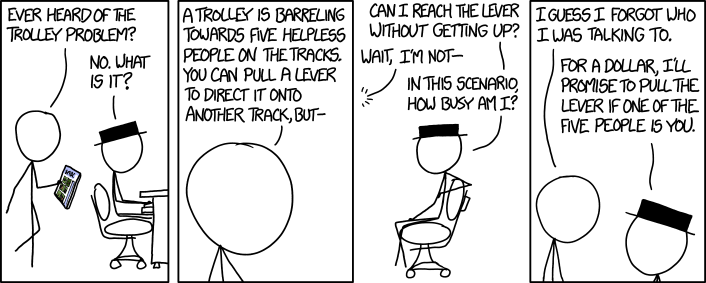
When I give talks on robocars, the most common question, asked almost all the time, is the one known as the "trolley problem" question, "What will the car do if it has to choose between killing one person or another" or other related dilemmas. I have written frequently about how this is a very low priority question in reality, much more interesting to philosophy classes than it is important. It is a super-rare event and there are much more important everyday ethical questions that self-driving car developers have to solve long before they will tackle this one.

In spite of this, the question persists in the public mind. We are fascinated and afraid of the idea of machines making life or death decisions. The tiny number of humans faced with such dilemmas don't have a detailed ethical debate in their minds; they can only go with their "gut" or very simple and quick reasoning. We are troubled because machines don't have a difference between instant and carefully pondered reactions. The one time in billions of miles(*) that a machine faces such a question it would presumably make a calculated decision based on its programming. That's foreign to our nature, and indeed not a task desired by programmers or vendors of robocars.

There have been calls to come up with "ethical calculus" algorithms and put them in the cars. As a programmer, I could imagine coding such an algorithm, but I certainly would not want to, nor would I want to be held accountable for what it does, because by definition, it's going to do something bad. The programmer's job is to make driving safer. On their own, I think most builders of robocars would try to punt the decision elsewhere if possible. The simplest way to punt the decision is to program the car to follow the law, which generally means to stay in its right-of-way. Yes, that means running over 3 toddlers who ran into the road instead of veering onto the sidewalk to run over Hitler. Staying in our lane is what the law says to do, and you are not punished for doing it. The law strongly forbids going onto the sidewalk or another lane to deliberately hit something, no matter who you might be saving.

We might not like the law, but we do have the ability to change it.

Thus I propose the following: Driving regulators should create a special panel which can rule on driving ethics questions. If a robocar developer sees a question which requires some sort of ethical calculation whose answer is unclear, they can submit that question to the panel. The panel can deliberate and provide an answer. If the developer conforms to the ruling, they are absolved of responsibility. They did the right thing.

The panel would of course have people with technical skill on it, to make sure rulings are reasonable and can be implemented. Petitioners could also appeal rulings that would impede development, though they would probably suggest answers and describe their difficulty to the panel in any petition.

The panel would not simply be presented with questions like, "How do you choose between hitting 2 adults or one child?" It might make more sense to propose formulae for evaluating multiple different situations. In the end, it would need to be reduced to something you can do with code.

Very important to the rulings would be an understanding of how certain requirements could slow down robocar development or raise costs. For example, a ruling that car must make a decision based on the number of pedestrians it might hit demands it be able to count pedestrians. Today's robocars may often be unsure whether a blob is 2 or 3 pedestrians, and nobody cares because generally the result is the same -- you don't want to hit any number of pedestrians. Likeways, requirements to know the age of people on the road demands a great deal more of the car's perception system than anybody would normally develop, particularly if you imagine you will ask it to tell a dwarf adult from a child.

Topic: 
Tags: 

How much can customers test robocars (and also I'm on Dateline: NBC tonight)

Reports from Tesla suggest they are gathering huge amounts of driving data from logs in their cars -- 780 million miles of driving, and as much as 100 million miles in autopilot mode. This contrasts with the 1.6 million miles of test operations at Google. Huge numbers, but what do they mean now, and in the future?

Topic: 

Tesla Crash, Declaration of Amsterdam, Automaker services and much more Robocar news

Here is the first report of a real Tesla autopilot crash. To be fair to Tesla, their owner warnings specify fairly clearly that the autopilot could crash in just this situation -- there is a stalled car partly in the lane, and the car in front of you swerves around it, revealing it with little time for you or the autopilot to react.

The deeper issue is the way that the improving quality of the Tesla Autopilot and systems like it are lulling drivers into a false sense of security. I have heard reports of people who now are trusting the Tesla system enough to work while being driven, and indeed, most people will get away with this. And as people get away with it more and more, we will see more people driving like this driver, not really prepared to react. This is one of the reasons Google decided not to make a system which requires driver takeover ever. As the system gets better, does it get more dangerous?

Some technical notes:

  • This is one of the things LIDAR is much more reliable at seeing than cameras. Of course, whether you can swerve once the LIDAR sees it is another matter.
  • On the other hand, this is where radar fails. I mean the stalled car is clear on radar, but it's stationary, so you can't tell it from the road or guardrail which are also stationary.
  • This is one of the classic V2V value propositions, but it's not a good one. You don't need 10ms latency to have a stalled car tell you it is stalled. Far better that car report to a server that it's stalled and for everybody coming down that road to learn it, whether they have line of sight radio to the stall, or V2V at all. Waze already reports this just with human manual reporting and that's a really primitive way to do it.

Declaration of Amsterdam

Last month, various EU officials gathered in Amsterdam and signed the Declaration of Amsterdam which outlines a plan for normalizing EU laws around self-driving cars. The meeting also included a truck automation demo in the Netherlands and a self-drive transit shuttle demonstration. It's a fairly bland document, more an expression of the times, and it sadly spends a lot of time on the red herring of "connected" vehicles and V2V/V2I, which governments seem to love, and self-driving car developers care very little about.

Let's hope the regulatory touch is light. The reality is that even the people building these vehicles can't make firm pronouncements on their final form or development needs, so governments certainly can't do that, and we must be careful of attempts to "help" that hinder. We already have a number of examples of that happening in draft and real regulations, and we've barely gotten started. For now, government statements should be limited to, "let's get out of the way until people start figuring out how this will actually work, unless we see somebody doing something demonstrably dangerous that can't be stopped except through regulations." Sadly, too many regulators and commentators imagine it should be, "let's use our limited current knowledge to imagine what might go wrong and write rules to ban it before it happens."

Speech from the Throne

It was a sign of the times when her Majesty the Queen, giving the speech from the throne in the UK parliament, laid out some elements of self-driving car plans. The Queen drove jeeps during her military days, and so routinely drives herself at her country estates, otherwise she would be among the set of people most used to never driving.

The UK has 4 pilot projects in planning. Milton Keynes is underway, and later this year, a variation of the Ultra PRT pods in use at T5 of Heathrow airport -- they run on private tracks to the car park -- will go out on the open road in Greenwich. They are already signing up people for rides.

Car companies thinking differently

In deciding which car companies are going to survive the transition to robocars, one thing I look for is willingness to stop thinking like a traditional car company which makes cars and sells them to customers. Most car company CEOs have said they don't plan to keep thinking that way, but what they do is more important than what they say.

Topic: 

Uber begins more active testing. Lyft will sell rides

Uber has announced the official start of self-driving tests in Pittsburgh. Uber has been running their lab for over a year, and had various vehicles out there mapping and gathering data, but their new vehicle is sleeker and loaded with sensors - more than on Google's cars or most of the other research cars I have seen. You can see several lidars on the roof and bumpers, and a seriously big array of cameras and other sensors.

Topic: 

Otto and self-driving trucks -- what do they mean?

Today sees the un-stealthing of a new company called Otto which plans to build self-driving systems for long haul trucks. The company has been formed by a skilled team, including former members of Google's car team and people I know well. You can see their opening blog post

My entire focus on this blog, and the focus of most people in this space, has been on cars, particularly cars capable of unmanned operation and door-to-door service. Most of those not working on that have had their focus on highway cars and autopilots. The highway is a much simpler environment so much easier to engineer, but it operates at higher speeds so the cost of accidents is worse.

That goes doubly true for trucks that are fast, big and massive. At the same time, 99% of truck driving is actually very straightforward -- stay in a highway lane, usually the slow one, with no fancy moving about.

Some companies have done exploration of truck automation. Daimler/Freightliner has been testing trucks in Nevada. Volvo (trucks and cars together) has done truck and platooning experiments, notably the Sartre project some years ago. A recent group of European researchers did a truck demonstration in the Netherlands, leading up to the Declaration of Amsterdam which got government ministers to declare a plan to modify regulations to make self-driving systems legal in Europe. Local company Peloton has gone after the more tractable problem of two-truck platoons with a driver in each truck, aimed primarily at fuel savings and some safety increases.

Safety

While trucks are big and thus riskier to automate, they are also risky for humans to drive. Even though truck drivers are professionals who drive all day, there are still around 4,000 killed every year in the USA in truck accidents. More than half of those are truck drivers, but a large number of ordinary road users are also killed. Done well, self-driving trucks will reduce this toll. Just as with cars, companies will not release the systems until they believe they can match and beat the safety record of human drivers.

The Economics

Self-driving trucks don't change the way we move, but they will have a big economic effect on trucking. Driver pay accounts for about 25-35% of the cost of truck operation, but in fact early self-driving won't take away jobs because there is a serious shortage of truck drivers in the market -- companies can't hire enough of them at the wages they currently pay. It is claimed that there are 50,000 job openings unfilled at the present time. Truck driving is grueling work, sometimes mind-numbing, and it takes the long haul driver away from home and family for over a week on every long-haul run. It's not very exciting work, and it involves long days (11 hours is the legal limit) and a lot of eating and sleeping in truck stops or the cabin of the truck.

Average pay is about 36 cents/mile for a solo trucker on a common route. Alternately, loads that need to move fast are driven by a team of two. They split 50 cents/mile between them, but can drive 22 hours/day -- one driver sleeps in the back while the first one takes the wheel. You make less per mile per driver, but you are also paid for the miles you are sleeping or relaxing.

A likely first course is trucks that keep their solo driver who drives up to 11 hours -- probably less -- and have the software drive the rest. Nonstop team driving speed with just one person. Indeed, that person might be an owner-operator who is paying for the system as a businessperson, rather than a person losing a job to automation. The human would drive the more complex parts of the route (including heavy traffic) while the system can easily handle the long nights and sparse heartland interstate roads.

The economics get interesting when you can do things that are expensive for human drivers and teams. Aside from operating 22 or more hours/day at a lower cost, certain routes will become practical that were not economic with human drivers, opening up new routes and business models.

The Environment

Computer driven trucks will drive more regularly than humans, effectively driving in "hypermile" style as much as they can. That should save fuel. In addition, while I would not do it at first, the platooning experimented with by Peloton and Sartre does result in fuel savings. Also interesting is the ability to convert trucks to natural gas, which is domestic and burns cleaner (though it still emits CO2.) Automated trucks on fixed routes might be more willing to make this conversion.

Road wear

There is strong potential to reduce the damage to roads (and thus the cost of maintaining them, which is immense and seriously in arrears) thanks to the robotruck. That's because heavy trucks and big buses cause almost all the road wear today. A surprising rule of thumb is that road damage goes up with the 4th power of the weight per axle. As such an 80,000lb truck with 34,000lb on two sets of 2 axles and 6,000lb on the front axle does around 2,000 times the road damage of a typical car!

Topic: 

Pages