Non Forbes

People get carsick as passengers? Shocking!

Earlier this week I was sent some advance research from the U of Michigan about car sickness rates for car passengers. I found the research of interest, but wish it had covered some questions I think are more important, such as how carsickness is changed by potentially new types of car seating, such as face to face or along the side.

Topic: 

Hugo awards suborned, what can or should be done?

Since 1992 I have had a long association with the Hugo Awards for SF & Fantasy given by the World Science Fiction Society/Convention. In 1993 I published the Hugo and Nebula Anthology which was for some time the largest anthology of current fiction every published, and one of the earliest major e-book projects. While I did it as a commercial venture, in the years to come it became the norm for the award organizers to publish an electronic anthology of willing nominees for free to the voters.

This year, things are highly controversial, because a group of fans/editors/writers calling themselves the "Sad Puppies," had great success with a campaign to dominate the nominations for the awards. They published a slate of recommended nominations and a sufficient number of people sent in nominating ballots with that slate so that it dominated most of the award categories. Some categories are entirely the slate, only one was not affected. It's important to understand the nominating and voting on the Hugos is done by members of the World SF Society, which is to say people who attend the World SF Convention (Worldcon) or who purchase special "supporting" memberships which don't let you go but give you voting rights. This is a self-selected group, but in spite of that, it has mostly manged to run a reasonably independent vote to select the greatest works of the year. The group is not large, and in many categories, it can take only a score or two of nominations to make the ballot, and victory margins are often small. As such, it's always been possible, and not even particularly hard, to subvert the process with any concerted effort. It's even possible to do it with money, because you can just buy memberships which can nominate or vote, so long as a real unique person is behind each ballot.
The nominating group is self-selected, but it's mostly a group that joins because they care about SF and its fandom, and as such, this keeps the award voting more independent than you would expect for a self-selected group. But this has changed.

The reasoning behind the Sad Puppy effort is complex and there is much contentious debate you can find on the web, and I'm about to get into some inside baseball, so if you don't care about the Hugos, or the social dynamics of awards and conventions, you may want to skip this post.

Topic: 

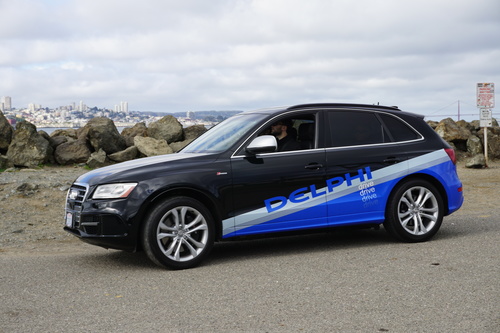
Delphi completes trans-continental drive, and Hyundai goes big

Most of the robocar press this week has been about the Delphi drive from San Francisco to New York, which completed yesterday. Congratulations to the team. Few teams have tried to do such a long course and so many different roads. (While Google has over a million miles logged in their testing by now, it's not been reported that they have done 3,500 distinct roads; most testing is done around Google HQ.)

Topic: 

Delphi's cross-country trip and a raft of Robocar News

I've been on the road, and there has been a ton of news in the last 4 weeks. In fact, below is just a small subset of the now constant stream of news items and articles that appear about robocars.

Delphi has made waves by undertaking a road trip from San Francisco to New York in their test car, which is equipped with an impressive array of sensors. The trip is now underway, and on their page you can see lots of videos of the vehicle along the trek.

The Delphi vehicle is one of the most sensor-laden vehicles out there, and that's good. In spite of all those who make the rather odd claim that they want to build robocars with fewer sensors, Moore's Law and other principles teach us that the right procedure is to throw everything you can at the problem today, because those sensors will be cheap when it comes time to actually ship. Particularly for those who say they won't ship for a decade.

At the same time, the Delphi test is mostly of highway driving, with very minimal urban street driving according to Kristen Kinley at Delphi. They are attempting off-map driving, which is possible on highways due to their much simpler environment. Like all testing projects these days, there are safety drivers in the cars ready to intervene at the first sign of a problem.

Delphi is doing a small amount of DSRC vehicle to infrastructure testing as well, though this is only done in Mountain View where they used some specially installed roadside radio infrastructure equipment.

Delphi is doing the right thing here -- getting lots of miles and different roads under their belt. This is Google's giant advantage today. Based on Google's announcements, they have more than a million miles of testing in the can, and that makes a big difference.

Hype and reality of Tesla's autopilot announcement

Telsa has announced they will do an over the air upgrade of car software in a few months to add autopilot functionality to existing models that have sufficient sensors. This autopilot is the "supervised" class of self driving that I warned may end up viewed as boring. The press have treated this as something immense, but as far as I can tell, this is similar to products built by Mercedes, BMW, Audi and several other companies and even sold in the market (at least for traffic jams) for a couple of years now.

The other products have shied away from doing full highway speed in commercial products, though rumours exist of it being available in commercial cars in Europe. What is special about Tesla's offering is that it will be the first car sold in the US to do this at highway speed, and they may offer supervised lane change as well. It's also interesting that since they have been planning this for a while, it will come as a software upgrade to people who bought their technology package earlier.

UK project budget rises to £100 million

What started with a £10 million pound prize has grown in the UK has become over 100m in grants in the latest UK budget. While government research labs will not provide us with the final solutions, this money will probably create some very useful tools and results for the private players to exploit.

MobilEye releases their EyeQ4 chip

MobilEye from Jerusalem is probably the leader in automotive machine vision, and their new generation chip has been launched, but won't show up in cars for a few years. It's an ASIC packed with hardware and processor cores aimed at doing easy machine vision. My personal judgement is that this is not sufficient for robocar driving, but MobilEye wants to prove me wrong. (The EQ4 chip does have software to do sensor fusion with LIDAR and Radar, so they don't want to prove me entirely wrong.) Even if not good enough on their own, ME chips offer a good alternate path for redundancy

Chris Urmson gives a TeD talk about the Google Car

Talks by Google's team are rare -- the project is unusual in trying to play down its publicity. I was not at TeD, but reports from there suggest Chris did not reveal a great deal new, other than repeating his goal of having the cars be in practical service before his son turns 16. Of course, humans will be driving for a long time after robocars start becoming common on the roads, but it is true that we will eventually see teens who would have gotten a licence never get around to getting one. (Teems are already waiting longer to get their licences so this is not a hard prediction.)

The war between DSRC and more wifi is heating up.

2 years ago, the FCC warned that since auto makers had not really figured out much good to do with the DSRC spectrum at 5.9ghz, it was time to repurpose it for unlicenced use, like more WiFi.

There is now a bill to force this being proposed.

Topic: 

How to avoid a pilot suicide

After 9/11 there was a lot of talk about how to prevent it, and the best method was to fortify the cockpit door and prevent unauthorized access. Every security system, however, sometimes prevents authorized people from getting access, and the tragic results of that are now clear to the world. This is likely a highly unusual event, and we should not go overboard, but it's still interesting to consider.

(I have an extra reason to take special interest here, I was boarding a flight out of Spain on Tuesday just before the Germanwings flight crashed.)

Topic: 

What colour is the dress? It's both.

Perhaps by now you are sick of the dress that 3/4 people see as "white and gold" and 1/4 people see as "dark blue and black." If you haven't seen it, it's easy to find. What's amazing is to see how violent the arguments can get between people because the two ways we see it are so hugely different. "How can you see that as white????" people shout. They really shout.

There are a few explanations out there, but let me add my own:

Topic: 

Uber price in LA approaches robocar cheap

I was recently considering the price of UberX in Los Angeles. It's gotten disturbingly low:

Flag drop: $0 18 cents/minute 90 cents/mile

This is not a very good deal for the driver. After Uber's 20% cut, that's 72 cents/mile. According to AAA, a typical car costs about 60 cents/mile to operate, not including parking. (Some cars are a bit cheaper, including the Prius favoured by UberX drivers.) In any event, the UberX driver is not making much money on their car.

Pages