Non Forbes

Will Robocars vastly increase battery life?

We know electric cars are getting better and likely to get popular even when driven by humans. Tesla, at its core, is a battery technology company as much as it's a car company, and it is sometimes joked that the $85,000 Telsa with a $40,000 battery is like buying a battery with a car wrapped around it. (It's also said that it's a computer with a car wrapped around it, but that's a better description of a robocar.) (Update: Since this article was written, the cost of the Tesla battery has dropped to closer to $20,000.)

Facebook makes less than $10/user, can we find alternatives to advertising?

Facebook's ARPU (average revenue per user, annualized) in the last quarter was just under $10, declining slightly in the USA and Canada, and a much lower 80 cents in the rest of the world. This is quite a bit less than Google's which hovers well over $40.

Tags: 

Google not hitting Delphi, going to Austin -- Vislab sold

The press were all a-twitter about a report from Reuters that there had been a near miss between Delphi's test car and one of Google's though it was quickly denied that anything happened

The situation described, one car cutting off another, was a very unlikely one for several reasons:

Topic: 

Just a couple more days to apply for our exponential tech startup incubator

At Singularity University, our students have been forming interesting ventures after the class for the past 6 years. This fall, we'll also be starting an SU Startup Accelerator for nascent startups working on exponential technology to solve the world's biggest problems. We will be accelerating both for-profit ventures (for the world's greatest problems can also be the greatest opportunities) and $50K grants for non-profit efforts.

Replacing E-mail: The calendar as communications tool

I want to begin a series of thoughts on how E-mail has failed us and what we should do about it.

Yes, E-mail has failed, and not, as we thought, because it got overwhelmed with spam. There is tons of spam but we seem to be handling it. The problem might be better described as "too much signal" rather than the signal/noise ratio. There are three linked problems:

Topic: 

Don't be fooled by robots falling down at Darpa Robotics Challenge

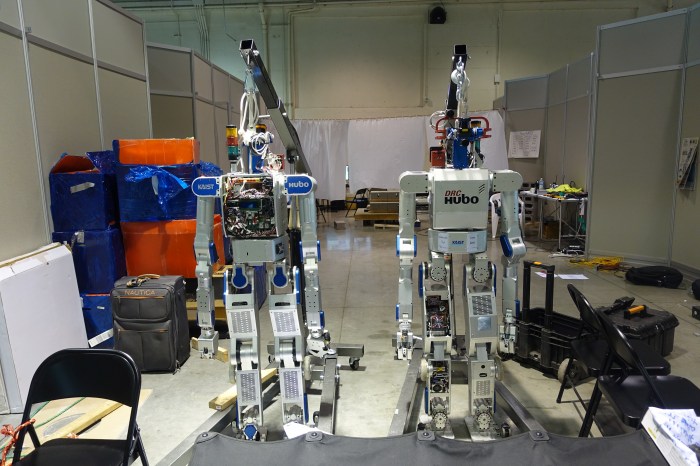
This weekend I went to Pomona, CA for the 2015 DARPA Robotics Challenge which had robots (mostly humanoid) compete at a variety of disaster response and assistance tasks. This contest, a successor of sorts to the original DARPA Grand Challenge which changed the world by giving us robocars, got a fair bit of press, but a lot of it was around this video showing various robots falling down when doing the course:

What you don't hear in this video are the cries of sympathy from the crowd of thousands watching -- akin to when a figure skater might fall down -- or the cheers as each robot would complete a simple task to get a point. These cheers and sympathies were not just for the human team members, but in an anthropomorphic way for the robots themselves. Most of the public reaction to this video included declarations that one need not be too afraid of our future robot overlords just yet. It's probably better to watch the DARPA official video which has a little audience reaction.

Don't be fooled as well by the lesser-known fact that there was a lot of remote human tele-operation involved in the running of the course.

Check out my Gallery of Photos from the DARPA Robotics Challenge Finals.

What you also don't see in this video is just how very far the robots have come since the first round of trials in December 2013. During those trials the amount of remote human operation was very high, and there weren't a lot of great fall videos because the robots had tethers that would catch them if they fell. (These robots are heavy and many took serious damage when falling, so almost all testing is done with a crane, hoist or tether able to catch the robot during the many falls which do occur.)

We aren't yet anywhere close to having robots that could do tasks like these autonomously, so for now the research is in making robots that can do tasks with more and more autonomy with higher level decisions made by remote humans. The tasks in the contest were:

  • Starting in a car, drive it down a simple course with a few turns and park it by a door.
  • Get out of the car -- one of the harder tasks as it turns out, and one that demanded a more humanoid form
  • Go to a door and open it
  • Walk through the door into a room
  • In the room, go up to a valve with circular handle and turn it 360 degrees
  • Pick up a power drill, and use it to cut a large enough hole in a sheet of drywall
  • Perform a surprise task -- in this case throwing a lever on day one, and on day 2 unplugging a power cord and plugging it into another socket
  • Either walk over a field of cinder blocks, or roll through a field of light debris
  • Climb a set of stairs

The robots have an hour to do this, so they are often extremely slow, and yet to the surprise of most, the audience -- a crowd of thousands and thousands more online -- watched with fascination and cheering. Even when robots would take a step once a minute, or pause at a task for several minutes, or would get into a problem and spend 10 minutes getting fixed by humans as a penalty.

Google Accidents and Deployment, Mercedes Trucks and more

Some headlines (I've been on the road and will have more to say soon.)

Google announces it will put new generation buggies on city streets

Google has done over 2.7 million km of testing with their existing fleet, they announced. Now, they will be putting their small "buggy" vehicle onto real streets in Mountain View. The cars will stick to slower streets and are NEVs that only go 25mph.

Topic: 

Pages