


New NTSB report is out -- with damning information on Uber's fatal robocar crash
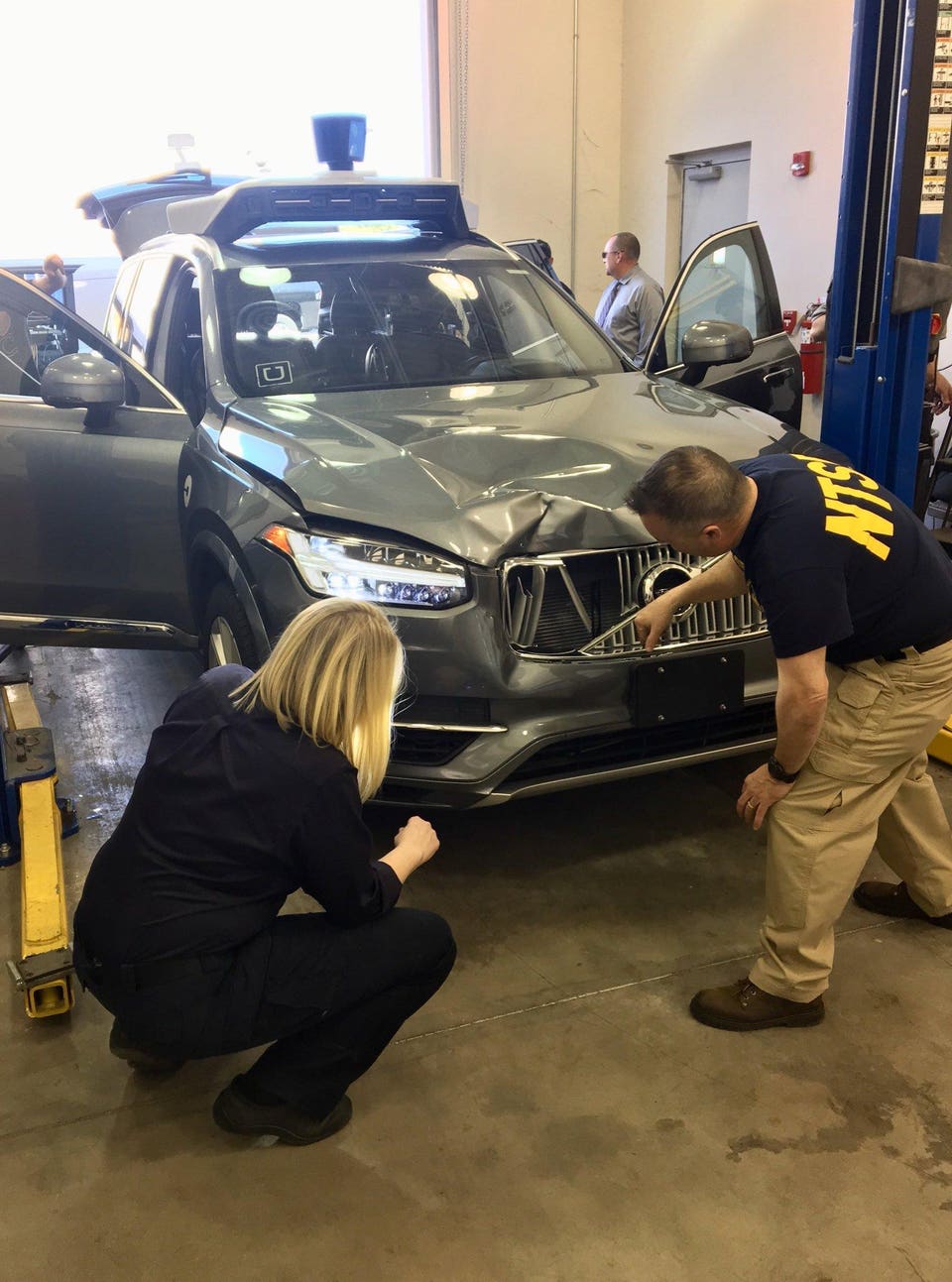
I have written extensive coverage of the March, 2018 fatality involving an Uber test robocar and the death of Elaine Herzberg in Tempe Arizona. On Nov 19, the NTSB will hold its hearing on its investigation, but preliminary documents already reveal that Uber’s errors were even worse than already reported.
Uber’s vehicle was a prototype, and like all prototypes other than Waymo’s near-release vans, it is only operated on public roads under the supervision of a “safety driver.” All vehicles in prototype phase regularly encounter problems which require the safety driver to take control to prevent an accident, especially in their early days. That is not surprising or even particularly dangerous when you have a good safety driver protocol and good safety drivers. Uber had neither – they selected bad safety drivers, and only had one in the vehicle where all similar teams use two. Worse, their safety driver, in complete abrogation of her assigned duties, was allegedly ignoring the road and watching a video on her phone at the time of the incident. The core blame remains there.
The new documents, however, disclose a system which was in a poorer state than expected, and which should not have been deployed with just one safety driver, and, I will declare for the first time, in many ways should not even have been deployed with two – though in all other teams, two-safety-driver operation has an excellent safety record.
The core issues
We now have a better view of the mistakes here. I will rank them in the order of blame that should be assigned to them, with the new revelations in bold:
- Safety driver ignoring road and allegedly watching video
- Only having one safety driver instead of two
- Poor decisions in the hiring and training of safety drivers
- General poor safety culture at Uber ATG
- Possible special tuning of “false positive” thresholds due to VIP demo
- System forgetting past information when it changes how it classifies something on the road, spoiling path predictions
- Delay of one second before sounding alarm in urgent situations
- Decision to not allow emergency braking with high deceleration
- Bad predictions for future path of perceived “cyclist”
- Pedestrian crossing the road at signs indicating not to cross there, and not watching the road while she jaywalks.
Not ranked (but discussed below): Disabling of built in Volvo emergency braking system.
No pedestrians outside crosswalks
Correction: This report previously indicated one source of problems was an inability of the Uber system to classify objects as a pedestrian outside of crosswalks. This is not the case, however, the Uber system never did classify her as a pedestrian for other reasons. They do have a flaw regarding how they predict the path of pedestrians outside of crosswalks – but this never played a role in this accident, and has been fixed.
The key system in a robocar for safety is the perception system, which begins by receiving sensor data and attempting to understand it. The key task is to split the observed world up into different surfaces and objects (known as obstacles if they might be in your way) and identify what they are, how they are moving, and where they are likely to go. The prediction is really important, and classifying them helps a lot with predicting where they might go. If their predicted path might intersect your path, that’s of top concern. Due to this mistake, Uber’s car took far too long to decide there was a danger of collision, and it also failed in handling that realization.
The system struggled to classify Herzberg. Because she was in the left turn lane, the first classification from just radar, a full 5.6 seconds out, was that she was probably a stopped vehicle. You don’t concern yourself with vehicles stopped in the left turn lane when you are turning right.
Quickly thereafter, the LIDAR came in and considered her an “other,” which is also expected at this sort of range, and on your first LIDAR observation you don’t know how things are moving. That needs several observations. (Radar doesn’t tell you how things are moving across your path, only how they move to or away from you.) This mistake was surprising, but the technical reason for the accident was not this, so much as the next flaw...
Forgetting the past
Over the next few seconds, the system alternately classified her as a vehicle or an “other.” A second and larger flaw in Uber’s systems was that when an object got reclassified, it forgot everything it had learned up to then from past trajectory points. Each time it changed thinking on what she was, it ignored the most important fact, that she was walking across the road, and going to enter the Uber’s lane. Perhaps if it had stuck with one classification, it might have built a better prediction for what the unknown object was doing and predicted the risk of collision.
Reclassifying obstacles is fairly common in robocar systems. In vision based systems, it is not at all uncommon to see obstacles “flicker” as the system identifies them in one frame and not in the next frame. This is normally fine because we know that obstacles don’t vanish and reappear, and conclusions can be combined across several frames by remembering the past. Classifications may vary and converge as data get better, too. But you must remember the past to deal with this issue.
As such, this is actually a worse problem than the refusal to classify pedestrians outside of crosswalks. All systems do misclassifications, most commonly deciding something is unknown. It is OK if you don’t know a pedestrian is a pedestrian if you still track them and notice their path. The big mistake was not being unable to understand her as a pedestrian, it was not realizing that, “whatever this is, it’s moving across the street and is likely to come into our lane and be hit by us.”
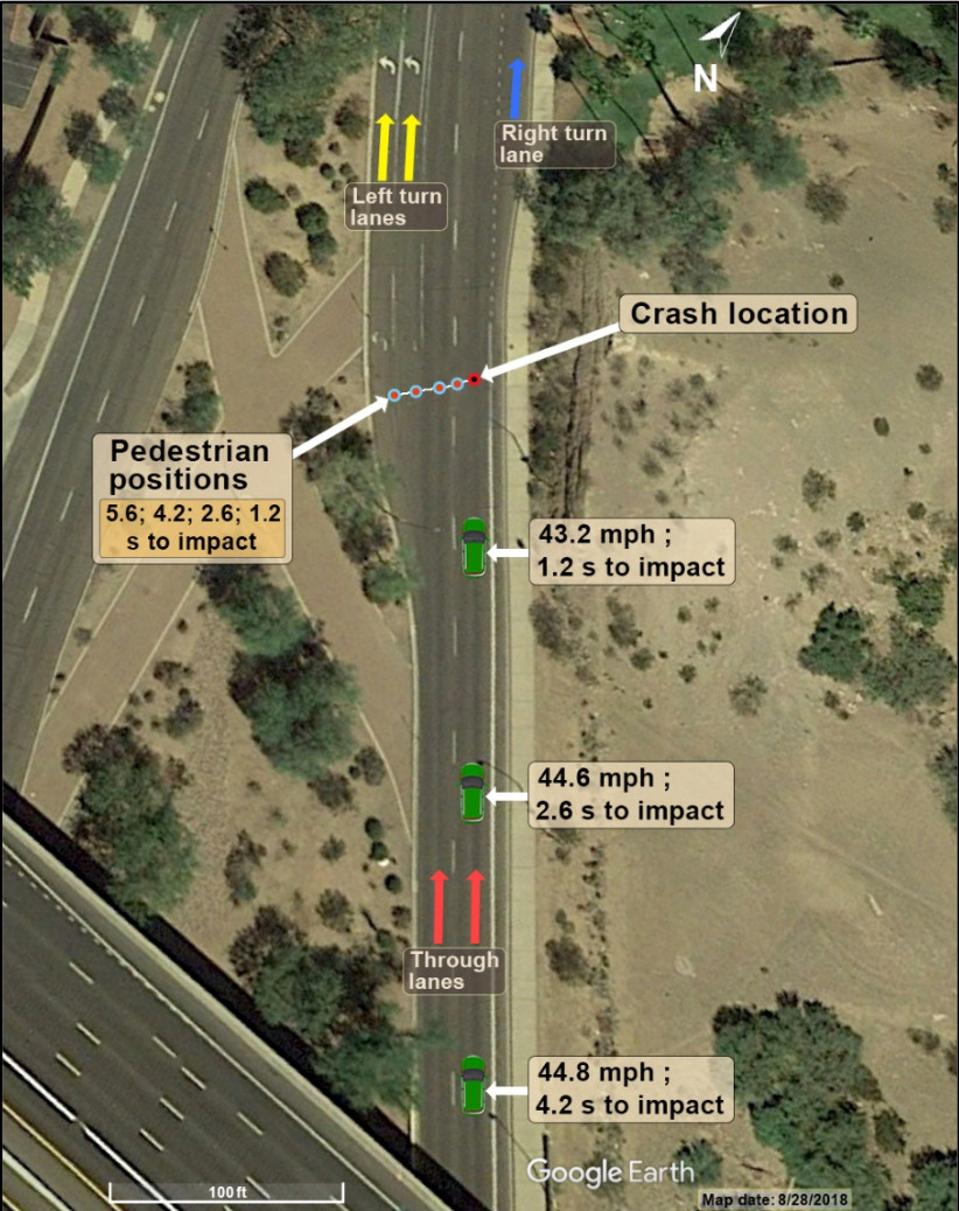
At 2.6 seconds out, the classifier thought she was a bicyclist. She was indeed walking a bicycle. Again, with no history, her path was unknown. Oddly, after another LIDAR frame she was classed as moving along the lane to the left of the Uber car. This may be because the system doesn’t expect bicycles to be going sideways in the middle of a traffic lane, which would be another error. Either way, it isn’t until 1.5 seconds out that the system (switching to Unknown again) realizes she is coming into the Uber’s lane. Correctly, it plots to swerve around her.
The fatal moment comes at 1.2 seconds out. She is reclassified as a bicyclist and in the path of the vehicle. The swerving plan no longer can help. It’s time to do an emergency braking. It’s really time.
Action suppression
Unfortunate, another serious design flaw comes into play. Uber’s system, like many prototype systems, often sees sensor “ghosts” which are not there, and wants to brake for them. A car which is constantly braking for ghosts isn’t usable. You can tune your system to help deal with this. If you tune it to be paranoid and brake for everything, it’s not usable. If you tune it to be lax it might not brake for something real, which is even worse. It’s hard to find the right balance, and you actually can’t find it in a prototype. This is one of the reasons you have safety drivers in your car – their job is to use human judgment to make sure the dangerous flaw – not braking for something real – doesn’t happen because the human hits the brakes. Of course, the human has to have eyes on the road and be ready, not watching a video.
In order to leave this decision to the safety driver, Uber’s car, when making a very sudden decision to brake, waits one second to give the human driver time to do the job. After one second, it does two things: It sounds an alarm, and it initiates its own braking.
It’s not clear why Uber would wait for one second to sound the alarm. It’s also a clear flaw that the system treated this as a new and sudden problem when in fact it had been tracking her for over 4 seconds. It’s more clear why it would wait to activate the brakes with a longer time window. This is how the emergency braking system found in many cars works – first let the driver brake, then give an audible warning, then apply the brakes automatically if they don’t act. Such a delay is less reasonable in a self-driving car once it has passed the point of “collision inevitable.”
It didn’t initiate its own braking, even after the one second not just because such braking could now do very little, but because Uber’s fear of braking for ghosts had led them to forbid the system to do super hard brake jabs. Any situation requiring super hard braking was supposed to be up to the safety driver.
There has been speculation from earlier reports and leaks that Uber added additional delays because the system was indeed braking for ghosts too much, and they had some very important demo rides for the new CEO coming up. If you give a demo ride and it brakes for ghosts, that’s very bad. It’s not necessarily bad to do this in a demo ride for a VIP, because you know that during the VIP ride you will have extra diligent safety drivers who will manually brake if it’s needed. You are being dishonest with your VIP, of course, and not showing them the true quality of your systems, but you aren’t putting the public at risk if you have those diligent safety drivers. Uber did not just do this for the CEO, though, they had this delay present during routine safety driving in the weeks before, which was a serious error.
What about the cameras?
The NTSB report says almost nothing about Uber’s array of cameras and their computer vision systems, as though they played no role in the perception. This needs further examination.
One safety driver
As noted earlier, Uber had decided, again for unknown reasons, to switch from having 2 safety drivers per vehicle to having just one. This was clearly a premature switch – while Waymo did this some time ago, their project is much more advanced. The reason for this is baffling. In well-funded robocar development projects, it is usually the number of vehicles that limits the amount of testing you can do, not the number of people available to work safety driving, or the cost of hiring twice as many safety drivers. This should not have been a time for cost saving. With two safety drivers you not only get to have two sets of eyes on the road (thought the second driver does this only from time to time) you also get the social dynamic of having two co-workers. With two in the car, it’s unlikely the second safety driver (known as the software operator) would have tolerated the main driver watching a video.
And, as noted, the one driver did allegedly ignore her duties and watch a video. Without that, none of this would have happened, it should be clear. Safety drivers aren’t perfect of course, but in other teams, the record seems to show they provide a level of safety similar to other humans driving cars. Of course, there are many human drivers who fiddle with phones on the road today, and they often end up in accidents.
Volvo Emergency Braking
There has been controversy around the fact that Uber disabled the Volvo’s built in “automatic emergency braking” and warning functions. This is a fairly common practice in robocar development. You are building a vastly more sophisticated emergency braking and warning system into your robocar, with much better sensors and logic. It makes sense not to also use the much more primitive system that comes with the car. You don’t want the car to have two masters, to have two different systems braking the car. If that system has false positives it stops you from testing what yours does.
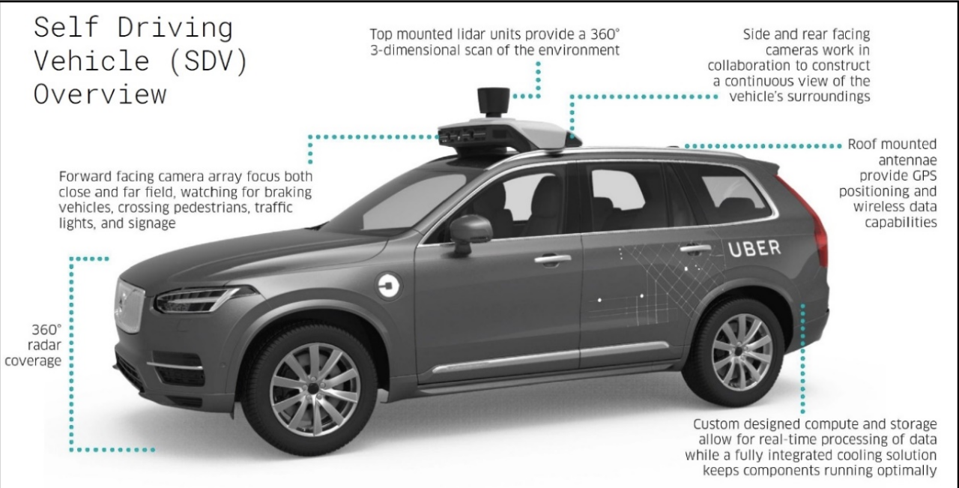
It is possible that this common thinking should be reconsidered, however. The existing systems are indeed more primitive, but that means they are also simpler. It may be that a better course is to find a way to feed their outputs through the robocar system, so that it has the ability to deliberately override them when it needs to. The audible alarm should never be disabled, except when you want to do a fake demo for a VIP and don’t care too much about how honest you are.
In fact, the report says that Uber has re-enabled the Volvo system and had no problems with it, though they also are doing very minimal operations.
Uber’s fate
Uber was immediately kicked out of Arizona by the governor, and they stopped all testing in all their testing centers. Since then, they have resumed test track operations and mapping and shadow driving operations with humans always in control of the vehicles. They want to return to doing full testing of course, and are doing some of it in Pittsburgh.
Uber quickly settled with the family of the victim – perhaps they will now feel it was too quickly. Because the victim was jaywalking, Uber’s liability under the vehicle code was low – she had the duty to yield right of way to the car. Another section of the vehicle code requires drivers to do their best not to hit pedestrians even when the car has the right of way. Uber was probably in violation of that but police did not elect to pursue this.
The safety driver is still at legal risk for her negligence.
Uber has, apparently, fixed all the things that went wrong in this case, including the flaws in the safety culture at the company. This exact accident will not happen again, and it’s pretty likely that these sorts of flaws will happen again. That might be cause to bless their return to the roads.
Alternately, society, through laws and public pressure, might want to tell Uber to take its cars and go home, shutting down their self-drive project, giving them no chance for improvement and redemption. This would send a strong signal to all teams that they can’t have this level of things going wrong, though it would have to be clear that you need a lot going wrong, because there will certainly be other accidents in future, and all of them will have complex causes and things which went wrong, though hopefully not as wrong as this.
I suspect the industry and other teams might welcome this “death penalty” because Uber has definitely tarnished the entire industry and eroded public trust and support for what is a very important and eventually life saving technology. Uber’s departure would actually help restore some of that trust. At the same time, they might fear that less negligent activity could also invoke a team death penalty, and thus become too conservative. As much as we don’t want accidents, we don’t want the teams to be too conservative on the path to eventual massive life saving. Each year that deployment is delayed will result in the death of hundreds of thousands of people at the hands of drivers who did not have the opportunity to give up the wheel and make their trip more safely in a robocar.
Uber’s stockholders of course will want to avoid the end of their project. Uber is correct that self-driving will be the core issue governing the future of their company. On the other hand, Uber today does not own or operate cars, it just sells rides (it claims it doesn’t even do that, just hooking up riders and drivers.) It can continue that business in a world where it connects riders to other people’s robocars. That is, if the business of middleman continues to be the keystone role in hailed transportation, which is a big if.
Originally published at Forbes.com in New NTSB Reports On Uber Fatality Reveal Major Errors By Uber. Copyright © 2019 by Brad Templeton.


Comments
Jason
Wed, 2019-11-06 14:44
Permalink
What about the cameras?
Great analysis. I am confused about the cameras. The report says that there were 10 cameras; that they were used for object identification; that the pedestrian can be seen clearly and that you can tell the bike had no reflectors, she did not look towards the vehicle etc. But Table 1 shows no camera identification at all. This seems like yet another system failure?
brad
Wed, 2019-11-06 15:19
Permalink
a good question
It says the near range cameras were not in use, but nothing else.
To see in this lighting environment, you would want HDR cameras, which it doesn't say they do. Without HDR, she would probably be pretty dark until in the streetlight. No mention of classifier using the camera.
Doggydogworld
Wed, 2019-11-06 16:04
Permalink
Cameras, indeed
A guy cruised N. Mill Avenue a few days after the incident. Impact point is at 35 seconds (not 33 as his comment says): video
He never replied to questions about type of camera or low light setting, but I've heard others say it's well lit and this video is much closer to what a driver sees than the extremely dark Uber dashcam video released shortly after the crash. Overhead illumination is significant, note how the headlight pattern on the road is barely visible in some areas.
It's hard to believe Uber's cameras couldn't detect a pedestrian with this much overhead lighting.
brad
Wed, 2019-11-06 18:41
Permalink
HDR or not
It was decently lit and a human and properly exposed camera can see things. However, a basic camera set to either show the shadows or show the highlights could fail on the other. This is why HDR is now considered important.
Jim Melendy
Thu, 2019-11-07 23:20
Permalink
They need aggressive testing
Don't they test these things by creating situations that might be difficult to analyze? Seems like they didn't try hard enough at that phase of development. Also, no expecting pedestrians outside of crosswalks is ludicrous. Sooner or later, there will be a pedestrian crossing at almost every point of a street. There are even pedestrians crossing freeways. I have seen pedestrians cross just thirty feet from a crosswalk at a light. No good will come of trying to predict pedestrian behavior.
brad
Fri, 2019-11-08 09:42
Permalink
Testing and peds
Teams are doing aggressive testing. Uber's car was much more immature than would be expected. You do try to predict pedestrians. If you don't, you can't drive, and humans do it all the time.
Jan Tångring
Fri, 2019-11-08 02:56
Permalink
Pedestrians only appear in crosswalks?
”Uber’s system for classifying things on the road acted as though pedestrians only appear in crosswalks”
On what do you base this claim?
The report says, for example: ”pedestrians outside a vicinity of a crosswalk are also not assigned an explicit goal. However, they may be predicted a trajectory based on the observed velocities, when continually detected as a pedestrian”
This implies that objects can be classified as pedestrians outside of crosswalks.
brad
Fri, 2019-11-08 09:31
Permalink
Good point
I think many have concluded this because the system kept refusing to classify her as a pedestrian in her location
brad
Fri, 2019-11-08 15:22
Permalink
The report says
"The system never classified her has a pedestrian ... the system desisgn did not include a consideration for jaywalking pedestrians."
Jan Tångring
Wed, 2019-11-20 17:56
Permalink
A Chesterfield sofa
This discussion is now moot, which is nice – I knew there was something fishy about this!
Actually there was an even more unambiguous wording in the report: ”According to Uber ATG, the SDS did not have the capability to classify an object as a pedestrian unless that object was near a crosswalk”
On the other hand, at the meeting yesterday Ensar Becic just as unambiguously stated: ”at the time of the crash the AVS could detect pedestrians but it would not give them an inherent goal of jaywalking”.
This does not seem consistent. I think we have to consider that the NTSB staff got some stuff wrong in their report.
I am not sure that we still actually know what was going in inside that ADS. I have some theories, but I don't want to add to the confusion. At least this is true: detecting a pedestrian — no quotation marks — and attaching the label ”pedestrian” to an object are two different things.
What would the usual classification of a person leading a bike at a crosswalk be — a ”bike” or a ”pedestrian”? From a pattern matching perspective I think ”bike” sounds like the category that would get the higher score of those two options. A ”bike” would never be just a bike. It would be a bike and a person sitting on the bike or leading it. It would not be ok to run over it.
In NTSB:s report Elaine is always (?) refered to as a ”pedestrian” but a self driving system might attach to her the label ”bike” – and that could be ok, I think.
Anyway, the reclassification and resets was the real problem. As a pedestrian I would not mind being classified as a ”bike”, an ”other” or a ”Chesterfield sofa”, as long as the ADS keeps track of me and does not run me over.
brad
Thu, 2019-11-21 11:52
Permalink
Cyclist
That's why I call it cyclist. A pedestrian walking a bike might be considered a different thing. They move at the speed of a pedestrian but are much less likely to be able to change direction instantly, though they can still do it by picking up the bike. Pedestrians walking bikes do not tend to appear in the traffic lanes the way cyclists do, but the way pedestrians do. So they act 95% like pedestrians. It seems likely that Uber did not have pedestrian-walking-bike as a classification.
I think the answer given in questions is the correct answer. That uber would not identify a pedestrian outside a crosswalk was a very strange idea. That it would not assign the road crossing goal outside the crosswalk makes more sense, even though it's also wrong.
FKA
Fri, 2019-11-08 05:37
Permalink
How did they know it wasn't a crosswalk?
Over-reliance on maps?
Over-reliance on bad maps, at that. If you're going to map crosswalks, you should also map non-crosswalks where people frequently cross.
Maybe they didn't even try to map crosswalks. Does it say in the report?
brad
Fri, 2019-11-08 09:30
Permalink
Mapping crosswalks
Legally there is a crosswalk at every intersection, even if not marked, unless crossing is explicitly forbidden. So it's not the kind of thing that changes often in maps.
Mapping places where people are likely to cross is not a bad idea (and exactly the sort of thing only mapping is likely to give you with reliability) but it remains true that you have the right of way there and pedestrians are expected to yield to you, and you are expected to yield to pedestrians in crosswalks.
If you see a pedestrian outside a crosswalk, of course you must work to not hit them. But drivers pay attention to people on sidewalks who appear to be about to enter a crosswalk, while we largely ignore people walking on the side of the road outside crosswalks or on the sidewalk there, unless they give strong signals of crossing.
FKA
Fri, 2019-11-08 11:07
Permalink
Right of way
Looking at driving in terms of who has the right of way is almost always the wrong type of thinking. Particularly when dealing with pedestrians, but almost always.
Mapping is not bad. Relying on maps is bad. A map makes a great input into a neural network. The neural network can then decide "is this a crosswalk" or not. Sure, if the map says there's a crosswalk, that evidence that there's a crosswalk. If someone is crossing the roadway there without paying attention to traffic, that's also strong evidence that there's a crosswalk, even if the map says there isn't.
And in the end, it really doesn't matter if there's a crosswalk or not. Sure, there are some cases where you could have software 1.0 rules like "pay attention to people on sidewalks who appear to be about to enter a crosswalk." Or you can feed the map into a neural net along with everything else and ask the software 2.0 question: "How likely is this pedestrian to cross in front of me?"
I'd go with the latter.
brad
Fri, 2019-11-08 15:13
Permalink
A subject of debate
MobilEye is arguing, through their RSS approach, that cars should drive within the legal ROW envelope, even though it might be less safe, because this is the way to permit cars the aggression needed to survive in cities like Jerusalem where they are based. Yes, RSS says that ROW is given, not taken, but it also lets you assert it.
The reality though, is we humans treat crosswalks (particularly marked ones) differently than we treat open road, and robots are likely to do the same.
Yes, maps are just one piece of data, and you believe your sensors over a map. (Though it is also possible for a map to say, "don't believe your sensors here" sometimes.)
FKA
Sat, 2019-11-09 10:24
Permalink
A debate on which MobilEye is wrong
MobilEye's approach is horribly misguided and utterly dangerous.
Sometimes humans treat marked crosswalks differently than open road. Sometimes they don't. As for unmarked crosswalks, it is rare for humans to even know about them.
Is it useful to map crosswalks? Sure. I'd probably go about it by mapping sidewalks (complete with paved vs unpaved designations), which would implicitly map unmarked crosswalks, and then additionally mapping any crosswalk markings. But the only use for that I can think of would be when approaching a crosswalk from a significant distance where it's too far to see it with the cameras and/or other sensors.
You say you believe your sensors over a map. Then, in parentheses, you point out why that's wrong. You don't believe your sensors over a map or your map over your sensors. Both are factors, the relationship between them is highly complex and situation-dependent, and in my opinion the proper way to deal with this is to feed both into the neural network. Not to hand-code rules about when to believe one and when to believe another.
One, of the several mistakes by Uber, apparently was making related decisions (is this a pedestrian, and is this a crosswalk) in separate decision-making units.
In all of this, I don't see why you need the rules of the road to predict behavior. The rules of the road will be understood implicitly by the neural network. Software 2.0.
(Yes, you need many of the rules of the road, at least in rough form, along with several rules of ethics, in order to make the driving decisions; at least until AI is much more advanced. But your suggestion earlier was that you need the rules of the road to determine whether or not a pedestrian is likely to cross in front of you. No! The rules of the road - the real rules of the road - the de facto rules of the road - are implicit in training the neural network.)
brad
Sat, 2019-11-09 11:30
Permalink
Rules of the road
The rules of the road are indeed not just coded into the law. For legal risk reasons, you have to understand which ones are in the law, but that doesn't mean you only understand the law.
We don't yet have machine learning based AI able to understand the written and unwritten rules to the safety level necessary. Perhaps some day we will. Until that day, you need other approaches.
The rules of the road sufficient for safe operation are actually not impossible to encode. Just because they are not written down by the government does not mean you can't write them down.
FKA
Sat, 2019-11-09 13:48
Permalink
...are mostly not that important
I'm not sure if we have machine learning based AI able to understand the written and unwritten rules to the safety level necessary yet. But I do think some basic rules should be explicitly coded and enforced for the foreseeable future.
That's not the tricky part, though. The tricky part is how to know what to do when the rules are contradictory.
Is it possible to write down all the laws? Well, I'd say that it isn't, because the way I'd define the law (something is illegal if and only if a judge would say it's illegal) it can only be known probabilistically (for many situations, for instance where a statute is broken but you have an arguable legal excuse, whether or not a judge would find you guilty can only be guessed at). It is possible to build a machine that can make superhuman guesses - a better than human judge of the law. Whether or not that qualifies as "writing down the law," I don't know, but moreover, I'm not sure what the point is. You don't have to be an expert at motor vehicle law in order to drive. A basic understanding of the most important laws is enough, especially when combined with real-world experience about how things actually work in the real world.
--
Here's an example: A California statute says, "A vehicle shall be driven as nearly as practical entirely within a single lane and shall not be moved from the lane until such movement can be made with reasonable safety."
How do you code that? What does "as nearly as practical" mean? What are the exceptions? What is "reasonable safety"?
I think it's much more feasible to build a neural network to answer those questions than it is to code them by hand. It's still not easy. Self-driving cars are going to be very hard to make. But trying to hand-code these kinds of rules is a fool's errand.
Add new comment