


Everybody's focused on "sharing" -- is it actually the right first path?
There’s been a received truth in some robocar communities — that the key value comes when vehicles are shared. There are two meanings of shared. The first, which everybody agrees is good, is sharing like Zipcar or taxis — many people use the same vehicle at different times in the day. We should just call this taxi service to avoid confusion with true ride sharing or carpooling.
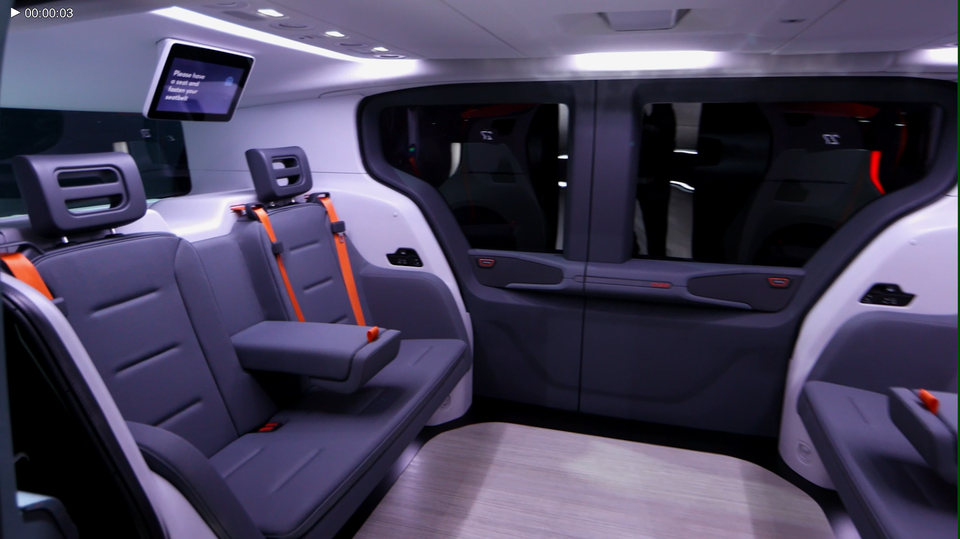
True ride sharing, which is what happens on most public transit, and with UberPool or LyftLines, is the more interesting question. GM/Cruise’s recent “Origin” vehicle, they say, is designed for this market with lots of interior room, and room for 4 to 6. In spite of the received truth about sharing rides, it’s not nearly as good as it sounds, and Cruise and others may be pushing to automate the wrong thing first.
Ride sharing offers 3 advantages:
- Less use of road space (and thus less congestion)
- Lower energy use and emissions per passenger
- Less cost per passenger
These all are good, particularly at rush hour. But it’s important to study how good they really are, because this approach comes with some significant disadvantages too.
- In traditional approaches like UberPool or Vanpools, the vehicle diverts from the desired path of passengers on board to pick up and drop off others, and there is a delay even if there is no diversion. These diversions and stops also reduce the savings above. They can be reduced if door to door service is given up or in rare cases where the entire group wants the exact same trip at the same time.
- It mandates vehicle sharing, blocking users from keeping stuff in the vehicle while they stop, or having it pre-loaded with everything they need for their small children.
- People ride with random (though typically identified) strangers, and no supervising driver. Some people (including a large fraction of women traveling alone) have discomfort with that. Most transit riders regularly encounter unpleasant fellow riders.
- In many cases, larger vehicles are operated less than full on all or part of their trip, erasing all the advantages above, and even having higher cost and emissions per person than solo driving, particularly than solo driving in a one-person vehicle.
It is important to understand that shared rides are a means to our goals (such as cost, low emissions, low congestion) and not a goal in themselves. Some of the downsides listed are for society, but many are just for the rider. Even so, if riders don’t like a service, they seek alternatives, which eliminates the benefits to society. It’s also hard to do. Uber and Lyft invested a lot into UberPool but found that even so, the rides were inconvenient and customers didn’t like them and stopped requesting them. So they raised the prices and people asked for them even less.
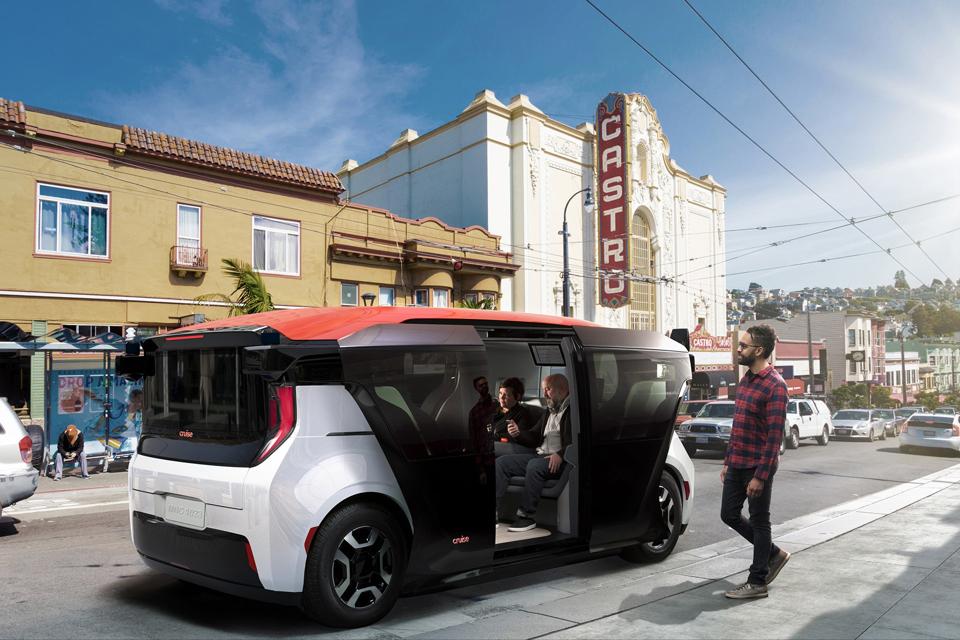
A good robotic fleet will reduce some of these issues by having a wide variety of vehicle sizes. If 10 people are riding the same trip you definitely want a van for them, but not a bus, and if 4 people are riding, you definitely want a traditional sized car and not a van. When 1-2 people are riding a mini-car is definitely called for.
Unfortunately, you must size your fleet in advance while any moment’s demand will be fluid. As a result you will, unless your fleet has oversupply, run 1 or 2 people in a 4 person car from time to time and erase your gains. Alternately, you will need more diversions and drive away more riders, saving nothing.
Micromobility and minimobility
The answer involves a tool that has not previously been in our quiver — small, efficient transport for 1-2 people. This can include today’s “micromobility” solutions like scooters, which are the overwhelming winners in road space use, emissions and cost, but which are not suitable in all weather conditions and for all people. The full answer is in minimobility — low cost, urban-speed half-width cars for 1-2 people. With self-driving minimobility, you can solve the problem of diversions to pick up and drop off other passengers. Instead most trips involve a short trip from a person’s door to a common point, then an instant mode transfer to the larger, shared vehicle, which makes no stops or few stops until arriving at another common point where there is another instant mode transfer to a scooter, minimobility vehicle or even a short walk.
Instant mode transfer is essential. With instant mode transfer, the vehicle you are getting into is always there waiting for you, and you walk only a few feet. It’s entirely unlike switching trains or buses as we know it from public transit today. It is not as good as a door to door private trip, but it’s 90% as good. Robocars can give us instant mode transfer because robots, of course, don’t mind waiting for people. It’s their job. While keeping vehicles idle is slightly wasteful the cost is actually very slow.
The second tool needed for instant mode transfer is the smartphone combined with modern traffic tools, which track how each rider moves and allows high accuracy prediction of when they will get places, and when they need to leave to get places at very specific times. If you’ve been creeped out by how accurately Waze predicts your arrival time in an hour-long drive you know that technology also exists today.
It turns out to be automating minimobility that is much more important for shared ride transportation than automating the shared vehicles. That’s because in a shared vehicle (particularly one with 4 or more passengers) the cost of a human driver is low because it’s shared. You could build a pretty reasonable cost shared ride van system today with human driven vans as long as you had a robotic way to get people from their doors to the common points.
If you run 15 passenger vans, the cost of a driver per passenger-mile can, in theory, be under 10 cents/mile if the vehicle is full. It’s actually quite some time before we can get the cost of a robotic driver that low during the R&D phase. On the other hand, as we know, Taxi and Uber trips all have flag-drop or minimum trip fees that make a sub-mile trip too expensive, and cost even more if you want the driver to wait to facilitate instant transfer.
As such, for shared rides, Cruise Origin, May Mobility and all the shuttle companies may be automating the wrong thing first.
Outside of rush hour
It is also worth noting that 1-2 person minimobility vehicles are quite efficient on their own, even for the whole trip. Some can be designed to allow highway driving, though it’s much cheaper to build them for urban streets only. Generally having 4 people in 2 mini vehicles, sharing a lane, will have a similar cost in road-space and emissions to having 4 people in a full sized car, but with the added flexibility that comes from being 2 vehicles instead of one. It’s only when you start pushing more than 6 passengers and move to highly occupied vans that you really start getting savings. But vans don’t work well without feeder minimobility, since you must do too many diversions and stops unless doing something like a carpool to a single building.
Outside of rush hour, you don’t have nearly as much commonality in trips, or do you have so much congestion on the roads. If transportation is electric and low emissions, the advantages of sharing rides are far less, and minimobility may continue to be the better choice.
At night in particular, the issue of being placed in a shared vehicle with untrusted strangers grows even more important. Today, we accept it because transit vehicles have drivers (and sometimes transit cops) and Ubers have both a driver and the fact that each rider had to provide a credit card.
One option for the shared vehicles is to design them not with open space, but with sealed compartments, each with their own door. This presents a challenge as often you will also get groups traveling together, who want an open vehicle, and you may not be able to swtich the configuration instantaneously.
Originally published at Forbes.com in The Push For Shared Ride Self-Driving Vehicles May Get It Backwards. Copyright © 2020 by Brad Templeton.


Comments
Ken Pyle
Fri, 2020-02-07 09:07
Permalink
There is a French company focused on a mini-car approach
Brad,
Great article and points. I interviewed a Leti/CEATech incubated, French start-up at CES2020 that is pursuing a 1 to 2 person mini-car solution that has many of the attributes you describe. I will shoot you the link when I have edited the video.
Thanks,
Ken
brad
Mon, 2020-02-10 14:26
Permalink
Small cars
While I have not written about that particular project, there are many minimobility companies out there, and I have written many other articles on the space.
Bob
Fri, 2020-02-07 17:37
Permalink
There is one more negative effect not mentioned
I am surprised you didn't bring up how many AVs might end up driving around empty from one fare to the next. In this likely scenario until deployment is massively scaled, we're going the wrong way. Instead of having only 1 passenger per vehicle like we have today, we end up with less than 1 passenger per vehicle.
FKA
Sat, 2020-02-08 17:40
Permalink
Taxis
For this reason alone I don't think it's true that everyone agrees that self-driving taxis are good.
Not as good as long-lasting, self-driving, personally owned vehicles, anyway.
Reducing the number of cars in parking spaces is useful in some places (places where taxis/ubers already are prevalent). In most places parking is not a big deal, though, whereas the number of cars actually on the road driving is (and taxis increase that).
A somewhat hybrid approach is to have short-term leases of vehicles. This allows you to reduce the dead miles, but still allows you to have access to the right size vehicle for your needs. Taxes and regulations might get in the way, though.
Personally I'd probably be fine with just using a four-seater almost all the time, with an occasional lease of something bigger or smaller for long trips. Leasing a one-seater might make sense if I have to travel far away and solo for work, for example.
Once the kids are a little older maybe that'll change. And by the time we have cars that can drive completely by themselves in the places I regularly drive, the kids will probably be much older.
brad
Mon, 2020-02-10 11:24
Permalink
Vacant vehicles
A lot of study is done by academics on how many vacant vehicles the taxis drive. There have been many results, some as low as 5%, but I think estimates of 10-15% are reasonable. New York Taxis have higher numbers, but they have to cruise the streets looking for fares. Robotaxis sit still waiting for a job, or at most do a bit of predictive movement to get closer to where rides are likely to be.
But if it's 20%, it is a concern, but only a modest one. Particularly if small and electric. And, of course, you can reduce this by increasing the size of the fleet. Larger fleet means a bit more capital cost, more parking cost and longer vehicle lifetimes. You can tune that in contrast with the costs of vacant miles.
FKA
Tue, 2020-02-11 08:53
Permalink
So what's the point?
Even if it's 5% that's more than my current car, which is driving around vacant 0% of the time.
But even 15% seems unlikely outside of tightly packed cities like NYC unless 1) the company's fleet is so large that each driver essentially has a car to himself, or 2) people use the service in addition to having a car (or transit pass) for typical daily driving, not instead of it.
In 2018, ride-hail dead miles were over 34%. http://www.schallerconsult.com/rideservices/favfact1.htm And that's despite most people who use it having other options for their normal daily driving.
Don't forget you have to clean them quite frequently. You have to park them in places where they have permission to park. You have to drive them somewhere to be recharged. These things alone will add significant mileage.
Either way, I don't really see the point. People owning their own cars means a bit more capital cost, more parking cost and longer vehicle lifetimes. And more privacy, more convenience, more certainty, less concerns over the spread of diseases, less overhead, etc. What's wrong with people owning their own cars?
Anyway, my issue was with the comment that "everyone agrees that self-driving taxis are good." No, not everyone agrees with this. There are significant concerns that self-driving taxis are going to significantly increase traffic.
brad
Tue, 2020-02-11 09:24
Permalink
Own your own cars
Of course, while I find it silly, many of the people who expect to own their robocar say they will do things like send it home to drive family around after the commute or loan it to friends, or even the very silly thing of having it drive around the block instead of park, which also would all contribute empty vehicle miles.
The car lasting "longer" is a bug, not a feature. Once a car starts aging with time instead of with miles, that's a cost in your total cost per mile of moving you. And it gets obsolete -- this is more like a computer than a car now, you don't want to expect 20 or 30 years of life for a robocar. Every year it sits underused, it depreciates just by being out of date.
Cleaning is indeed an issue. As for parking, while I think that would be cheap (especially if people use them as taxis and far less is needed) it is also strictly not parking, it is standing, and there are tons of places that standing will be allowed that parking is not.
Not everybody wants to ride in a taxi, but what I meant to say by that line is that in public discussion of the field, you don't usually see people say that taxis are a bad idea.
Jean-Yves
Sat, 2020-02-08 10:51
Permalink
Did you say i-RIDE, i-ROAD and COMS?
Your article is spot on and at Toyota we have long thought this was the answer to urban mobility. We did a trial in Grenoble, France with 35 COMS (four-wheeler one pax with a small trunk) and i-ROAD (three-wheeler for two) from 2014 to 2017. COMS are currently operating in Toyota City, near Nagoya in Japan, profitably. Multimodal use is not easy to sell to people but given the right incentives and conditions (key is multimodal payment/pass, I believe) and car bans in city centers, it would work, I think.
brad
Mon, 2020-02-10 11:26
Permalink
i-Road
Yes, I have written about the i-Road and vehicles like it a few times. Keep me posted with more as you develop it. I have not had a chance to study the COMS, but without banking wheels its speed is limited, but that can be OK for an urban taxi.
freepress
Sat, 2020-02-08 11:51
Permalink
Specious article from financially vested writer
What's most striking about this article is that its author criticizes, with zero quantitative rigor, the "room for 4 to 6" rideshare business of a competitor to the author's former employer. Waymo is operating the exact same "room for 4 to 6" rideshare business today and yet gets zero mention in the article. Without a quantitative point, the author is simply trying to hustle sentiment for his legacy and fluff his column spot at Forbes. This article is clickbait.
Why is the "room for 4 to 6" the sweet spot for cities? Because a rigorous analysis of trip data shows it's profitable! DUH! Both Cruise and Waymo enjoy useful *private* trip data from Lyft and Uber. What does such a study look like? Here's a nice one that's based on not trip data but a cell phone proxy: https://www.caee.utexas.edu/prof/kockelman/public_html/TRB18OrlandoDRS.pdf Both the Cruise Origin and Waymo Pacifica are designed to do primarily one thing: maximize the potential value returned to their shareholders. And both companies made those choices through a lot more rigor displayed in this article.
Gosh, can the public replicate these sorts of studies? Yes and no. Uber does offer some public trip data here: https://movement.uber.com/?lang=en-US
It's really really hard to release trip data though because (1) Uber / Lyft don't want competitors tapping into their businesses and (2) properly anonymizing data is very hard, and failure to do so can cause huge problems as exemplified by AOL years ago: https://en.wikipedia.org/wiki/AOL_search_data_leak
While it's nice to have a discussion about the pros and cons of AV rideshare, it's critical to offer something unbiased and with some piece of rigorous substance that hasn't been put out there before. Without authenticity, you're just fluffing your stock options.
brad
Mon, 2020-02-10 14:25
Permalink
Waymo
The article puts a focus on Cruise because Cruise made a recent big announcement with a deliberate focus on this plan. Your accusations are inaccurate. Having worked on proto-Waymo 7 years ago hardly gives one a financial interest in Waymo. Owning Google stock does, but Waymo is still only a small portion of the value of that. I make no secret of these things. I am also working on investments that will compete with Waymo. I am bullish on the whole space and feel many approaches -- including shared vehicles -- are worthy of exploration. This article just questions whether the unquestioning drive for shared rides is correct.
Timothy Lee
Mon, 2020-02-10 07:04
Permalink
UberPool
"Uber and Lyft invested a lot into UberPool but found that even so, the rides were inconvenient and customers didn’t like them and stopped requesting them. So they raised the prices and people asked for them even less."
What's your source for this? I use Lyft Line fairly regularly and it seems to me that the average number of co-passengers on my trips has been going up, not down.
brad
Mon, 2020-02-10 11:15
Permalink
Uberpool
It's behind a paywall at https://www.theinformation.com/articles/uber-ceo-khosrowshahi-struggles-to-find-formula-for-success
Add new comment