


Can EV charging be a business?
Gas stations are a business. They sell gasoline to drivers and make a profit, just like any commodity vendor. But charging for electric cars is very different. Even though it was estimated in 2020 that there are 26,000 EV charging stations with over 86,000 plugs, and a much larger number of home charging points, they are generally not a business with a few exceptions.
EV buyers tend to be homeowners. That means they install some sort of charging at home. There they buy electricity at the consumer price, but usually arrange for “time of day” pricing where the electricity is cheap at night, and that’s when they charge. That costs from 8 to 16 cents/kwh, or roughly 2 to 4 cents per mile of driving. The power company sells electricity but is not even aware they are in the EV charging business.
Many others charge at work. Even homeowners do this because many employers offer the charging free to employees as a perk and to encourage green driving. If they do charge a fee, they’re not in it as a business like a gas station.
For the modern generation of EVs with 200 miles of range, their owners can charge at home or work and never need to do any more for all their driving around their town. They may see EV charging stations at stores and parking lots but have no great motive to use them, though they will use them if they are free. A lot of them are free, put there as a perk for customers or again to just promote green driving. But many drivers don’t even bother plugging into the free ones. It’s a hassle, and a typical parking stop for shopping or dining would be unlikely to get even $1 worth of electricity.
There are charging stations that cost money and try to be a business. But they usually cost a bunch of money — 25 to 55 cents/kwh. That’s 2 to 5 times the cost at home, and nobody’s going to plug in unless desperate.
Imagine what gasoline would be like if everybody had a gas station at home where they filled up slowly every night for $1.00/gallon. How often would they stop at an ordinary station charging $3.00/gallon? Only in a desperate situation, or when far from home. Running a gas station would not be much of a business!
As noted, this changes when far from home, on inter-city trips. There, one must charge at public charging stations, ideally fast ones. (Not always, as many hotels offer free charging for guests, reducing some of that need, and more will in the future.)
The fast charging world began with Tesla. When Tesla first built their supercharging network, they made it free for all customers. It wasn’t there to sell electricity, it was there to sell cars. Later, Tesla stopped giving free lifetime supercharging, and charges a rate around 25 to 30 cents/kwh. That’s quite a bit more than charging at home, but Tesla says it is their break-even price. Again, they are not running the charging network to profit off selling electricity, they want to sell cars.
The largest non-Tesla network is being built by Electrify America/Electrify Canada. This project has been funded by Volkswagen, as a penance for the “Dieselgate” scandal. While it operates a bit more like a business, that’s not why it’s being built. A typical price there is 43 cents/kwh (31 cents for users who pay a $4/month membership fee.) This price could make a profit, but it’s not as easy as it seems. Fast charging stations are expensive to build, and electricity prices vary during the day, and can exceed that 43 cents during the peak hours of summer. Fast charging stations are rarely used at night when the power is cheap. Tesla’s claim that they break even around 28 cents suggests EA doesn’t make a lot of profit and is there to be something other than a business.
Truth is, at 43 cents/kwh, interest also wanes. That’s 11 cents/mile. With today’s $2/gallon cheap gas, a hybrid car like a Prius can be a fair bit cheaper than that, and while EVs have many other advantages than fuel price, people don’t like paying more than the price of gasoline.
If you’ve charged an EV, you’ve probably come upon a station with the Chargepoint brand. They’re the largest brand in making and managing charging stations. The key is that they only manage them. Chargepoint don’t generally sell you electricity — Chargepoint just sells the station to somebody else who wants to sell or give you electricity, and most of them are not trying to run a business. Chargepoint figured out early that selling electricity wasn’t the business it wanted to be in.
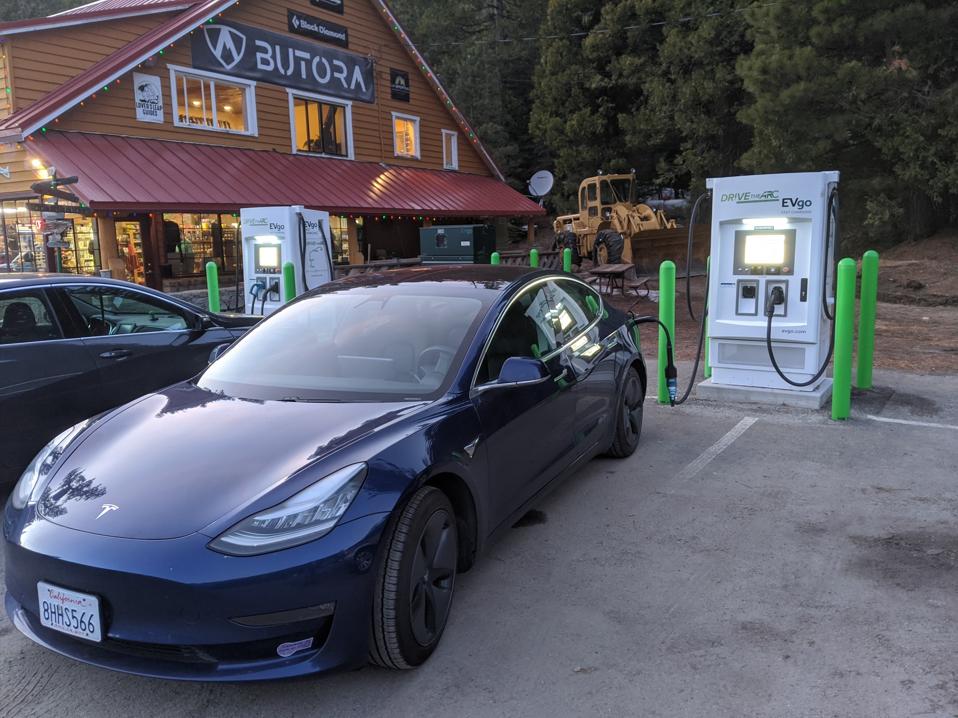
Not all agree. EVgo is a charging station operator who sells electricity with both slow and fast-charge stations. Even they admit there may not be much business from the ordinary consumer. In the city, they face the issue of most people having that $1/gallon station at home every night. Instead, their plan is for a business charging EV fleets. While many fleets can charge at a base, running and installing a charging array there may not be that much cheaper than making a fleet contract with a provider like EVgo — particularly if they want to charge mid-day or away from base.
Problems of not being a business
Because charging is not a business, it has had negative consequences on charging stations. Many stations were installed thanks to government subsidies. They were often put in odd places nobody would want to charge and sit vacant a great deal of the time. Worse, because the money to build them came from sources other than the money (or lack of money) to operate them, they are often in bad repair. One of the best directories of charging stations, plugshare.com, has many stations reported as broken or offline. This even extends to the fast-charging networks, where reports of outages are common and repairs can come slowly. This is a problem for people attempting to do road trips with CCS or Chademo fast charging, since you are absolutely dependent on there being a working charger in many of the locations.
Tesla’s network is not run for profit but because Tesla owners are very vocal and buy their cars in part for the ability to do these road trips, Tesla maintains the network which is exclusive to their cars and does it well. Other networks get frequent complaints of outages, with occasionally stranded drivers, though smart drivers check reports and plan for potential outages. While Tesla tends to build large charging stations placed further apart, where the outage of one sub-unit is not a problem, other networks tend to make stations with just 2-4 chargers, but spaced more closely so that with planning, drivers can get to a different one if equipment has failed.
According to reports, many networks have problems, but apparently the stations operated by Plugshare have a higher reliability result. Problems are more common in networks run for other reasons, such as state-funded EV-kickstart networks and power company networks or other networks put in for political reasons rather than business ones.
The real problem is that customer service is only given to customers. And if the driver wanting to charge isn’t the real customer, the service will not be great.
Non-homeowners
There are many drivers who can’t charge at home or at work. They buy fewer EVs today but want them. They are forced to charge at public charging stations. This is not nearly as attractive a proposition — the price at those stations is more than gasoline in a hybrid, and and stopping and charging can be very time consuming. People with such cars hear the regular promises of fast charging that takes 10 or even 5 minutes and salivate, but charging at that speed is going to be expensive because of the immense power flow required. There might be a business selling these drivers power at the higher price, but those drivers will always want to find another way to get their power at a better, more convenient price.
That demand will lead more apartment blocks to install charging in portions of their parking lots. They will either do it because it becomes a necessary amenity to get such tenants, or in rent-controlled units and other situations, they may install it to sell electricity. Charge-where-you-park does not need to be fast charging, and as such the installed cost is lower, and charging while you sleep requires no travel or time compared to fast charging, so this will be more profitable than selling fast-charging to these customers. To top it of, night power can be 1/3rd the price of the daytime power needed at fast-charging stations, another big advantage for installing charging in these lots.
Fuel at a profit?
It should be noted that while gas stations do sell fuel at a profit, many try to get more of their profit from convenience stores, car washes and other services. In effect, EV charging stations located with shopping may also use this approach. Today, though, it’s not that productive to charge at level 2 during a 30 minute shopping stop.
On the other hand, fast charging on intercity road trips is often paired with a meal. Because charging today takes 30-60 minutes, it is the common practice to eat while doing it — making it take effectively zero time rather than an unacceptable wait. Everybody on a long road trip has to eat, it’s just a question of where and when. It is obviously not an ideal choice to eat only in limited locations, but in time this will improve. Today, the restaurants next to fast chargers don’t do any “combination” deals but this could change, with food and charging bundled together in some fashion, or even things like pre-ordering food delivered to your car or ready when you arrive to speed up the process. A fast-charge of 50kwh is about $15 at Tesla’s break even price, so it would have to be a fancy restaurant that bundled it in for free, but this is an area for entrepreneurs to explore. People stopping for charging definitely want to make productive use of their time. That will be true until the mythical 5 minute charge is developed, and even so, the 5 minute charge is likely to be more expensive than slower charges because of the cost of megawatt-capable charging gear.
The great solar flip
Today, the cheapest power is at night. The most expensive power is from 3pm to 9pm. As more and more solar power is put on the grid, however, this will change. 3pm to 9pm will continue to be expensive, but there will eventually be a surplus of solar power from 8am to 3pm. Indeed, those imagining future grids wonder what to do with all that extra solar power, since it has to be stored to be useful, since the demand to use it is not present.
When this happens, the power prices will flip, and the 8am-3pm period may become the cheap power while night becomes more expensive, since it can’t come from solar and must come from storage, nuclear, hydro, wind or fossil.
The best place to put that extra power is into cars. Unlike almost all other loads on the power grid, cars can be very flexible about when they take the power. 95% of the time, they just need to add their average demand every few days. On special days with long trips they are more demanding. As such, they would be very happy to get low prices on power by being flexible about when they take it. That means, once plugged in, they will charge opportunistically when there is a surplus, including from solar and from wind. (Wind turbines are even more eager to be sure somebody will take any unplanned power they have. There are times when the price on the grid goes negative because nobody nearby wants it.)
To make this work, cars need to be plugged in during those hours. Cars that don’t commute and are still at home can do that, but otherwise it means putting in charging connections where commuters park. That includes parking lots and even along the streets.
The need of those with surplus power to sell it is so great in the world of renewable power that providers expect power companies might well pay to install charging in these commuter spaces just so that they can be sure to sell their extra power. These stations will still work at night for people who need to park on the street and want to have electric cars.
Of course, before too long, it will be very common for cars to be able to move on their own to charging stations and even plug in without human help. This actually reduces the need for building too much of the infrastructure described above. Cars will get a notice, “there’s surplus solar right now. If you’re free and need power, get yourself to a charging station now to get a great price.” And so they will. (With good forecasting, surplus power is often predictable well in advance, too.)
Many imagine that these cars will also feed the power they picked up during this surplus period back into the grid during the peak demand times and even the night. This idea is called “vehicle to grid” and requires special inverters and other tools to let the car’s battery feed the power back, ideally with custom waveforms to also offset unusual power factors in grid demand. While this is expensive, it is possible, but the reality is that just having the cars pick their charging time based on messages from the grid about price breaks (or to meet contractual agreements) provides a great deal of the value without needing any special equipment at all.
Originally published at Forbes.com in Can Electric Car Charging Be A Business?. Copyright © 2021 by Brad Templeton.


Comments
Professor Andr...
Sun, 2021-01-31 11:32
Permalink
Vehicle to Grid V2G with long electric range PHEV--SPHEV l
This kind of vehicle is like a range extender EV. So it will be able to supply grid specified electric energy. But in must be centrally controlled by the central power companies or other third party arrangements. These vehicles can serve as the main stay of energy storage and auxiliary liquid to electric energy conversion and solar and wind storage without needing separate large expensive energy storage farms. They can absorb solar and wind as they occur and be activated to supply local grid, reducing transmission line capacity issues, and much more.in addition they never have to be fully charged. They can be extremely useful in disasters, since they can supply quality energy from liquid fuel. I have built over 100 cars trucks and buses with this concept and demonstrated the technology in a company called Efficient Drivetrains Inc. we have recently been bought by Cummins Engine Corp. My contact is aafrank@ucdavis.edu
FKA
Mon, 2021-02-01 03:44
Permalink
depends on regulations
Just about anything could be a business.
The question is whether or not governments will allow it to be one.
brad
Mon, 2021-02-01 21:03
Permalink
Governments
Governments have been dicking around a bit. Their first efforts were to subsidize the installation of charging stations. That wasn't harmful (except to taxpayers) but did result in stations going where there was no demand for them, and them not being maintained.
The second way they have gotten involved is in trying to regulate the pricing. Some states actually require charging by the minute. Some require charging by the kwh. Others don't control this, which is the right choice. There are merits to both forms of charging but the regulation has mostly been muddled.
I will contend it can be very hard to make a business when consumers can get power at home at night rates, while the commercial charge station has to charge day rates plus recover lots of infrastructure that was already in the home. With a 3x difference in price, the only people buying in the day (until the solar makes it cheaper) are people who can't charge at night, but even they will work very hard to find alternatives rather than pay 3x the price.
FKA
Fri, 2021-02-05 15:04
Permalink
charging for charging
Not all consumers can get power at home at night rates, nor do all of the ones that can necessarily want to. Price is only one factor, after all. I'm surprised there aren't many, if any, charging businesses that offer 100% renewable energy.
As long as there's a demand, a supply, and lack of government interference, there will be a market.
Commercial EV charging can always be done at night (though some government regulations might preclude time-of-day rates). Calling it "commercial charging stations" seems to imply a "gas station" mentality. But EV charging, or at least a majority of it, is not likely to look much like gas stations.
Julian Egelstaff
Fri, 2021-02-19 11:51
Permalink
Roadside restaurants with chargers are where it's at
Interesting article, thank you. I agree 100% that the real business opportunity is highway road stops that bundle charging with some other offering, most likely food. People need to stop on road trips, for food and for fuel. This is a natural. Using a "gas station" to refuel makes no sense with an electric car because you start pretty much every day with a full tank. But car washes and other related services are still needed, so maybe the local "service station" will pivot to something else.
With gas cars, you fill up when you're driving. Electrics "fill up" when you're not driving. That's the bottom line. Cue disruption.
Carrie
Mon, 2021-05-03 15:38
Permalink
What about the time?
EV's are different from gas vehicles, it is a complete mind change, they take time to "re-fuel". You can't pull up to a pump, fill up with your CC and leave in 10 min. So, when you are the owner of one you have to plan and make sure you can charge if you are going on a long trip. Ideally as mentioned in other comments while you are eating or stretching your legs. It takes time to charge your car and a lot of EV owners are not going to sit in their vehicles while they charge. If you want to make it a "business" offer it with services like a store or a restaurant. The "business" part comes with the people spending money while they wait on their EV to charge. You would think more restaurants, stores, and hotels would put stations in place to draw in the big spenders.....but it doesn't seem like they think of that. If it takes 45 min to completely charge a car that is 45 min that owners spend money in your store.
brad
Mon, 2021-05-03 16:42
Permalink
Stores vs. Restaurants
Yes, charging on long trips takes time. But charging in daily travel takes no time for most people, because they are asleep or at work.
The problem with restaurants is that demand for food happens at lunch and dinner. Mostly at lunch, since if you have hotel charging (and you will in the future in enough hotels) you don't need charging during breakfast, and possibly not during dinner.
That's not a business, you can only put 2, maybe 3 people through your charger at lunch. This is going to be hard to solve. Most people don't need to make 30 minute shopping stops when they travel. The ideal location is a place where people make 30 minutes stops at all times of the day. Museums and roadside attractions perhaps.
Carrie
Wed, 2021-05-05 07:53
Permalink
I can honestly say, as an EV
I can honestly say, as an EV owner, that I would go to a restaurant that offers charging over one that doesn't. I would go to a nail salon that offers charging over one that doesn't. I would target my daily chores to places that offer charging over those that don't. Unlike owning a gas-powered vehicle where you fill up when empty, you charge your EV every opportunity you have. We drive our EV to the Airport, parking is closer and you can charge your car while away. I go to Walmart a little further away, because they have chargers.
I agree it isn't an easy thing to solve, but I believe there is a mindset involved. Maybe we should stop looking at it from the monetary standpoint and more from the customer satisfaction standpoint. You get return customers when your clients are happy with the things you provide.
brad
Wed, 2021-05-05 11:39
Permalink
Offering charging
All other things being equal, one would be happy to go to a place that gives you free charging, or charging that competes with your home price. But are all other things equal? Would you take inferior food, or higher prices to get the charging if you are just going to fill up at home later? I would not.
A few of the strip malls around here offer Volta free charging. Free. I used it the first times I went to these places, and I guess I will still use it if I happen to see it open and near the store I am going to, or maybe if I know I am there for 2 hours, but otherwise, no. I'll get 80 cents of electricity (it's only 3.3kw because it's free.)
But of course free charging is not a business.
Paid charging? Only if it costs the same as I pay at night at home, which it simply can't do during the day. Otherwise, why take the hassle of plugging in and paying and unplugging?
Now, on a road trip, this all changes. I won't be going home. Then I need fast charging and I will definitely have lunch where there is fast charging. Tesla charges over 2x the price at home (they say they break even) but of course you pay it. Others charge 3x the price of home, but you pay it.
Phillip Helbig
Wed, 2021-05-05 13:11
Permalink
free charging
Here in Germany, I bought a Tesla back in December. I still haven’t paid to charge it up. When the pandemic dies down and I take longer trips, then, yes, I will charge at superchargers to save time. But it is not uncommon to get 11, 20, or even 50 kW charging for free at places I go to anyway, such as Ikea, supermarkets, parking garages when there is a hospital appointment, etc.
brad
Wed, 2021-05-05 18:33
Permalink
So you don't charge at home?
I am surprised that 50kw charging is free. That's very expensive to provide. A typical "fill up" of 50kwh will cost about $20 to $25 at a 50kw charger in the USA. That's quite a freebie. The Tesla model 3 can't take more than 7.6kw in the standard range and 9.6kw in the long range, I know the S and X can take a bit more, but chargers above 7kw are rare at stores -- usually I only see those at Tesla Destination Charger at hotels.
Can you point me to some specific example chargers you have used that are free and offer 20 or 50kw? Or do you just mean Frei, not free?
Phillip Helbig
Thu, 2021-05-06 00:05
Permalink
free charging for the Tesla Model 3 in Europe
Power here is 230 V and two or three phases are common. 230 V three phases at 16 amps is 11 kW. That is also the limit for the Tesla when using its internal rectifier. Most home chargers are of this type, and it takes a few hours to charge up, which is fine for overnight. I have a garage but not attached to the house and there is no electricity in there. If it is possible and makes sense financially I might set up some sort of home charger, but do I really need it? For normal travel around town, it is enough to charge up at the supermarket a couple of times per week. For long trips, I’m not at home, so again don’t need a home charger. There are two supercharger stations, each with many chargers, not far away if I want to charge up before a long trip.
Public charging stations commonly offer 11 kW AC, and 20 or 50 kW Chademo and CCS, the latter two being DC. Not as fast as a supercharger, but still not bad.
IKEA example: https://de.chargemap.com/ikea-23.html
Note that exceptionally here there is 22 kW AC, but the Model 3 can take only 11. But I use DC if available, but occasionally AC if not.
Supermarket: https://filiale.kaufland.de/service/e-ladestationen.html. Note that here there is 43 kW AC and 50 DC. As in most places, CHADEMO, CCS, for DC and Type 2 for AC. Note that the app is no longer needed, just plug in and charge.
Many parking garages include charging in the price. There, it is usually just 11 kW AC. Sometimes, some sort of RFID card is needed, even though it is free, but not always.
Phillip Helbig
Thu, 2021-05-06 01:11
Permalink
differences
I should add that driving in Europe is very different than in the States, even more so for electric cars. A typical domestic price is 30 cents per kWh; Tesla charges 35 at the superchargers, so the differences is not very much. Investing, say, EUR 1000 for charging at home means that one would have to charge quite a bit before breaking even. The typical distance travelled by car, and the amount of time spent driving, is probably much less. Good public transportation is available at most places. Thus, my car is used mainly for shopping trips a couple of times a week for groceries, for when I’ll come home late and public transportation might not be convenient and I want to get home fast (if there is little traffic, a car can be faster, but usually not if there is a lot of traffic), and for long trips with the family. Also, the number of people who buy a relatively expensive electric car yet have no possibility to charge at home is probably much higher. Many people like to live in nice old apartment houses in town and park on the street (if they have a car at all). On the other hand, the range of a Tesla is greatly reduced if travelling at 150 m.p.h. on the Autobahn. :-)
Phillip Helbig
Thu, 2021-05-06 01:16
Permalink
green
Both IKEA and the supermarket I mentioned and many other places offer 100% green electricity for their free charging.
brad
Thu, 2021-05-06 11:01
Permalink
3 phase
While I know that regular service is 230v in Europe, I did not realize Tesla had wired to use 3 phases and put a charger inside the car able to handle 11kw. Free chargers in the USA at 7kw (2 phases of 240) are not uncommon. (Also common is 208v, which is what 3 phase power offers over 2 of its phases and US connectors only do 2 phases.) And then you've got the people who say, "If it's free it's 208v at 16a" which is not very much.
But 50kw DC for free? I've rarely heard of that in the USA or Canada, and I am wondering how common it is in Europe. Looking at that Idea I see just two stations, one broken (a common problem with free stations, no motive to keep them maintained) so as EVs become popular a free 50kw station will probably be harder and harder to find available.
At an average price of 30 cents/kwh in Germany just for the electricity, filling up 50kw would cost 15 Euros just for the electricity, and right now the station, while not billed by the kwh, probably works out to a similar amount. 30 euros is a pretty good freebie!
So if that can handle you, you're good for now. It's not a business of course.
I recommend installing charging at home, even low speed, because you just do it while you sleep and you never worry about it. You don't have to worry if you haven't been to the store in a while, or if there is a free charger when you get there (which could be an issue at that Ikea.) I go to Ikea maybe once a year myself, if that.
But it's hard to argue with free. That can be worth some inconvenience. But around here, the free ones are a pain. They only give 3 to 6kw, and because people are suckers for free, they are the only ones that get full (other than small supercharger stations.) So I just don't bother.
I see some press that Volta (which operates some free 3kw stations around here I don't bother using) has installed some free 50kw stations (30 minute limit) in the USA. Volta's plan is interesting -- they put in the stations in high traffic areas in order to erect a digital sign next to them which they sell ads on. Giving away 25kwh per day -- about $7 -- can be handled with that ad revenue. But maybe it is more lucrative than thought, if they can give away more. They say free for the first 30 minutes, which may mean they also sell some electricity as well when charging fairly empty cars.
Phillip Helbig
Thu, 2021-05-06 14:29
Permalink
lucky
I usually spend about one week thinking about a purchase for every EUR 1000 it costs. That includes planning, gathering information, finding the best deal, and so on (and doesn’t apply if it is a repeat, e.g. a trip somewhere I’ve been before). I had planned to buy a car, probably electric, in 2021, but due to my old one breaking down and not being worth repairing last October, I had to act quickly, so the Tesla was almost a spur-of-the-moment decision. That was helped by the EUR 9000 subsidy and the fact that sales tax dropped from 19 to 16 per cent last year as a COVID-relief-stimulation measure (it is now back up). Also, I got the slightly older but in some respects better made-in-China model (as opposed to made in USA) for EUR 3000 cheaper. That brought it down to the upper limit of what I was considering for an electric car (which was higher than for a conventional car because of less maintenance, less tax, less cost per km, and so on, especially since I tend to keep cars a long time).
I don’t have charging at home, but it might be possible. (I bought my house from an electrician and in addition to being well wired for things like telephone, television (though those two are over IP now) and internet—-with a flexible system which allows me to run whatever I want, even a serial line—there is also a three-phase connector in the cellar, but too far from the garage). I was planning on charging at superchargers (two stations are very close by), then a neighbour mentioned the supermarket with free charging. I also noticed a few other possibilities. At the moment, it wouldn’t be good to charge at home, but if I can arrange to get electricity in the garage for a reasonable price, I might do so, especially since there is now a subsidy for 11-kW chargers, but more with a look to the future, since I doubt that the situation will stay as it is now forever.
The current system doesn’t scale, of course, as only a small fraction of cars are electric. Also, the supermarket might recoup some costs because people (like myself) now shop there rather than (or in addition to) elsewhere, but people won’t spend more overall just because they can charge for free, so it will work only as long as only a few places can attract more customers via such a gimmick; at the point when all do, it won’t be profitable for any.
The supercharger is faster, of course, and the time is about that for a typical break for a meal on a long trip. But for, say, 20–30 kW while I am spending time somewhere anyway, it doesn’t have to be that fast. Also, it doesn’t have to be a full charge, just enough to last until last time.
I haven’t looked into the details, but the wiring of the Teslas is different here. The Tesla itself has a socket which the CCS (for DC) cable or the type-2 cable (for AC—same but without the two big pins) plugs into. (CHADEMO is common on Japanese and French cars. For that reason, sometimes it is available when the CCS and type 2 or not, so perhaps it would be worth it to buy an adapter.). The Tesla superchargers here also have what looks to be the same CCS plug, but it will fit only into a Tesla socket. In addition to the superchargers, many public chargers have cables (usually the three mentioned above). Some don’t. The Tesla comes with a cable for the type-2 AC connector and also for a household 230 V single-phase socket.
brad
Thu, 2021-05-06 16:52
Permalink
Charge at home
Chademo is on the way out, just as well. Tesla proprietary connector is the best but legal factors made CCS win in Europe along with Type 2.
Most homes don't have 3 phase and I wonder if many home chargers have it?
Anyway, at home you don't need a lot. The 3.3kw of a 230v 15a circuit would do the job for you if it's easier. If it's easy, wire more of course. I presume your garage is an outbuilding so you would have to trench a wire to it, which electricans will charge a lot for? Other electricity in there would be handy for tools or lights of course.
Or you can even just get a heavy duty extension cord and plug into that, you could do 10AWG and run 230v at 20a over it no problem. It's rated for 24a continuous but I would not go that high. You can look at cords for welders etc. It's an alternative to expensive trenching. Or you can run overhead wires, I guess, I don't know what the rules are on that.
The nice thing about charging at home is you just no longer even think about it. You don't change what grocery store you go to.
Phillip Helbig
Fri, 2021-05-07 00:00
Permalink
connectors
The Tesla Model 3 here has what looks like a CCS connector, so it can charge at CCS and at the supercharger with no adapter. The older superchargers had the proprietary connector (which the Model S here still has), then the CCS-like connector was added (so they have two cables). The newer superchargers have only the CCS-like cable, so the Model S needs an adapter for them. Maybe newer Model S will also have the CCS-type connector.
I think that most domestic wiring here is three phase, but usually only one phase (rarely two) is used. Sometimes, part of the house will use one of the phases and part another. (That can make it tricky to do internet over power lines, but that is not something I need.). Note that due to the copper shortage after the war, in England there is a completely different wiring system, which is why they have the big plugs with fuses in them. The UK used to be 240 and the Continent 220 but they converged at 230. However, much modern equipment will take anything in that range, or even in a larger range.
IIRC Tesla offered to make the proprietary connector the standard but the others said no. With the current setup for my Model 3, I can charge at all superchargers and all CCS chargers with no adapter (though sometimes I need my own cable at CCS chargers).
Phillip Helbig
Fri, 2021-05-07 00:12
Permalink
garage
I live in what in England is called a terraced house. There are three such on the lot (with 9, 6, and 16 individual houses each). Each is the property of the individual owners. Also on the lot are private roads between the houses, a playground, and the garages (in two big blocks). Those are all common property, though each owner has a garage and the space before it for his own use. As such, in contrast to the houses, there needs to be some sort of agreement when construction is involved. That means I can’t just do what I want, but on the other hand if more people are interested in might be cheaper to get power in the garages if it is done all at once for all of them. As for an extension cord, that would be technically possible, but would be across the private street where people walk and cars drive, so not really a good option. A trench would require removing the bricks in the private road and so on,
Actually, I’m glad that I started going to the new supermarket, because some things are cheaper and/or better than the one I had been going to. Now, I go to both, buying the things which are cheaper and/or better at each one. They are about the same distance away so it is no extra time or effort to go to one then to the other.
A full charge costs about EUR 20, so even if I do put in a charger at home I would probably use it only when I really need to charge.
At the moment, the more pressing problem is lack of internet in the garage, so soon I need to see if I can set up an access point in a window which will give me enough range.
brad
Fri, 2021-05-07 22:44
Permalink
Ah
That's a tough one. No, you can't run a cord over the street. Sounds like you have to wait until other people also want power in the garage and get it with them. Possibly even swap garages if that makes sense to group the people who want the plugs together. So for now, be glad you have all these folks handing out free power!
As the number of EVs in a country grows, it will become a checkbox item for any building that it has EV charging, or the building won't get buyers or tenants if more than 10% of cars are EVs. At that point there will be efforts to get that charging in all the apartment blocks. I presume you own your unit, in which case there is some sort of TIC or HOA -- they will be the ones pressured to do this.
Because 230v power is common, it should not be too hard. Most people don't realize that it's fine to have a lower power circuit -- the common 16a 230v is more than most people need except on the most extreme days -- in which case they can visit that 50kw charger, or put a couple of 32a or 3-phase units in the parking lot if there's a parking lot. You don't need 11kw at every station, though some people don't believe that.
You believe it' You're getting by with zero. But with 16a/230v I doubt you would need outside charging for local driving ever, just when doing long road trips.
Phillip Helbig
Sat, 2021-05-08 01:19
Permalink
new requirement
Charging stations are already a requirement for new buildings.
As for the garage, it depends on how many others want it and what the price would be.
brad
Sat, 2021-05-08 11:51
Permalink
Requirements
That's a very German way to do it. But I'm saying that without requirements, even for old buildings, if the number of EVs gets high, the managers of parking lots will start doing it, at least if there is competition for tenants. If 10% of potential tenants will reject your building out of hand for lack of charging, you'll put it in.
Or you may even put it in as a business, charging those tenants who use it enough to pay for the charging stations. (Most will charge for the electricity, or more ideally it will be worked out how to get it on the tenant's existing electrical bill.)
In a competitive market we will have buildings that offer free charging, which offer free stations but you pay for the electricity, charging where you pay for the station and electricity, and even commercial charging where they take a profit. Tenants will choose. German electricity is expensive. Probably 750 euros per year to do all the charging for a car (less what people charge at work, stores or road trip chargers it might only be about 400 euros.) 400 is an interesting figure. It's too high to just ignore, but low enough to be a "free" perk in competitive buildings. After all, parking spaces themselves are usually included "free" with units and they cost more than 400 euros a year in reality.
Roger Cook
Wed, 2021-05-26 10:23
Permalink
Electric Vehicle Charging as a Profitable and Legal Business
Is it even legal in all 50 States to sell electricity for a profit if the business/entrepreneur is not a Utility Company? I know at one time is was not legal here in Michigan, but I don't know if the laws have changed. Consumers can select the energy supplier to provide power to their home or business from a limited list of offerings via the concept of 'Wheeling of Power', but the Invoice is still prepared by, and fees collected by, the authorized Utility for that geographic area.
brad
Wed, 2021-05-26 11:20
Permalink
Legal
I have never heard of it being illegal to sell charging for cars. Perhaps it's illegal to sell power to homes without being licenced by the PUC, that would make sense.
Brian
Wed, 2021-06-30 08:34
Permalink
Show me, don't tell me.
You do a lot of talking but I don't see the numbers. Hand wavy "$2 per gallon gas" and platitudes from Tesla about break even points do not interest me. Do you have any numbers and data? I want that info.
brad
Thu, 2021-07-08 16:59
Permalink
Can you be more specific
What numbers do you need? EVs like the Tesla model 3 use about 250 wh/mile. A typical car is perhaps 30mpg at $3/gallon, ($4 in California) Electricity is average 10 cents/kwh in the USA, but more like 18 cents for EV drivers here in California at home.
So the EV costs around 2.5 cents/mile, the gasoline car about 12 cents/mile. In California the EV is 4.5 cents/mile, the gasoline car about 14 cents/mile.
Paul Villella
Sat, 2022-04-16 08:52
Permalink
Low hanging fruit
Solar day parking makes the most sense, if you Park and Ride you'll be topped off by quitting time. Same with at work charging. These huge commercial buildings with desert like parking lots represent a host of opportunities for solar to supply the business and it's employees. One day you may even drive home full, V2H your home during peak evening and re-top off at night rates to supplement peak shave for your employer in the 6-9am hours and re-top for free during solar highs at work.
brad
Sun, 2022-04-17 11:54
Permalink
V2H
Yes, companies will probably put up solar, charge cars in the morning with any surplus, run the company in the afternoon, buy from grid after sun gets low (unless they have storage.)
V2H can help for certain situations but do you want to drain your car and use battery life at night? As long as batteries have a lifetime, always going to be cheaper to use up a battery in your house than the one in your car.
Ray
Wed, 2022-04-20 09:12
Permalink
A very well written article.
A very well written article. It carefully details the reality of the situation, using sound economic principles to bolster the points made, instead of utopian thinking that all too many other authors rely upon when exploring the future of this infrastructure.
I wish more people who are highly engaged (if not a bit fanatical) in this technology would view it in a reasoned perspective such as this.
William
Fri, 2023-09-22 12:02
Permalink
Demand is 24/7
I can tell you are intelligent but you dont have an EV, and therefore have not been out there to experience the madness. You were wrong in saying there isnt a demand for charging stations to be a business. Saying that people will charge at home unless emergency due to high prices. In Southern California, no matter I look for chargepoint, evgo, Electrify America, or Tesla stations, its 35c to 68c a kw/hr. AND THERE ARE ALWAYS LINES OF 2-3 CARS EVERY DAY, ANY HOUR, EVEN MIDNIGHT PEOPLE PAYING 68cents..its psycho! I had to wait the other day 2 hours to charge my car. I drove around los angeles for another hour trying to find open chargers...elecricfy america has hundreds around malls and shopping areas, but for the last 2 years are still wrapped in plastic. No one is talking about that. I think because they were put in before the mall flagship stores closed their doors (such as Macys/ JCPenny). Anyway Im looking to buy stations to put around my area. Any small business who will let me use your lot, let me know. Thanks!
Add new comment