


3 At-fault accidents involving Robocars and what they mean
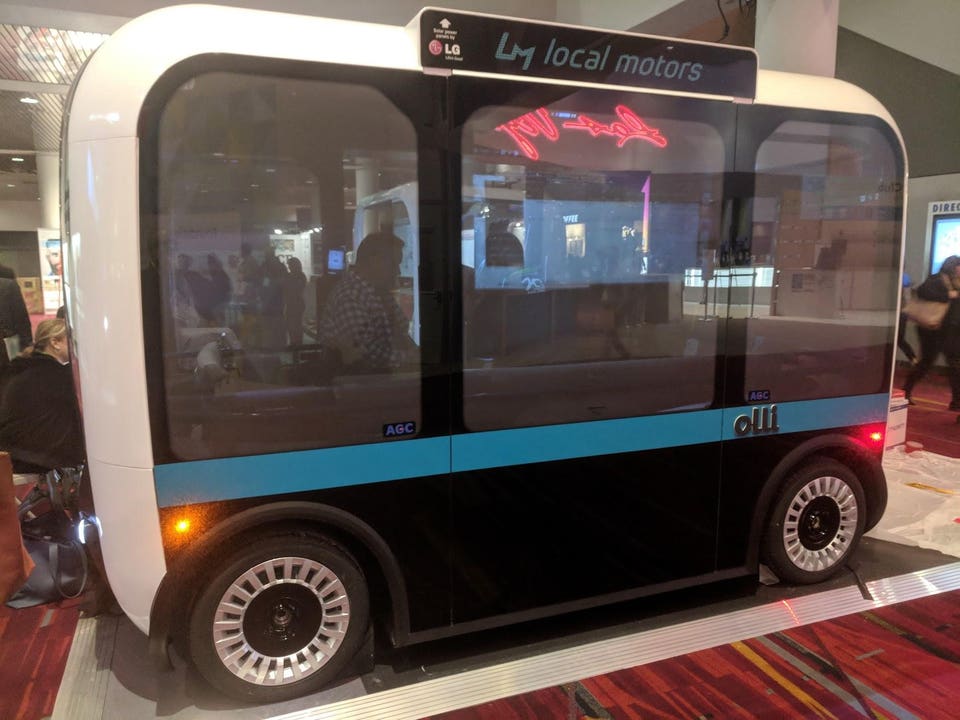
Update: Local Motors, makers of the Olli, report that the vehicle was confirmed to be in manual mode when it crashed.
Three different robotaxi-related accidents at the end of this year raise some interesting issues about what they mean going forward. This includes a serious injury accident when an Olli shuttle near Toronto ran off the road, the loss of Pony.AI’s California no-driver test permit over a road departure, and less significantly, an injury accident where a manually driven Waymo hit a pedestrian who allegedly moved unexpectedly out onto the street in San Francisco.
Perfection never has been and never should be the goal for these vehicles, so accidents are going to happen, and the frequency of them will go up with the number of miles being driven. At the same time, crashes that are the result of deploying too soon deserve some extra scrutiny. Overreaction to the crashes can also occur, in a way that delays the deployment of crash-preventing technology.
Olli
The Olli shuttle is a low speed shuttle that was being used to move passengers to and from a commuter train station in Whitby, Ontario. The shuttle runs with a supervisor on board who can stop it, as most self-driving test cars do. Unfortunately, that supervisor sustained critical injuries when the shuttle veered off the road and into a tree for no clear reason. The supervisor’s condition improved — normally critical injuries should not occur in a vehicle only going 20 km/h, but it’s always possible when people are not seat belted or protected by airbags and other passive safety measures.
Update: A similar Olli based shuttle in Toronto has also been suspended after the accident. Local Motors reached out, however, to say that an investigation into the crash showed it was in manual mode, making this not a self-driving accident, at least not in any direct sense. The issues below remain the same, however.
This is not the first incident with such shuttles. An Easymile shuttle threw people to the floor when it stopped hard for no reason in Columbus, OH, causing a shutdown of the service. At the time, I considered the question of seatbelts in such vehicles, and it remains an issue.
Seatbelts are rarely used on public transit. Transit has a lower accident rate than personal cars do, but it’s been given a bit of a “pass” on this because in part, seatbelts would seriously degrade transit service. Imagine if a transit bus or train could not allow standing passengers, and if people had to wait before coming to a full stop before unbelting and exiting, and then the bus had to wait for new passengers to get seated and belted before it could start up again. It wouldn’t work. But seatbelts are a good idea if a vehicle has a significant chance of unexplained sudden stops or leaving the road.
It’s thus fairly important that one either not test while this is likely, or that if seatbelts are put in, and especially mandated, that the mandate be explicitly temporary, ended when some goal is met. Once you require seatbelts it’s almost impossible politically to then decide to remove them. While you do demand them, it’s hard to make a competitive bus or shuttle, unless it does trips with very few stops.
Trips with few stops actually are the answer — robotic transportation doesn’t need to be in big vehicles that are limited in number because we only have so many drivers. With robotic transit you use more, smaller vehicles and keep them fairly full, rather than big, infrequent vehicles that often run with low loads. Smaller is actually more energy efficient, and provides better service. That means you also arrange to do far fewer stops, and ideally, you make every trip non-stop, other than the first and last mile, trying to match the virtue of door-to-door private cars. Then you can have seatbelts with no problem.
Pony.AI
Pony.AI is one of the few companies which has, and is using a permit from California to test vehicles with no safety driver on board at all. (The EasyMile and Olli vehicles had a safety driver, but had incidents that a safety driver with only a stop button can’t deal with.) Details are scant, but in October, a Pony.AI test vehicle also departed from the road. There were no injuries (as you would hope with nobody on board.) When they reported this, as required, to the California DMV, the DMV decided to revoke their permit.
That’s a fairly appropriate action. It’s actually not clear what the value is of testing with no safety driver and no passengers, other than saving a bit of money on safety driver salaries. All these teams can easily afford the driver. While everybody has to eventually get to operating without a safety driver to have a real service, and it’s good to do some basic testing of anything new, extensive testing in this form seems odd.
When it comes time for passengers, it is a slightly different story. You learn things about how passengers interact with the vehicle if you take the safety driver out. You eliminate the risk of spreading Covid as well. You are testing the whole system, but at this point, you are not really testing the self-drive system in the way you were before. You don’t put passengers in it alone until your testing has revealed it’s safe to put passengers in it. That doesn’t mean it’s accident- proof, but rather that it has reached some low level of risk that makes it good enough for limited deployment. Both the Pony and Olli vehicles had road departure accidents sooner than would be expected for a vehicle at that level.
Waymo
The Waymo crash almost doesn’t qualify as a self-driving story. According to Waymo, the vehicle was not only in manual mode, but was in an all manual mission. (There have sometimes been questions about statements a car was in manual mode if it had only entered manual mode recently, and automation still might have played a role in the whole sequence.)
Details are also scarce but some details suggest possible fault with the pedestrian — but police will rule on that. The one self-driving issue is to note that the Waymo vehicle could, but does not, make use of its impressive sensing and computation engine to prevent accidents even in manual mode. Many cars have forward collision avoidance systems which will hit the brakes if the driver doesn’t. Waymo’s cars could have the best such system out there if they made the effort to do that, though it’s not a trivial effort and includes liability risks for a system which will only see minor use. Unlike the other teams, Waymo has been operating a service with no safety driver on board for years in Arizona.
What about more crashes?
All crashes that are the fault of a robocar are likely to involve some type of mistake. Unlike humans, who may get away with, “I just didn’t see him,” the robocar is always looking in all directions, and we can look inside its brain and usually know what caused the error, though that can be opaque if neural networks played a large role in the decision. And after every accident, the team will fairly quickly make sure that that type of accident doesn’t happen again, and every new revision will be tested again and again in simulator.
This means we have to adjust our reactions. If an accident caused by a mistake causes people, including regulators or the public to say, “we can’t have such a vehicle on our roads” we will never get them on the roads. We just learn to study the type of mistake, and whether it indicates the vehicle has been placed on the road far too early and recklessly, or it is of the type of crash that is going to be part of any period of learning. After all, we let freshly minted teen drivers on the road, knowing they are more dangerous than others, and will have crashes, but may take away their licences if they are reckless or get DUIs. That’s the only path that turns them into better mature drivers.
Making this determination will not be easy because all crashes will have a mistake at the root of them, one that, if we can look inside the brain, follow patterns of negligence. But unless you don’t believe the eventual goal of driving with much less risk than human drivers can ever be attained, the sooner vehicles get deployed, the sooner we get to that goal. The math tells a clear reason: Early vehicles which are more risky will be deployed only in small fleets, for relatively low total risk. Later vehicles which reduce risk and prevent accidents will be deployed at massive scale, reducing risk massively compared to human drivers, and compared to whatever early risk they presented when few in number. We don’t want to pass up that opportunity.
Originally published at Forbes.com in At-Fault Robotaxi Accidents For Waymo, Pony.AI, (Not) Olli And What They Mean For The Future. Copyright © 2021 by Brad Templeton.


Comments
Dick Mudge
Sat, 2021-12-25 07:19
Permalink
3 at fault accidents
Brad
Good column as always. I believe the Toronto shuttle was not in automated mode at the time of the crash. While still not going very fast, I was told by friends in Toronto, that it followed a bizarre path until it hit the tree. The Olli uses a stick to control the vehicle. This always struck me as very shaky. No word on how long the operator had been on the job.
You are correct in pointing out that an inherent advantage of auto taxis is the ability to provide smaller vehicles rather than standard buses (or even worse, articulated buses) that may be full for one or two runs a day. I worry that the large infrastructure bill will encourage transit authorities to continue to manage their systems by minimizing costs per seat mile rather than costs per passenger mile.
Have you seen the press release from my friends at Robotic Research? I think they are the only profitable North American AV firm.
https://www.businesswire.com/news/home/20211208006171/en/Robotic-Research-Announces-228-Million-Series-A-Funding-Round-to-Scale-Autonomous-Technology-Commercially
Fun times
Dick
brad
Sat, 2021-12-25 16:21
Permalink
Commercial vehicles
Everybody knew that commercial vehicles were a quicker path to profits -- but not to the brass ring of changing personal transport. At first, all people do with the tech in commercial vehicles is remove the cost of drivers, which is economical but not world changing (except perhaps for the driver.) It's when you get to changing the nature of transit (with small vans) that something interesting happens.
Let me know if you learn more about the Olli. I did not think it was usually operated in steered mode.
Anonymous
Tue, 2022-08-16 11:41
Permalink
iX in Reutlingen
bmw iX in Reutlingen by Stuttgart
Anonymous
Tue, 2022-08-16 14:02
Permalink
BMW iX on B28 roadway
BMW iX on B28 roadway from Zainingen in the direction of Feldstetten.
In a long right-hand bend after the Salzwinkel ski lift, the BMW suddenly came into the oncoming lane
brad
Tue, 2022-08-16 14:39
Permalink
Not a self driving car event
This car had no self-driving systems. It does have lanekeeping, it is unknown if that was on or not. It was just being driven on a family errand with a small child, not for business. Tragic, but unrelated to self-driving.
Anonymous
Tue, 2022-08-16 23:45
Permalink
www dot 7aktuell dot de report is
www dot 7aktuell dot de report is with many photos
Anonymous
Wed, 2022-08-17 00:19
Permalink
Bild dot de has tele report at location on youtube
Bild dot de tv has tele report on youtube of crash
On youtube for bild dot de
Autonomes Fahrzeug verursacht tödlichen Unfall Römerstein
Add new comment