


Cities stuck in last mile, Stupid Cities, Scooters and the future of Hydrogen
Hydrogen is often touted as an important transportation “fuel” in the future, though it has never gotten significant traction. One reason is confusion over what it is – it’s not an energy source, though it is used like a fuel, but rather a form of energy storage. You take some other energy source (today it’s natural gas, in the future it’s renewable electricity) and you generate the hydrogen, which you can then turn back into useful energy through a fuel cell, or even by burning it.
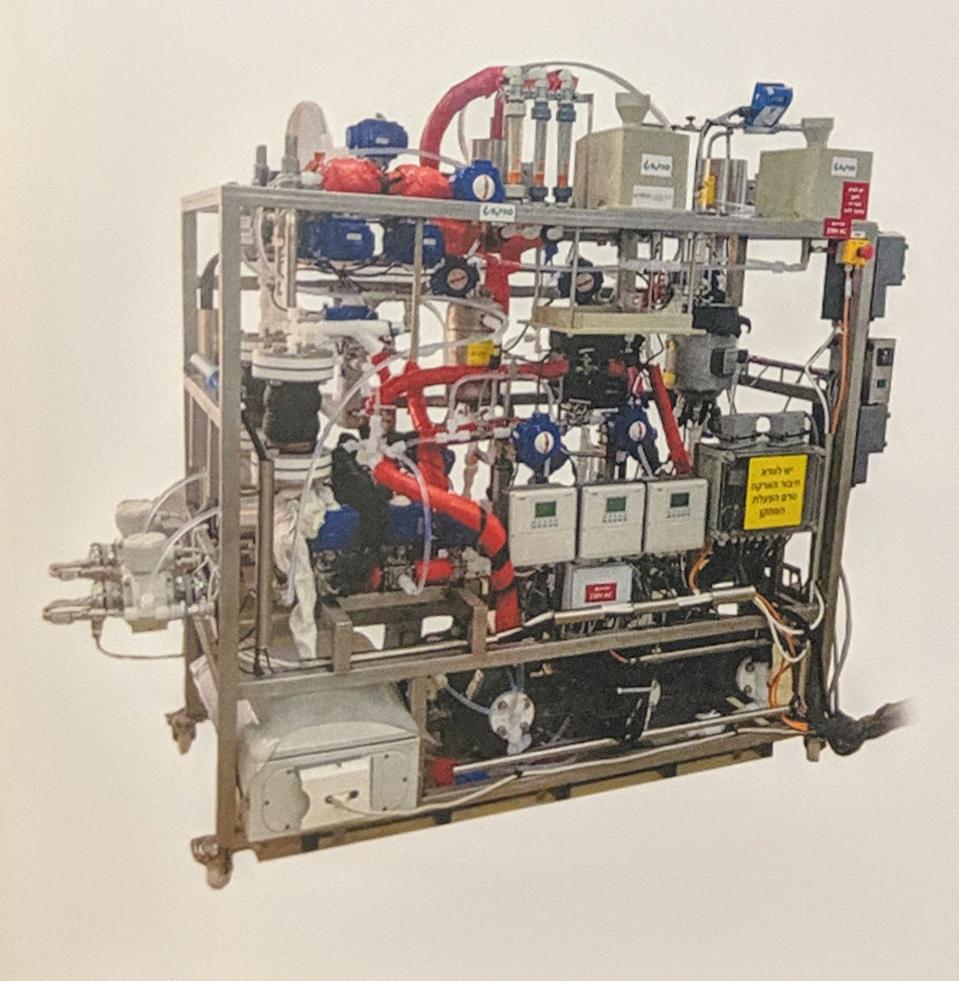
Hyundai’s Mobility Innovator’s Forum closed a week of 3 different California mobility conferences I attended. There, I met folks from H2Pro, a company which claims a radical new electrolysis cell which converts electricity to hydrogen at a 95% efficiency. Unlike other methods of electrolysis, this one uses a consumable anode (which makes the oxygen, not the hydrogen) which can be restored by heating the system temporarily. With this, they hope (should they find a way to do it at scale) it will be over 90% efficient, compared to the 70-75% of existing systems. Even better, it can produce the gas at high pressure, saving the energy needed for compression.
That’s good – and as noted almost all the hydrogen generated today comes by cracking natural gas (methane) which is not renewable and causes emissions.
Hydrogen’s big advantage as an electricity source is you can pump it like a gaseous fuel. That means you can refill tanks quickly, though the tanks are expensive and large high-pressure tanks, not simple gasoline tanks. Its other big advantage is energy density per kilogram – 3-4 times better than jet fuel or gasoline, though there is less advantage due to the need for a large, strong tank.
To turn hydrogen back into electricity you use a fuel cell. Sadly, these are not currently very efficient, around 50%, and under 40% in hydrogen-electric cars. As such, even with a 90% efficient electrolysis, you’re only going to get well under half of your energy back with hydrogen, compared to around 85-90% for batteries. If you burn the hydrogen to move a car, you will only get about 1/3rd of the energy turned into motion. For heating homes, it’s better to use a fuel cell to run a heat pump. Heat pumps can be 300% “efficient” in turning electricity into indoor heat, and on top of that, the 50% waste heat of the fuel cell can be recovered for heating the building, too. However, better just to use the electricity directly – the only reason to turn it into hydrogen is to ship it, store it or carry it.
And I have not even discussed the issues withe costs costs and dangers of storing, transporting and using hydrogen – a highly flammable gas.
Hydrogen cars
People had hopes for hydrogen cars, and due to regulations, some have been produced such as the Toyota Mirai. They are not very good, and few have sold, and with filling stations being very rare, not convenient to use. Boosters of hydrogen didn’t predict the way that lithium battery prices would plummet, and it seems it’s time to declare batteries as the winner, at least for now, in electric cars. Hydrogen’s only advantage is the quick fill-up, and there’s lots of promise on having quick fill-up for batteries, and even the 45 minute fill-up of the Tesla supercharger turns out to be reasonable if you can time it with eating a meal.
Hydrogen Trucks
Hydrogen may still have promise as a truck and bus fuel. While these are also being built with batteries, the amount of batteries they need is very large, and the amount of power needed to charge them in a reasonable time is immense – several megawatts. The weight of such large battery packs is very high compared with both diesel and hydrogen, and trucks and buses can handle having large tanks on board. As such, this is where the action may be for hydrogen in ground transport.
Electric Aircraft
I think the real potential for hydrogen in transportation is in aircraft. Here, the fantastic energy per weight advantage of hydrogen comes into its own, as long as you can make lightweight tanks. As noted, it’s much better than jet fuel, and can be converted to spinning propellers at higher efficiency too. Batteries are just to heavy for anything but short range aircraft at present, and worse, no major breakthrough is sitting on the horizon to give great hope this will be solved. Batteries also have the annoying property of weighing the same full and empty – a fuel powered plane takes off very heavy and is inefficient, but as it travels, it gets lighter and lighter, gaining in efficiency. This would also apply to hydrogen.
Standing in the way of hydrogen-electric aircraft is the high cost of fuel cells per watt of output. Takeoff requires lots of power, especially in electric vertical takeoff (drone style.) Hundreds of kilowatts, even for small vehicles. Once up, you can fly with just a few kilowatts. One answer being explored is the combination of batteries and hydrogen fuel cells. Take off with a small battery pack that only has enough power for takeoff and an emergency landing. Fly (and recharge slowly) on the smaller fuel cell. This also solves an important reliability problem. Aircraft have to have backups in case any system fails. One powered on just a fuel cell would need two expensive fuel cells. Batteries can be split up into independent packs to provide reliability.
Grid storage
Hydrogen, and other forms of chemical storage, can make sense for grid storage. Grid storage is the big unsolved problem when it comes to creating an all renewable grid. Since we get no solar at night or on rainy days, and wind is also unreliable, the only way to have them generate most of our power is to be able to store extra power from sunny and windy days, and get it back over the course of a cloudy, rainy week or more. (The other big problem is the giant power demand peak that comes around 7pm, just after all the solar panels faded away.)
For batteries, if you want twice as much storage, you pay twice as much. For hydrogen, twice as much storage is mostly just twice as big a tank.
Off-grid storage
Efficient electrolysis may also offer an option for very remote renewable generation sources, such as offshore wind and wave power, or certain types of remote land renewables. One could imagine wave generators just floating out in the ocean, filling H2 tanks and serviced by robot tankers. (Though piracy could be an issue.) Due to the inefficiency of hydrogen, you would want these to be how you refilled your storage tanks and aircraft, not as a mainstream storage technology, but even the latter could make sense in certain cases.
So the future isn’t probably full of hydrogen as its boosters imagine, but there is hope yet.
Originally published at Forbes.com in The Uncertain Future Of Hydrogen As Transportation Energy. Copyright © 2019 by Brad Templeton.


Comments
Johnny
Tue, 2019-11-12 18:57
Permalink
Walking the last mile would
Walking the last mile would do Brad Templeton some good.
Then again, we do have to worry about the San Andreas fault.
Russell de silva
Wed, 2019-11-13 02:01
Permalink
Good analysis of hydrogen as an energy storage medium
Pretty clear and obvious that hydrogen can't compete on efficiency grounds vs batteries for cars.
For aircraft I presume the upper limit for propeller driven aircraft speed would mean that burning it in a turbine would also be considered. While the efficiency would be lower, the advantages of being a renewable energy source and lighter fuel load (longer range) still apply.
Where do ships fit here? Weight is far less crucial than for aircraft, but I'm guessing fuel as a percentage of mass is higher than for a car. Batteries might be too bulky as well as heavy for shipping. Does the efficiency of hydrogen along with its green qualities do enough to give it an advantage over diesel?
Too lazy to look it up but do ships actually use diesel electric with power station like efficiency, or just plain diesel and ICE type efficiency?
brad
Wed, 2019-11-13 14:56
Permalink
Ships
I have not studied them as much. I believe they usually drive the screws directly, not diesel-electric. Trains are often diesel-electric, and could power with hydrogen. They can also just do plain electrification on major routes as they have in Europe, which is twice as efficient.
Ships are not very efficient propulsion wise, they become efficient by being huge and doing things at scale. Even so, ship scan gain a fair bit by putting up kites.
Larry Hawes
Thu, 2019-11-14 07:14
Permalink
Research and development
Research and development being done now on large ship fuel cells. One of many examples below.
https://fuelcellsworks.com/news/havyard-taking-next-step-in-hydrogen-system-for-large-ships-with-fuel-cells-from-powercell/
Russell de Silva
Sun, 2019-11-17 12:20
Permalink
Thanks for the link
Thanks for the link
Larry Hawes
Thu, 2019-11-14 07:13
Permalink
Hydrogen Future
I would comment that the analysis is rather ignorant regarding the current state of hydrogen technology. There are technological advancements every day and the world is adopting hydrogen as fuel source as this being typed. Yes in shipping as well.
https://fuelcellsworks.com/news/havyard-taking-next-step-in-hydrogen-system-for-large-ships-with-fuel-cells-from-powercell/
The link below shows those advancements on nearly a daily basis and the question isn't if but when it becomes the fuel of choice for our future needs.
https://fuelcellsworks.com/news/
brad
Thu, 2019-11-14 10:01
Permalink
Just not in cars
As I wrote, hydrogen has potential in certain fields, but seems to have lost in cars. It lost because batteries got better and cheaper more quickly than expected, and fuel cells and hydrogen tech, while they also have improved, did not match what batteries did.
Both batteries and hydrogen have a history littered with promising developments "in the lab." Now it's about economics. What cost can you actually buy a fuel cell for. What cost can you actually make renewable hydrogen for? What's the efficiency of the whole cycle?
As noted, if you want to store a very large amount of energy, or want to do it at the lowest weight, hydrogen has some advantages which will make it a good choice once those costs get down. Though it's probably never going to be easy to store.
But the fact that you wrote that hydrogen was a "fuel source" suggests your own understanding may have flaws. H2 is not a fuel source. It is an energy storage medium.
sigmund gronich
Wed, 2019-11-13 16:10
Permalink
hydrogen economy
Your analysis doesn't cover the production of hydrogen from biomass and natural gas with carbon capture and sequestration of carbon dioxide. High temperature hydrogen turbines and SOFCs will allow the latter options to be economic. Battery electric vehicles won't compete with HFCVs where the vehicle weighs a lot and if the range is great which characterizes the U.S. marketplace. BOTH require large batteries vs storage tanks. Also many vehicles are parked on the street or parking lots where it will be difficult to recharge. RNG from biomass will allow our homes and industry to remain unchanged.
brad
Wed, 2019-11-13 19:03
Permalink
Biomass fuel
Carbon capture natural gas is still not renewable, though it can be non carbon emitting. Biomass conversion could make sense -- can it scale up to meet the transportation demand, and at what price?
John Rowat
Wed, 2019-11-13 16:25
Permalink
What’s Hydrogen’s Future As Transportation Energy?
Brad, I think your analysis is incomplete and a tad off the mark. Efficiency arguments alone are not particularly decisive. What matters is the price of hydrogen (can it be produced at or below the petroleum equivalent price) - one kilogram of hydrogen will power a FCEV for about 100 kms. And what does it cost to purchase a FCEV. Yes - efficiency gains can bring down the H2 price a bit, and yes, gains in fuel cell efficiency will take the car farther on the same amount of of H2. But these are just incremental factors. That internal combustion engines in automobiles are not much more than 20% efficient has never been a decisive factor for the fossil fuel economy.
brad
Wed, 2019-11-13 19:01
Permalink
Efficient and fossil fuel
The comparison is between FCEV and BEV. While for EVs the cost of fuel is much less important, there is still an issue with it being double for FCEV what it is for BEV, once the H2 is generated from renewable electricity. Yes, the costs of the two systems also matter, as do size of tank, risks, and refueling/charging infrastructure.
In that latter camp, H2 can refuel quickly, but there is almost nowhere to do that, while electricity is everywhere. The slower speed of battery recharge has become much less of an issue.
If you had a robocar, it could drive itself to H2 refueling stations, which would be a big plus for H2 when it happens. But costing twice as much per kwh will still be an issue. The other issue is discharge rate. The BEVs can take you to 60mph in 3 to 5 seconds. The Mirai takes 9 seconds.
Steve Simonds
Sat, 2019-11-16 21:13
Permalink
Possible hydrogen cost reduction if proton.energy is successful
Their experiment is to take watered out hydrocarbon reservoirs which have no current economic value and gasify them underground by introducing oxygen, which would mean the hydrogen would float to the top and be harvested with zero carbon emission. The hydrogen cost would be as low as $.10/kg. They did a proof of concept, but it will be a year before they attempt production at commercial scale.
The hydrogen would be produced wherever there are deep reservoirs of hydrocarbons or coal so it would be in a lot of places in certain countries. I would love to read comments about how that would affect hydrogen's possibility in the automobile market.
brad
Sun, 2019-11-17 11:37
Permalink
Let's see
Obviously 10 cents/kg would be a very attractive price, particularly in markets where you don't need to build a large fueling infrastructure, such as trucks, trains, and robotaxi fleets.
The question is, can they produce the volumes needed to serve those markets. It's a lot of hydrogen. And how long to deplete the known reservoirs?
Steve Simonds
Sun, 2019-11-17 15:38
Permalink
There are lots of watered out
There are lots of watered out oilfields for starters, and they think there will be more money in it for producers to switch good fields into hydrogen producers as well.
brad
Sun, 2019-11-17 18:44
Permalink
So how much
Have you done the math, or has somebody done the math? How many watered our oilfields are there? How much H2 can you get from them?
Is this one of those things that solves the problem, or solves 2% of it? That's important to know.
Steve Simonds
Mon, 2019-11-18 14:59
Permalink
I only read what is on their
I only read what is on their site. Maybe a geologist will show up here and provide insight.
Proton claims that the oilsands (aka tarsands) alone have enough hydrogen to provide 300+ years of power for Canada. After all these years of production, there are a lot more economically watered out wells loaded with hydrogen than producing oilwells, and I think most wells have some water in them and the watercut can only increase with production. The water will also yield hydrogen in their process.
Maybe there is as much recoverable hydrogen as hydrocarbons although they can't recover hydrogen from shallow reservoirs.
brad
Mon, 2019-11-18 15:42
Permalink
Not yet real
This is another one of those claims from the lab. With energy, it's all about economics. If the economics don't work it doesn't work. So when somebody says, "We hope in the future to make hydrogen for 50 cents/kg" then that's something to tell investors, because you can't buy the H2 from them at that price.
Of course the economics are foremost, but it also matters how renewable it is and if it emits CO2. Where does the CO2 go in this process? It is not renewable, and even saying it could run for a long time while depleting a resource will only get accepted as a stopgap and if it's much cheaper than the other methods.
So, what matters is what price they can actually make it for, or failing that, what price a lot of informed people are confident is a probable result.
Steve Simonds
Tue, 2019-11-19 12:16
Permalink
The process would be carbon
The process would be carbon free because the earth is the combustion chamber. The 700 degrees C process converts everything into gaseous elements, so the light and slippery hydrogen that emerges from the former hydrocarbon and water floats at the top but the carbon is heavier so ends up on the bottom, forever. Presently any abandonment well process that meets government enviro regulations does not recover the unrecoverable oil because it can't and there is no need to deal with it after cementing the cap rock because it is sealed it in place where it has always been.
The best place for a well to capture a reservoir's hydrocarbon contents is at the top, so the same is true for capturing hydrogen. The palladium membrane placed at the bottom of the drilled well before the heat event does not allow anything but tiny hydrogen through it.
brad
Tue, 2019-11-19 17:16
Permalink
Sounds reasonably good then
While I think people would have concern over the non-renewability of the process, if it had no other consequences it could be a reasonable hydrogen source for several decades to ramp up renewable H2 production, and perhaps increase the efficiency of fuel cells. However, if the H2 costs truly such a low price per kg, it can compete with other sources at that price. We still have the issues of shipping and storing the gas but they can be resolved. As I have said, I think for electric airplanes and possibly ships/trains and the grid too.
Another thing that would help people get over the non-renewable nature of it is if it enables other renewables, like grid solar. Right now the barrier to grid solar is that storage is expensive and you need tons of power from 5:30pm to 9pm in the summer which solar can't provide. If you got it from carbon neutral but not renewable H2 that could be valuable, again as a temporary measure.
Steve Simonds
Wed, 2019-11-20 11:37
Permalink
Solar panels have a 20 year life and aren't recyclable
Proton would not create any mess like solar does, because everything not used remains underground. Gas lines transporting hydrogen would require embrittlement but their hydrogen carrying limit would be stuck at 15% although the furnaces could handle more. Oil pipelines can handle hydrogen with the oil so no adjustments would be needed for that although they would end up producing hydrocarbons. Hydrogen is also trucked or sent by rail currently.
I don't know anything else about how it would be transported, and it is early days.
David Paull
Mon, 2020-04-13 06:53
Permalink
Hydrogen's Future
I generally agree with the state of play you presented in your November 2019 articles on Hydrogen applications. However there is an area where green hydrogen's advantages will see the mining industry being an early adopter. Could be the basis of a follow up article for you? This space is rapidly progressing and all the large mining companies are backing it as a diesel replacement.
brad
Mon, 2020-04-13 11:17
Permalink
In tunnels
Yes, I could see where it could make sense to have emissions free power deep in a tunnel. are they using fuel cells or just burning the H2?
Add new comment