


Reports Of The Death Of Self-Driving Cars Are Greatly Exaggerated
Recent weeks have seen a number of reports of the death of self-driving cars, triggered mostly by the closure of Argo.AI, the self-driving startup funded by Ford and VW. That shutdown hasn’t been the only bad news in a year of bad news for almost all of tech.
The declarations that self-driving cars are a decade or more away have come from press like Bloomberg and Techcrunch, but perhaps more concerningly from insiders like Oxbotica and Luminar (though they claim to have always felt this way.) We’ve also seen all the public companies (except MobilEye) see very large stock declines this year, especially the SPAC-funded startups. Monday saw the “merger” of LIDAR pioneer Velodyne into Ouster. Fedex and Amazon shut down research projects into sidewalk delivery. Press have calculated that (depending on who you read) $75B, $100B or $140B have been invested without deployment of a full production service. Even so, the idea that it’s likely decades away is mostly based on a too-strong definition of what “it” is that needs to be delivered. Today, the New York Times mistakenly evaluated Tesla’s primitive system and called it self-driving, leading them to a wrong conclusion about the state of that technology in general.
During this same period, though, we have seen MobilEye have a very successful IPO. We’ve seen significant expansion of operating projects from Cruise and Waymo and growth from some of the trucking players. Zoox and Nuro have reported growth and new manufacturing plans. Starship has continued to open up new delivery territory.
Clearly, a consolidation is underway, as would be expected in any emerging technology of this sort — even if there were not a major market downturn and recession. Self-driving, with its potential to rewrite the global $5 trillion dollar ground transport industry, is easily on the list of the grandest software projects ever attempted, and it easily justifies much more than the money invested so far, but only for those who succeed.
For an alternate examine of what happens if the naysayers are right, read this companion article on what simpler technologies will appear.
Who are the naysayers and who are the boosters?
The closure of Argo.AI did shock the industry. While most self-driving projects within car OEMs have been scaled back in the last couple of years — except at Tesla — the ones that were run outside the OEMs with subsidiary startups, such as Cruise, Motional and Argo, seemed to be on the right path. Not much has been released about the state of Argo’s project — they were much less open to the public than Cruise, for example — but they gave appearances of being on an upward path. Ford and VW decided to pull back. They did this, however, after failing to raise money from any other player. That can be partly blamed on the poor market conditions where all companies are having trouble raising, but that’s not the whole story.
It is important to understand that car OEMs, given the choice, would rather there not be a fast revolution in their industry. They are already scrambling to deal with the electrification revolution, which Tesla forced them to address. They didn’t like also being forced to address self-driving by companies like Google/Waymo. In the 2010s, they could not take the risk that tech companies would define the car of the future. As long as they they felt the pace of change would be fast, they had no choice but to be in that game, even if they would rather it happen at the slower pace that incumbents prefer.
As soon as car OEMs start to feel there is no rush, they will pull back. That is the natural desire of incumbents. Revolutions come, but they don’t lead them — instead they acquire the revolutionaries. When the revolution is being led by companies bigger than them in market cap like Google or Apple or Tesla, that’s not an option. Cruise, Hyundai/Aptiv and Amazon all acquired startups to let them deal with working at startup pace, and Ford invested in a fresh-startup in a big way.
As such, we’ll expect those type of projects to be shut down or scaled back as soon as the fear of quick disruption fades — as always happens in the trough of the Gartner “hype cycle.”
The more negative message, however, is that nobody else is scared any more, at least not scared enough to want to save or buy Argo. Of course many of the players already have another effort underway, or a partnership with MobilEye, Cruise or one of the other companies, and as such would not be looking to duplicate it. Zoox was able to find Amazon during the earlier downturn but there are not too many such rescuers out there. However, one obvious candidate, Apple, clearly didn’t bite. There are a few other high-tech companies without major efforts in this direction who might have been interested like Microsoft or even Facebook. While it’s not a match for their existing business, it wasn’t a match for Google, Baidu, Naver or other tech companies that got in the game. NVidia is another player that perhaps should have shown some interest — but not enough.
If the cold feet of Ford and players like them are not a strong indicator, one might look at the recent statements from Oxbotica and Luminar’s CEOs. Most notable is that these statements declare they have always felt that specialty markets, rather than robotaxis, were the right course, so their views haven’t changed. That’s not quite true for Oxbotica, whose founder definitely was interested in robotaxis, but their business did switch some time ago to more tractable problems like industrial machines. This is a valid path for smaller startups, since only a few companies have the resources to do a robotaxi project. Austin Russell, founder of Luminar, was a robotaxi believer at the start, but he moved a few years later to the ADAS market. Many did not realize that robotaxis were something that, at first, would be made in modest qualities, since they get deployed city by city. Cars, however, are deployed worldwide when they release, and so a LIDAR for consumer cars is a much higher volume product in the early stages. It becomes high volume only once robotaxis start competing with privately owned cars over a wide area — and that was never something that was going to happen in the early stages of the industry — though some people thought it would, and Tesla still thinks it will (though without LIDAR.)
The good news
Let’s look at some other recent events:
- Cruise has greatly expanded its service area in San Francisco. In addition, it will deploy in Austin and Phoenix by the end of the year. Cruise also announced their custom vehicle is in manufacturing. This week they announced having done a very impressive 500,000 autonomous miles with no safety driver in San Francisco. (Update: Nov 16 Cruise began daytime rides for insiders.)
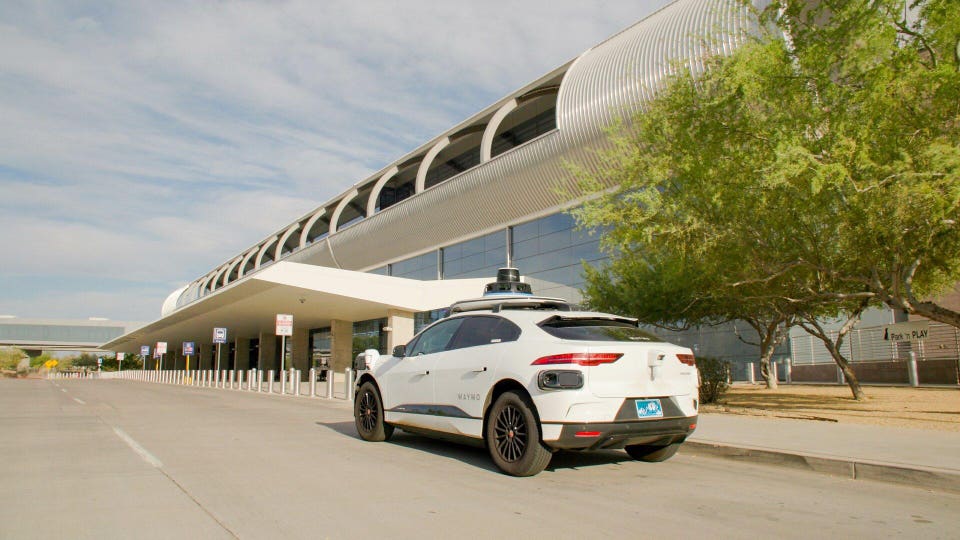
- Waymo has expanded in Phoenix, including taking people to/from PHX airport. Waymo also is charging for rides in San Francisco and should shortly expand to the whole city. This week, Waymo expanded their downtown Phoenix to the general public. They also started taking the public in San Francisco.
- Zoox has spent billions constructing a factory to make its custom vehicles. Nuro also has constructed a factory.
- Starship has added several new service areas and announced 4 million paid autonomous deliveries.
- MobilEye popped 30% on its IPO, and is now modestly higher than that.
- Baidu Apollo announced 1 million autonomous rides and construction of a new custom robotaxi vehicle.
What becomes clear is that those who were never really committed to the true vision of robocars are pulling back, while most of those who were dedicated are doubling down.
That doesn’t mean it’s going as fast as people hoped, though it’s not far from the timelines I laid out 10 years ago, which called for pilot projects to be deployed around 2020 (they were) with commercial deployments a few years after, and the big land rush mid-2020s.
It’s just too complex?
One main shift, though, is a rise of the view that the problem is almost intractable — at least with today’s tools — because it’s just too complex. Indeed everybody expected great complexity but nobody could forecast exactly how much. Advocates of this view point out that the current pilots mostly run in environments that are too simple to make a true demonstration. That argument is reasonable for Chandler, Arizona and possibly even for downtown Phoenix. It’s harder to make for San Francisco and arguably even harder for several of the Chinese cities that have deployments. But full operation is still not underway in San Francisco, where Cruise operates only at night, and both Cruise and Waymo avoid the downtown. (A recent Waymo teaser suggests they might hope to deploy there soon, though.) While most of the Chinese deployments avoid the most complex centers of their cities, even the less complex areas they are driving involve more chaos with scooters, pedestrians, bicycles and more than is found in most U.S. cities.
Robocar teams test their vehicles on the road, and measure how often they come upon complex situations, in particular situations they have not seen before, and most of all situations they are unable to handle well. As they grow better and better, these unusual situations grow less and less frequent, but they never get to zero, at least not with current technology.
This presents two questions:
- How close to zero is acceptable?
- Are there techniques that can be used in these situations to reduce them even further, to reach that acceptable level?
The first question is in the moral and political sphere. Most teams have declared they want to match or surpass the level of mistakes humans make — for humans are certainly not perfect. And some teams have indeed done that, yet they have not deployed. I outline several of the things possibly standing in their way in my two part article and video series on why you don’t have a robocar yet.
The problem is that public opinion and the legal system don’t easily tolerate any serious failures. Uber’s very extreme failure was the end of their project, and while there’s a reasonable argument that they deserved it, the risk is there even for teams that don’t deserve it. Cruise vehicles have occasionally stalled and briefly blocked traffic, calling for some to ban them from the roads — as though human drivers aren’t blocking traffic a million times a day with their foibles, even when they’re supposedly done learning.
Though perfection isn’t going to happen, there are ways to fail gracefully. Most of these can involve blocking traffic for short times, either by being conservative or because they take time. Being conservative can mean stopping when confused, and calling for remote human operator assistance — a feature most teams have available. The remote humans can resolve any confusion a human can, but they can’t resolve urgent, kinetic situations generally. (It’s not out of the question, in a world of high quality bandwidth and well trained operators to resolve some of those, but most teams have not wanted to go that far.)
What do they have to do to be ready?
Naysayers who think success is decades away imagine that a vehicle has to handle all situations before it can go into production. That’s not the case. A more correct description of the criteria for a real service would be:
- It must operate with a commercially useful service area — but that can be as small as the central area of a large city. It can also mean that some areas or streets can be excluded if the system doesn’t meet the goals below on just those streets.
- In that city, it must cause few enough accidents so as not to be seen as a menace. This is typically described as being better than the accident rates of ordinary human drivers, though the precise level may be more or less than that.
- It must not disrupt traffic to an unacceptable level. This does not mean it never disrupts traffic, or even that it’s better at not disrupting than human drivers, though they are quite disruptive!
- To deal with #3, it is good if it has a means for human oversight to correct errors in situations the vehicle does not handle well.
Waymo and Cruise have demonstrated being close to this, as have several companies in China. In fact, SAIC just announced today they will start a robotaxi service in Shenzhen. They’re not a decade away from this. They’re only a decade away if one demands an incredibly high level of performance, one far beyond humans. It’s not out of the question that society might demand that, but it would be quite unwise for it to do so.
What if this doesn’t happen?
Part two covers all the things that can still happen, even if the world demands so much from robotaxis that they have to wait longer to deploy.
Originally published at Forbes.com in Reports Of The Death Of Self-Driving Cars Are Greatly Exaggerated. Copyright © 2022 by Brad Templeton.


Comments
Richter7
Mon, 2022-11-28 17:28
Permalink
Baidu will be kicking off Apollo Day today
Baidu will be kicking off Apollo Day today from 5:30 PM PDT to share the progress made in the technology and commercial operation of driverless robotaxis.
Below is the agenda:
Jingkai Chen
Building Safe, Intelligent, and Efficient Autonomous Driving Systems
Jizhou Huang
Rethinking Maps for Autonomous Driving: Apollo's Practice and Insights
Jingdong Wang
Applying Wenxin Large AI Model to Autonomous Driving Perception
Ang Li
Apollo Loop -- The Practices and Thoughts of "Fine Purification, Strong Digestion"
Jian Ouyang
AI Chip Innovation Empowers Advanced Autonomous Driving
Liang Wang
Parallel Development of L4/L2+ Technology in the Era of Intelligent Vehicles
youtu dot be/JISnVvff7Jc
Richter7
Mon, 2022-11-28 21:46
Permalink
Baidu Apollo has more employees working on its AV simulation
Baidu Apollo has more employees working on its AV simulation than Tesla has working on its Autopilot (FSD), AI, and humanoid bot teams, combined. ApolloDay
Anonymous
Mon, 2022-11-28 22:16
Permalink
Goggo Network and Mobileye to launch in 2023 L4
Goggo Network and Mobileye plan to collaborate to introduce Level 4 autonomous vehicles for logistics in Europe in 2023.
www mobileye com/news/goggo-network-and-mobileye-plan-to-collaborate-to-introduce-level-autonomous-vehicles-for-logistics-in-europe/
Anonymous
Tue, 2022-11-29 10:29
Permalink
Goggo plans to start operating self-driving taxis by 2024.
Goggo plans to start operating self-driving taxis by 2024.
Richter7
Fri, 2022-12-02 10:45
Permalink
mobileye at 32.75 valuation 26 billion
mobileye at 32.75
valuation 26 billion
Richter7
Fri, 2022-12-02 12:23
Permalink
underwriters of IPO incentive
The quiet period begins when the registration statement is made effective and lasts for 40 days (if revenues are over $1 billion) after the stock starts trading and is for analysts employed by the offering’s managing underwriters and 25 days for analysts employed by other underwriters participating in the IPO. The quiet period also includes 15 days before or after the expiration, termination, or waiver of the IPO lockup period.
Studies indicate for 5 days prior until 2 days after the end of a underwriters quiet period, above-average market returns occurs during those 7 days.
"concluded the only holding period for quiet period plays with statistically significant above-market returns is (-5, +2) days"
These reports are, more often than not, positive. (Underwriters have a strong incentive to boost a company they recently underwrote.) Widely distributed, the first round of reports usually affects a temporary increase in the company's share price.
What's more, savvy investors, having studied the quiet period expiration, often buy shares of a company approaching their quiet period expiration in anticipation of the price increase described above. Thus, a company's share price often rises several days preceding the event.
Richter7
Fri, 2022-12-02 12:29
Permalink
true to form so far. what manipulation
true to form so far
what manipulation
Richter7
Fri, 2022-12-02 12:38
Permalink
this weeks low to high diff of $ 6.83 is 26 per cent
Tues Nov 29, 2022 low of 26.17
Fri Dec 02, 2022 high of 32.90
Anonymous
Fri, 2022-12-09 00:39
Permalink
Carrefour and Goggo Network go live with L4 delivery
Carrefour and Goggo Network are trialling the use of autonomous delivery vehicles in the Plateau de Saclay, France.
www carrefour com/en/news/2022/carrefour-et-goggo-network-sassocient
futuretransport-news com/france-carrefour-deploys-autonomous-delivery-vehicles-in-plateau-de-saclay/
Anonymous
Fri, 2022-12-09 00:56
Permalink
Carrefour has 12,225 stores, 321,000 employees
Carrefour today has 12,225 stores in over 30 countries. 321,000 employees
Anonymous
Fri, 2022-12-09 01:06
Permalink
WTH - Purchase a Udelv Electronic Control Unit
Purchase a Udelv Electronic Control Unit
udelv com/uecu-electronic-control-unit/
Anonymous
Tue, 2022-11-29 06:13
Permalink
Apollo details from Baidu Apollo Day crush Waymo
www prnewswire com/news-releases/baidu-announces-plan-to-build-the-worlds-largest-fully-driverless-ride-hailing-service-area-in-2023-301688518 html
Anonymous
Wed, 2022-11-30 09:37
Permalink
Japan to open roads to autonomous vehicles in a limited capacity
Japan to open roads to autonomous vehicles in a limited capacity in April 2023.
Japan hopes that it can offer mobility services using Level 4 AVs in 40 areas of the country by 2025, and in more than 100 areas by 2030.
www therobotreport com/japan-to-open-roads-to-autonomous-vehicles-in-2023/
Anonymous
Mon, 2022-12-05 19:24
Permalink
Ford team grows with about 550 from ArgoAI
Ford team grows with about 550 from Argo per Tech-crunch
Paul Perrone
Sun, 2022-12-11 15:06
Permalink
Good reporting Brad as always
Good reporting Brad as always. Thank you for covering this space so in depth.
I've been in this industry for 20 years now and have seen the excitement and ups and downs. I think there is a non-trivial amount of R&D and exploration interest driving what some companies do versus production-driven automation oriented and deterministic design. That said, I've shared some thoughts on the path to autonomy last year that am sharing here: https://www.linkedin.com/pulse/reality-autonomy-path-forward-paul-perrone
Shlomo
Thu, 2022-12-15 12:42
Permalink
Waymo safety testing explaination on Waypoint
The Waymo blog Waypoint often presents AV safety testing articles by the company. As an example, Waymo uploaded a new entry yesterday.
Anonymous
Tue, 2022-12-27 12:42
Permalink
when does Amazon buy Aurora
when does Amazon buy Aurora
brad
Tue, 2022-12-27 13:19
Permalink
Seems less likely
Though Amazon did poke around Argo so who knows. Their zoox tech would make more sense but it's not quite right for a delivery truck, it is true, a bit costly. It does already own a piece, of course.
And Aurora is now trading for not that much over its cash value.
But Apple and a few others would be more likely to swallow Aurora.
Shlomo
Thu, 2023-01-05 07:15
Permalink
$17 billion pipeline
Mobileye now sees a revenue pipelinei of ADAS business through 2030 of greater than $17 billion – including $3.5 billion of projected revenue from SuperVision alone, a product that was only launched in the fourth quarter of 2021. Thanks to other new products like EyeQ system-on-chip, the pipeline grew impressively over the course of 2022 as Mobileye added $6.7 billion projected revenue in ADAS, across projected future volume of 63.6 million systems.
In addition to ADAS, Mobileye announced an additional $3.5 billion in expected revenue from Autonomous Mobility-as-a-Service products through 2028, based on deals with three major partners, including a recently secured mobility-as-a-service AV program with a leading EU commercial vehicle builder. Mobileye also has line of sight for $1.5 billion in revenue from a single consumer AV (Mobileye Chauffeur™) program through 2030.
“In the short time since we went public in October, Mobileye’s business has accelerated substantially,” said Shashua. “We’ve seen strong positive response from our existing customers and new automakers as well who believe in our vision for building cloud-connected, AI-driven driver assist and autonomous technology that can scale globally and provide meaningful benefits to millions of drivers worldwide.”
Mobileye has kicked off development work with a premium European automaker for programs targeting delivery in 2025, with other customers at advanced stages of development. Overall, Mobileye now expects volume of SuperVision based vehicles to reach about 1.2 million units in 2026.
Just as importantly, OEMs are showing strong desire to leverage investments in SuperVision as a bridge to enable eyes-off autonomous functions – comparable to SAE Level 3 and Level 4 – across a variety of operational design domains. This can be done by simply adding additional sensing suites and computing power in a modular way to create a high-value, cost-efficient, eyes-off product for consumer-owned vehicles in the medium term.
Beyond SuperVision and consumer-owned AVs, Mobileye has continued to develop its Mobileye Drive mobility-as-a-service (MaaS) autonomous vehicle technology in 2022. We recently signed an MOU for several thousand units with a major global producer of light commercial vehicles. In 2023, Mobileye will continue testing its AV tech, with pilots of our latest vehicle technology hitting the road in Germany.
Last year alone, some 233 models launched globally with Mobileye technology inside.
Lsrc
Thu, 2023-01-05 08:32
Permalink
MBLY down below $30
MBLY down below $30
ZF news the issue
Shlomo
Thu, 2023-01-05 21:38
Permalink
replay link CES Mobileye conference
Search for
“Mobileye: Now, Next, Beyond”, CES 2023 Press Conference w/ Mobileye CEO Prof. Amnon Shashua (Live)
The Forbes article today covering the keynote is tilted to the subjective side.
Richter7
Fri, 2023-01-06 12:56
Permalink
buying, news coming "in weeks" per investors mtg ces
news coming "in weeks" per investors meeting at ces
Richter7
Fri, 2023-01-20 21:42
Permalink
the next SuperVision design win
the investors meeting was many days ahead of the Handelsblatt CES Mobileye interview with the same reference to this new SuperVision design win.
Anonymous
Mon, 2023-01-16 18:57
Permalink
CEO interview and comments admits pivot
Mobileye CEO admits pivot.
"Then we made a business pivot. Instead of trying to make robotaxis and doing everything end-to-end, building vehicles and operations, like Waymo - we will work on partnerships. We want to be in a position where we sell our entire system to a partner, and they build the vehicles and other partners operate them. We already have agreements with companies that are creating demand with platform manufacturers and a revenue pipeline of $3.5 billion by 2028. There is no player in the industry that has such forecasts. What does that mean? That in 2023, instead of 2022, there will be 200 autonomous vehicles on the road with our systems. The big jump will be at the end of 2025, then there will be tens of thousands and at an increasing rate until the end of the decade.
"At the same time, we have a new business activity of developing a privately owned autonomous vehicle, with the goal being the ability to drive autonomously without supervision on highways in 2026. We want to offer a vehicle that is legally autonomous in a certain area. This is a business that did not exist in 2017. It is a new business opportunity. It is not a pivot, but an additional layer in all of Mobileye's business activities."
From Calcalistech in Israel
Anonymous
Tue, 2023-01-17 07:01
Permalink
New Handelsblatt interview as well
As the founder confirms, another partnership with a large car manufacturer that does not come from Europe is to be announced in the coming weeks. It would be the seventh cooperation: According to Mobileye, it has already signed contracts with four Chinese and two European manufacturers.
On BMW:
“Hopefully we will have a closer relationship again in the future,” Shashua says of BMW.
On Mercedes:
Shashua thinks little of this approach. “All autonomous driving systems below a speed of 130 kilometers per hour are useless,” he says. Too often drivers have to intervene, the system switches on and off at will. “That cannot be marketed in the future.” The aim must be for the car to drive autonomously from the motorway entrance to the exit – and also to be able to deal with dangerous situations without the driver having to intervene.
Mobileye differentiates between systems in which the driver can take his hand off the wheel and those where where he no longer has to look at the road. “The driver needs to know when the system will intervene and when not,” says Shashua.
On Tesla:
The Mobileye boss believes that Tesla will soon have to make a fundamental change. “What Tesla says publicly is different than what they do internally. Tesla will have to add active sensors, I’m sure,” says Shashua. There are already reports that Tesla is testing imaging radars.
Anonymous
Wed, 2023-01-18 18:10
Permalink
BMW CEO agrees with Mobileye CEO
efahrer dot chip dot de/news/kauft-kein-kunde-bmw-chef-gibt-wichtiger-autotechnik-kaum-eine-chance_1011031
Richter7
Thu, 2023-01-19 14:28
Permalink
Innoviz - WHAT ? a reporters lack of due diligence
reporter needs to re-read Mobileye S1, page 10, Relationship with Intel
from calcalistech today
Mobileye is developing its own technology, but the talk in the industry is that it is in negotiations with Innoviz and is interested in it not only as a potential supplier, but also as a potential purchase. Mobileye's reissue in October 2022 will allow it to complete such a move in a stock deal without turning to its parent company Intel, as was the case with the acquisition of Moovit in 2020.
Richter7
Thu, 2023-01-19 18:38
Permalink
China regulators and mass Lidar production
China's antitrust regulator has suspended the clock in its review of Intel's planned $4.5 billion purchase of Tower Semiconductor.
The clock was stopped by China's State Administration for Market Regulation after requests from the companies, according to a Dealreporter item on Thursday.
It's possible that the deal could end up with remedies at some point.
The clock could resume when SAMR receives answers to questions it has posed to the deal parties, according to the report. The transaction could possibly have another clock stop or pull-and-refile if the parties agree to discuss remedies.
The acquisition agreement gave the companies a full year in which to complete the deal - February 2023.
Intel reiterated in earnings call in late October that it expected the Tower deal to be completed in Q1.
Intel is set to report Q4 results on Jan. 26.
Tower Semiconductor's chip manufacturing technology for laser sensors (photonics) is an important new Intel acquisition for Lidar development and mass production, let alone Intel's Foundry Services 2.0 strategy.
Anonymous
Fri, 2023-02-03 17:14
Permalink
Mobileye needs Tower Semi for low cost lidar mass production
Mobileye needs Tower Semi for low cost lidar mass production.
Richter7
Fri, 2023-01-20 22:01
Permalink
did Zeekr 009 start delivery on January 15 2023
did Zeekr 009 start delivery on January 15 2023?
Zeekr 009, a pure electric MPV, started delivery, and the first batch of users held delivery ceremonies at Zeekr delivery centers in Beijing, Shanghai, Hangzhou, Nanjing and other cities on January 15. As the second model of Zee Auto, 76 days after its launch on November 1, Zeekr 009 was delivered as scheduled.
If accurate, video of the full SuperVision capabilities should be surfacing soon.
Anonymous
Thu, 2023-01-05 09:10
Permalink
only 1.2 million SuperVision units in 2026?
only 1.2 million SuperVision units in 2026?
the majority is Geely.
Zeekr alone aims to sell 650,000 vehicles a year by 2025.
add the other 3 Geely brands already announced to begin use of SuperVision and there is minor major OEM adoption of SuperVision other than Geely.
Geely could represent 75% of SuperVision sales by 2026.
only 300,000 units from all other oems?
Anonymous
Thu, 2023-01-05 11:53
Permalink
Could 75% of SuperVision units be from just 1 OEM thru 2026'
Geely could represent 75% of all SuperVision sales by 2026.
Lsrc
Thu, 2023-01-05 16:23
Permalink
Mobileye delays AV rollout
No guests on stage with CEO.
No Moovit discussion.
Changes from the Oct 2022 IPO roadshow presentation to todays presentation is apparent.
some examples
Mobileye delays AV rollouts from sometime in 2024 to latter part of 2025 or 2026.
The EyeQ Ultra transitions into 2 EyeQ7H ?
Revenue estimates for Chauffeur and Drive provided.
Supervision unit sales estimates provided for 2023-2026.
Radar still scheduled for 2025 and not earlier.
As of today, of the 9 models of SuperVision Mobileye is discussing, 6 models are likely from Geely Holding.
Etc
Other details such as simulation design and testing with REM data, validation steps, scalability/ODD/geo-fencing etc should be discussed in greater detail in a detailed blog article.
Prof Shashua understands how complex and demanding validation is both for the OEMs, the regulators and Mobileye and how validation is one of the 800lb gorillas in the room. Again, a blog discussion is warranted as the modularity design underpinning the entire mobileye strategy is too important to be communicated in 2 powerpoint slides.
Richter7
Sat, 2023-01-07 11:53
Permalink
New ZF Smart Camera 6 with Mobileye EyeQ6 for 2025
Nothing really happening until 2025.
New ZF Smart Camera 6 and the Image Processing Module IPM 6 with Mobileye EyeQ6 are ready for Start of Production in 2025.
Smart Camera 6 features a 120-degree field of view, more than 4x higher image resolution (8-megapixels) from the previous generation and greater processing power to enable advanced functions.
The Smart Camera 6 utilizes the latest generation EyeQ6 processor from Mobileye, and the new ZF Image Processing Module systems are also based on EyeQ6 processors.
The systems are fully scalable from a single satellite camera input up to 12 satellite camera inputs as well as multiple radar, ultrasonic or LiDAR sensors. This allows features including AEB and Pedestrian AEB, VACC, Camera/Radar Fusion, 3D surround view, Driver Monitoring and Interior Monitoring, e-Mirror and integration of ZF ADAS and/or OEM algorithms supporting full-featured driving functionality from L2/L2+ to L3, advanced Driver and Interior Monitoring and Automated Parking.
Richter7
Sat, 2023-01-07 12:25
Permalink
New ZF Smart Camera 6 with Mobileye EyeQ6 for 2025
Nothing really happening until 2025.
New ZF Smart Camera 6 and the Image Processing Module IPM 6 with Mobileye EyeQ6 are ready for Start of Production in 2025.
Smart Camera 6 features a 120-degree field of view, more than 4x higher image resolution (8-megapixels) from the previous generation and greater processing power to enable advanced functions.
The Smart Camera 6 utilizes the latest generation EyeQ6 processor from Mobileye, and the new ZF Image Processing Module system is also based on EyeQ6 processors.
The systems are fully scalable from a single satellite camera input up to 12 satellite camera inputs as well as multiple radar, ultrasonic or LiDAR sensors. This allows features including AEB and Pedestrian AEB, VACC, Camera/Radar Fusion, 3D surround view, Driver Monitoring and Interior Monitoring, e-Mirror and integration of ZF ADAS and/or OEM algorithms supporting full-featured driving functionality from L2/L2+ to L3, advanced Driver and Interior Monitoring and Automated Parking.
Richter7
Fri, 2023-01-06 03:59
Permalink
Google launches HD maps for vehicles, Volvo and Polestar first
Google launches HD maps for vehicles, Volvo and Polestar first to integrate.
Richter7
Fri, 2023-01-13 00:58
Permalink
Google HD maps availability
Google HD maps will only be available for vehicles with which the automaker licensed Google Automotive Services along with the Android Automotive OS.
Google is selling these services to carmakers as an optional buy-in beyond the OS licensing.
Some automakers are shipping cars with the Android Automotive OS, but aren’t using Google Automotive Services.
Google also states the new HD maps will only be available on 'select' roadways at this time. HD mapping is initially focused on high-traffic roads like freeways,
Google’s HD mapping essentially provides extra layers of data over and above the normal Google Maps data, such as precise lane-level and localization data such as recognition of details like lane markings and localization objects, including road signs. Google’s HD map is not a consumer-facing application but an additional layer on top of Google Maps that is transparent to the consumer.
Watching for any Tesla reaction to Google HD maps is a new sport.
Ford has the most curious combination with the 2021 licensing of Google Automotive Services and the Android Automotive OS, the licensing of the Mobileye REM Roadbook for a future version of BlueCruise, the recent acquisition of Argo AI intellectual property as well as the hiring of nearly 700 Argo employees, and the transition to Google Cloud Services.
Anonymous
Sat, 2023-01-14 13:19
Permalink
strategy at conf
read the transcript on seeking alpha of doug field of ford at bernstein conference back on november 7 2022
when did vw and ford know?
Jul 20, 2020 - Ford and Mobileye partnership
Feb 1, 2021 - Ford and Google strategic partnership
Sep 7, 2021 - Doug Field joins Ford
Jan 5 2022 - Ford and Mobileye strategic collaboration deepening BlueCruise REM, SDK dev partner
Apr 26, 2022 - Ford delays switch to Android Automotive until late 2023
July 5, 2022 - EyeQ Kit SDK deployment announced
Sep 7, 2022 - Doug Field expanded role
Oct 27, 2022 - Argo announcement. Ford refocus on L2 and L3
Nov 7, 2022 - Doug Field Investor conf talk
Dec 2022 - Ford Argo staff / IP acq peaks
Jan 5, 2023 - Google HD Map launch
Shlom
Sat, 2023-01-07 15:06
Permalink
Mobileye Q and A from CES keynote buried link
Mobileye Q and A from CES keynote buried link.
2 versions of the link to playback the CES keynote from Mobileye (the listed and unlisted versions). There is Q and A on the unlisted version.
The Q and A is available from the link in the Forbes Jan 5th review by BT.
The listed version from the Mobileye YouTube portal edited out the Q and A.
Anonymous
Thu, 2023-01-12 08:59
Permalink
see photos mobileye VW test autos on Munich roads
see photos mobileye VW test autos on Munich roads
Richter7
Thu, 2023-01-12 19:20
Permalink
CES test vehicle for demo rides with radar
CES test vehicle for Mobileye demo rides with radar show an Intel branded radar unit. There is test ride video posted today.
The new Wistron agreement with Mobileye for radar production, given the below TSA reference with Intel in the S1, reinforces Mobileye is supported by Intel's involvement in long-term, high volume negotiations between Mobileye and an automaker or a Tier 1 for the advanced imaging radar system.
S1
"we are not licensed to manufacture products based on Intel technology with anyone other than Intel. Pursuant to the Technology and Services Agreement, the license is limited to the development of a specific type of radar for specific applications, and any radar products that do not fall under the scope of the agreement will require a separate license from Intel, at Intel’s discretion. As a result, we will not own most new lidar and radar intellectual property, even if developed solely by us.
Intellectual property developed under the agreement, either solely or jointly with Intel, regarding the radar technology, except for certain rights to specifically identified radar technology which is developed solely by us following the completion of this offering, will be assigned by us to Intel. As a result we will not own most new radar intellectual property, even if it is developed solely by us".
The significant 2025-2026 ramp indicated by developments and the pipeline supports a secondary offering by Mobileye by mid 2024 to accommodate this ramp. Four billion in 2025 projected revenue by analysts requires reserves to procur silicon production for SoCs for EyeQ, EyeC-Radar and Eye-Lidar.
Richter7
Thu, 2023-01-12 19:38
Permalink
Munich photos look to be
Munich photos look to be ground truth validation with what appears to be a GNSS system in the mix. This same vehicle set-up has been sighted previously.
On a seperate note, 15 of the Mobileye robotaxi vehicles are being deployed in Darmstadt for the RMV PTA operations.
Richter7
Sat, 2023-01-07 18:37
Permalink
14-18 month delay of the AV
The 14-18 month delay of the AVs (Mobileye Chauffeur) that Zeekr and Vinfast were to originally launch in 2024 was definitely a low key reveal (in the Q&A). But Mobileye Drive is not delayed though and is still a go for 2023.
Will the delay allow the incorporation of the new EyeC-Radar and Eye-LiDAR and deliver a sub $5000 price point? EyeC-Radar (C sample) should be in the field late 2024 per the CEO and production in 2025.
No update on when the revamped EyeQ Ultra (composed now of two EyeQ7 (chiplet tech?)) will be sampling (also announced in Q&A).
Mobileye Drive is not delayed and still rolling out in 2023 -
"this is booked business you know hundreds of vehicles in 2023 but
many many thousands, tens of thousands of vehicles starting from 25 to 28".
For Mobileye Drive, even at $20,000 per kit, $3.5 billion of revenue still represents meaningful unit volume.
Richter7
Sat, 2023-01-07 19:20
Permalink
Holon production of 15,000 vehicles with Mobileye Drive
Holon Launch (source - company website)
REGIONAL HEADQUARTERS
North America
Start of production in 2025 with an initial annual volume of 5.000 vehicles. Regional headquarters in Auburn Hills, Michigan.
GLOBAL HEADQUARTERS
Europe
Start of production as early as 2026 with an initial annual volume of 5.000 vehicles. Global headquarters and engineering center in Paderborn, Germany.
REGIONAL HEADQUARTERS
Middle East and Asia
Start of production as early as 2026 with an initial annual volume of 5.000 vehicles. Regional headquarters in the Middle East, final location to be determined.
source - company website
The intial start of production for the Holon Mover is planned for the end of 2025 in the USA (press release)
Anonymous
Thu, 2023-01-12 10:35
Permalink
Which AV version did you buy?
Which AV version did you buy?
My AV drives for me on highways and ramps.
My AV drives for me on highways, ramps, arterial, and rural roads.
My AV drives for me on highways, ramps, arterial, rural and urban roads.
Can I upgrade from one version to another?
No.
Talk about confusing.
Richter7
Thu, 2023-01-12 22:06
Permalink
BMW CTO 7 Series G70 will get Level 3 in 2023
new 7 Series G70 will get a Level 3 self-driving system later this year. CTO Frank Weber - Las Vegas CES 2023
BMW CTO went on to specify a “more affordable Level 3 will come over the decade” suggesting the technology will trickle down to lesser models in the years to come. It should be mentioned the 7 Series won’t be available with this sophisticated self-driving system all over the world since the necessary legislation has yet to be finalized. For example, the functionality will be offered in Europe but not in the United States where the necessary regulations have yet to catch up with the advancement of tech.
It is believed BMW’s system will be called 'Personal Pilot' and will be available near the end of the year on the G70 sold in Europe and China. The next-generation 5 Series Sedan G60 launching this summer is rumored to receive the functionality later in 2024 when the 5 Series Touring G61 will also be around.
Richter7
Thu, 2023-01-12 22:09
Permalink
BMW leading contender 2026 Chauffeur AV
BMW - leading contender for AV pipeline for Mobileye Chauffeur in 2026
- from 2026 through 2030
- $ 1.5 bil rev
- major premium brand
- Chauffeur CH63 'Highway' (ODD3)
- EyeQ6H (available 2024)
approx 250,000 - 300,000 units over 5 years
Anonymous
Fri, 2023-01-13 13:57
Permalink
How many states in US allow Level 3 vehicles to operate ?
How many states in US allow Level 3 vehicles to currently operate on the road? Is 40-41 states an accurate estimate?
Will Level 3 regulations be in place in all US states by 2026 ?
BMW CTO at CES 2023- ' the functionality will be offered in Europe but not in the United States where the necessary regulations have yet to catch up with the advancement of tech '
Add new comment